How to Trade Binary Options 9: The Psychology of Binary Trading
Why Psychology Hits Harder in Binaries
Conventional binary options create a particular kind of psychological pressure due to a combination of factors, including the all-or-nothing dynamic, how only the price exactly at expiry matters, and how retail binary options platforms tend to push ultra-short-term and short-term contracts. Many of the normal risk management tools for traders are unavailable due to the structure of the binary options, and this also amplifies psychological pressure.
On top of this, the individuals who are drawn to retail binary options tend to be inexperienced traders, which means they are largely unfamiliar with the psychology of trading. In essence, those who are least equipped to handle the very particular high-pressure environment of binary options trading are the ones most likely to sign up and put their money on the line.
On some retail binary options platforms, it is difficult to even find binary options contracts that are longer than end-of-day and end-of-week, and ultra-fast contracts, e.g. the ones that are 30 seconds, 1 minute, or 5 minutes long, are pushed to the forefront. This creates a very short feedback loop that is more akin to playing roulette in a casino than investing in the stock market. A trader makes a decision, waits a very brief period, and receives a clean verdict. Win or lose. In the money or out of the money. You get the predetermined profit (e.g. 80%) or lose your entire stake. There is not much ambiguity, and that simplicity is one reason binaries attract inexperienced retail traders. It is also one reason why binary options can distort behavior so quickly and deplete a hobby trading account in no time.
With ultra-fast trading (not only binary options), the contract settles, the result is logged, and the trader’s emotional system receives immediate positive reinforcement or punishment. That speed matters. We might want to believe that fast feedback will improve learning, but quite often, it instead encourages impulsive pattern seeking, emotional escalation, and the belief that the next trade will remove the negative feeling created by the last one.
The psychology of binary trading is not separate from performance. It is part of performance. Revenge trading turns losses into emotional spiraling, cognitive biases turn small samples into false stories, overconfidence and recency bias distort risk assessments, and confirmation bias corrupts analysis before the trade is even placed. This is why psychology in binary trading cannot be treated as a soft topic for people who lack technical skill. Behavior is part of the edge or part of the leak. A sound setup traded badly will still ruin your account.
The realistic goal here is not to become emotionless, but to learn how to rein in your emotions and prepare in advance. A rigid trading strategy, disciplined risk management, and a firm checklist do not remove emotion, but they can limit how much damage emotion will do to your bottom line. You need to develop a system where you trade in a way that does not require perfect emotional balance to survive.
While you are striving to stay on top of your own emotions and stick to your plan, remember that you are probably trading on a platform designed for the opposite. Look around and take notice of how the platform is designed and which messages you receive. Binary options tend to reward emotional neutrality more than emotional intensity, but the interface on retail binary options platforms often encourages highly emotionally-driven trading. Countdown timers, sharp outcomes, fast re-entry, and visible payouts all push attention toward urgency. Ultra-fast contract times are promoted and bonus offers come with a deadline, sometimes measured in hours rather than weeks. You might even get assigned an “account manager” who actively encourages you to deposit more money, trade more frequently, and sign up for signal services and similar programs.
On some platforms, it is difficult to know if we have logged into a trading platform or an online casino. All this is not an edge for the trader. It is an environment the trader needs to defend against. Psychology in binaries is not only about fear and greed in the abstract, but it is also about operating inside a structure that repeatedly invites the trader to speed up when slowing down would be far wiser.
Here’s where you are in our 10-step guide to trading binary options:
- The Foundations of Binary Options
- Regulatory Landscape and Safety
- Market Analysis I – Fundamental Drivers
- Market Analysis II – Technical Charting
- Technical Indicators for Binary Options Trading
- The Three Pillars of Binary Options Strategy
- Timeframes & Expiry Management
- Money Management & Probability
- The Psychology of Binary Trading
- Advanced Implementation & Tax Compliance
The Emotional Structure of Ultra-Short Binary Options
Every market creates emotional pressure, though binary options have a particular way of concentrating it. With a conventional short-term binary option, traders are not only dealing with normal market uncertainty, but they are also dealing with very rapid resolution. Each binary option is a small event, and a sequence of small events can become psychologically loud even when each individual stake size is modest. This is why traders often describe binary sessions as intense even when the individual financial amounts are not large.
There is also the issue of perceived recoverability. When trades settle quickly, losses can appear repairable almost immediately. This creates a dangerous mental shortcut. The trader sees a losing contract and thinks “I can fix this in the next few minutes”. That thought is emotionally seductive because it offers control. It is also the opening line of many avoidable drawdowns.
We know from gambling research that ultra-fast feedback increases the risk of problematic gambling behaviors. Pushing coins into a one-armed bandit is more likely to hijack our brain than buying a UK Premium Bond and patiently waiting for the result of the monthly draw. Ultra-fast feedback compresses the cycle of action → anticipation → reward or loss → possibility to re-enter. If you always had to wait until the end of the month to find out if your binary option finished in-the-money or not, it would be less exciting, and if buying another binary option would result in another month of waiting, it would probably make you less likely to risk your money recklessly.
The rapid loop strengthens reinforcement learning in the brain and encourages repetitive behavior before reflective thinking can interrupt it, and it doesn’t really matter if you are in front of a roulette table, video poker machine, or binary option platform. The fixed payout structure of a conventional binary option contributes to the similarities between binary options trading and putting your money on red/black at the roulette table, while you still believe that you are actually reading the markets and engaging in financial analysis for your 30-second ultra-short binary option. Each win returns a known amount and each loss costs the full stake.
Combine this with how we believe we are analyzing markets (skill) rather than trusting Lady Luck (gambling), and the account history can start to feel like a series of simple personal verdicts. A win feels great and looks like proof of a functional strategy and our supreme market reading skills. A loss takes our entire stake in one quick sweep, hurts our pride, and leaves us eager to repair the damage as soon as possible. For binary options, outcomes typically depend on a complex mixture of skill, luck, and variance, but the nervous system of an inexperienced trader tends to read it differently. Wins are assigned to skill while losses are chalked up to bad luck or platform manipulation.
Points That Are Good to Know
Rapid and Variable Reinforcement Trains Behavior More Efficiently
Slot machines and similar games use what psychologists call a variable-ratio reinforcement schedule, which means that rewards arrive unpredictably after repeated actions. This schedule is known for producing very persistent behavior, and the faster each gambling round completes, the more reinforcement cycles occur per minute. A player can experience hundreds or thousands of reward cues in a short session, and research has shown that this type of gambling is associated with elevated risks of problematic behaviors. It does not take much of a stretch to see how fast-paced binary options trading would establish a similar variable-ratio reinforcement schedule and provide the trader with a very large number of reward cues in a short session.
For further reading:
- “The complex nature of human operant gambling behaviour involving slot games: Structural characteristics, verbal rules and motivation” https://www.sciencedirect.com/science/article/abs/pii/S0306460322003069
- “Why are Some Games More Addictive than Others: The Effects of Timing and Payoff on Perseverance in a Slot Machine Game”
https://www.frontiersin.org/journals/psychology/articles/10.3389/fpsyg.2016.00046/full
Unpredictable Rewards Strongly Activate Anticipation Systems
A key driver is not just “earning money”, it is uncertainty and anticipation. With binary options, we know exactly how much we will profit if we win (just as we know this at the roulette table), but we never know if we will win or not, and this unpredictability strongly activates anticipation systems in our brains. Unpredictable rewards create repeated “reward prediction errors” where the brain continuously updates expectations.
This process is strongly linked to dopamine signaling and reinforcement learning. The shorter the delay between bets and outcomes, the more often anticipation spikes occur, the less time exists for emotional regulation, and the easier it becomes to enter repetitive, automatic behaviors.
Fast Games Reduce Reflective Decision-Making
Ultra-fast gambling leaves little time for conscious evaluation like:
- “Should I stop?”
- “How much have I lost?”
- “Is this rational?”
Modern slot-machine systems are intentionally designed to minimize pauses between actions, and many retail binary options platforms are designed in similar ways. Researchers studying immersion in slot-machine gambling have found that continuous rapid play affects post-reward pauses and sustained engagement.
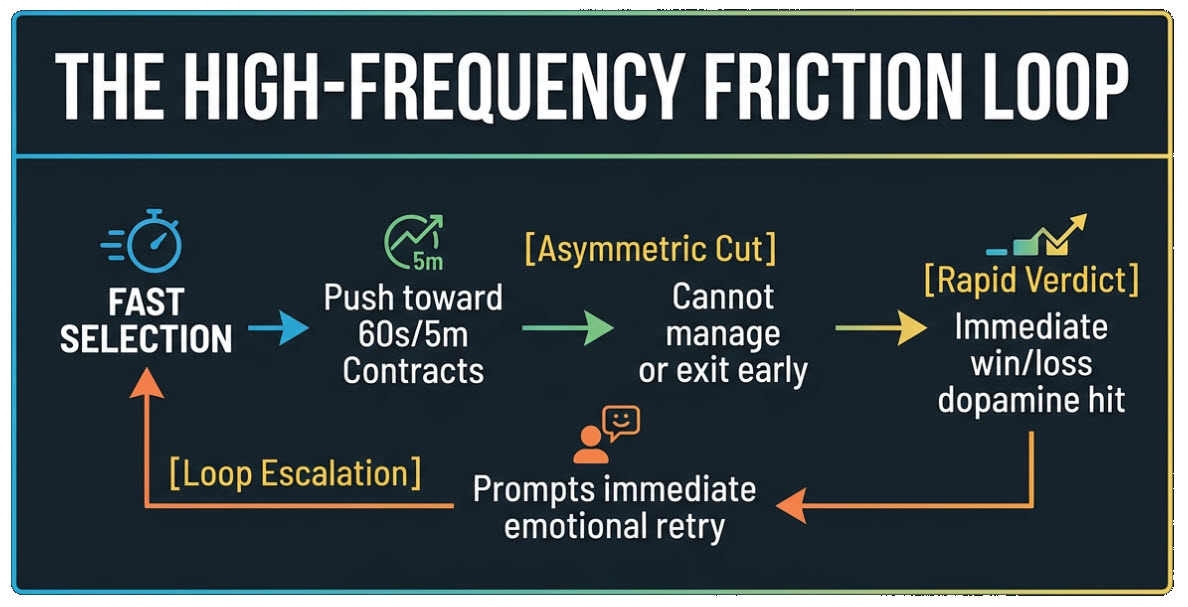
Speed increases total behavioral conditioning, and platform designers are well aware that a slow pace might allow for reconsideration and increase the risk of the participant being distracted by something else. Ultra-fast systems seek to eliminate the natural stopping points and keep you in the loop for as long as possible.
Anthropologist Natasha Dow Schüll, who has studied casino machine design extensively, describes how rapid machine cycles can push players into a dissociative “machine zone” where behavior becomes automatic rather than deliberative. While her research is about slot machines, it is still interesting for anyone who is trying to understand the psychological effects of being immersed in a trading platform designed for the frequent trading of ultra-short binary options contracts.
For further reading:
- “Addiction by Design: Machine Gambling in Las Vegas” by Natasha Dow Schüll. https://www.natashadowschull.org/addiction-by-design/
Near-Misses and Instant Retries Can Intensify Compulsion
Fast gambling systems are known to exploit near-misses, flashing sensory feedback, stop buttons that give a feeling of control where there is none, and rapid replay options. These features combine to create the illusion that success is close and somewhat within your control, and they encourage an immediate retry. Research on slot-machine “near misses” found they can foster erroneous perceptions of skill and agency during gambling play.
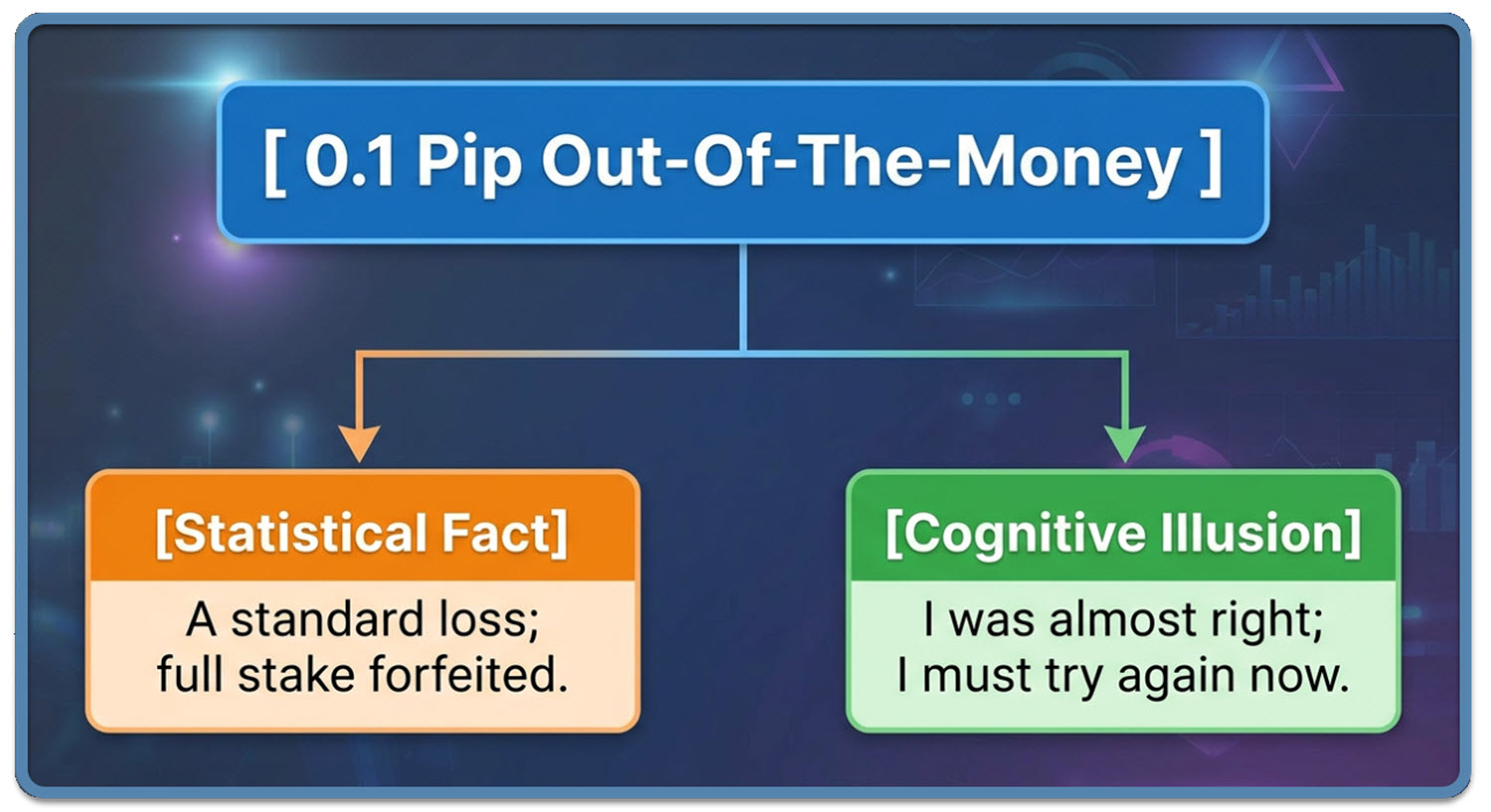
We can see a similar dynamic on many retail binary options trading platforms that push ultra-fast contracts. While the trader is essentially just gambling on variance rather than analyzing markets, the idea of being a trader rather than a lottery ticket buyer fosters a feeling of control. Since only the price at the exact expiry moment matters, it is fairly easy for the platform owners to design contracts in a way that makes it very likely for them to expire somewhere very close to in-the-money when they expire out-of-the-money. This strengthens a trader’s perception of being almost right, and it makes the trader more eager to try again.
The flashing sensory feedback and how easy it is to quickly open another position is also something we recognize from many retail binary options platforms. It is clear that many platform designers within this field are very familiar with the psychology of fast-paced gambling.
For further reading:
- “Near-Misses and Stop Buttons in Slot Machine Play: An Investigation of How They Affect Players, and May Foster Erroneous Cognitions” https://link.springer.com/article/10.1007/s10899-017-9699-x
The Revenge Trading Cycle and Losing Streak Behavior
Revenge trading is one of the most common ways traders turn an ordinary bad session into an account-level problem. Revenge trading is by no means a behavior limited to the field of binary options, it is known from all types of trading, and even a normally disciplined trader can fall prey to it when circumstances align.
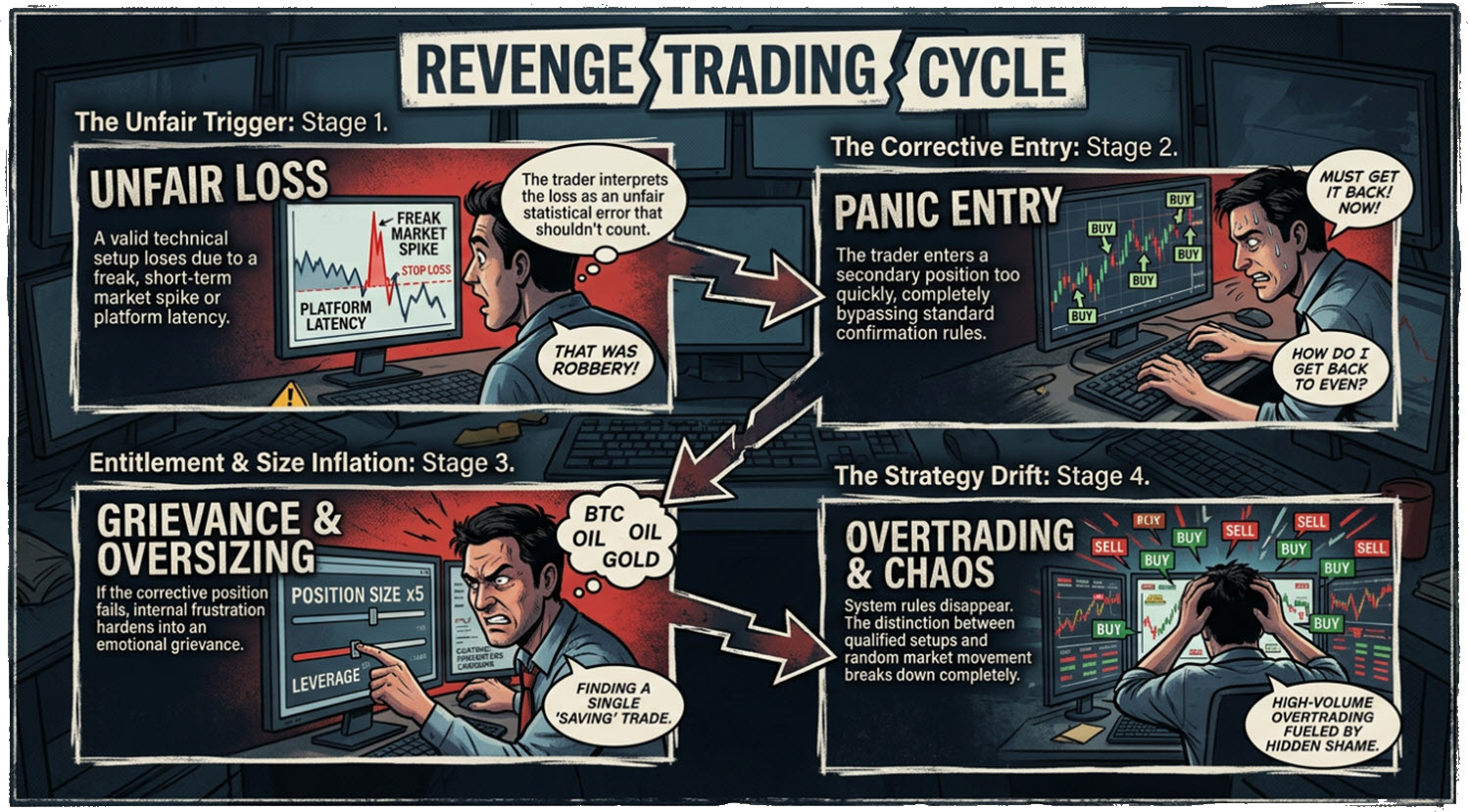
Revenge trading is when someone makes impulsive trades after losing money, mainly to “win it back” quickly rather than following their predetermined strategy. The phrase revenge trading sounds dramatic, though the behavior is often quiet and can look calm at the surface. It does not always begin with rage and wild position size. Often, it begins with irritation, then urgency, then the belief that the next trade will restore emotional balance as much as financial balance.
That is an important point. Revenge trading is not just about wanting money back, it is also about wanting the discomfort of being wrong to end. A losing trade creates tension. A second losing trade adds insult to the first one. Soon, the trader is no longer selecting setups from a stable process. Instead, the trader is trying to escape a feeling, and markets tend to charge heavily for that.
How Revenge Trading Begins
Losing trades are a part of trading, but some losses sting more than others. Revenge trading often starts with a trade that feels undeservedly bad. Maybe the analysis was broadly right but the expiry was too short by a few seconds. Maybe price missed the strike by a few points and then moved exactly as expected after settlement. Maybe the platform lagged or a random spike ruined what looked like a clean setup. The story varies. The common feature is frustration mixed with the sense that the loss was unfair and should not count. That emotional reaction matters because it encourages the trader to frame the next trade as a correction rather than as a new independent decision. The trader is no longer asking “Is this setup valid under my plan?” but “How do I get back to even?” Those are completely different questions, and the second one usually leads to lower-quality trades.
The cycle tends to escalate in predictable stages. First comes the corrective trade, usually taken too quickly, and maybe with a position size that does not follow the predetermined plan. Nothing dramatic, but the trader has now moved away from the trading strategy, and this is psychologically important. Then comes the increase in confidence without increased evidence, because the trader now feels entitled to a win. If that trade loses too, the internal narrative often hardens. The market is unfair. The timing was unlucky. The setup almost worked. The next trade now carries emotional weight far beyond what the trader normally experiences. This is usually when traders begin deviating more heavily from their strategy by changing contract duration, underlying asset types, and stake size, and/or by taking setups they would normally ignore.
The danger is not only that the next few trades may be poor, but that the trader’s definition of a valid trade begins to shift in real time. Rules soften, filters disappear and “close enough” replaces “qualified”. By the time the trader recognizes the session has become heavily emotional, several low-quality decisions may already have taken a dramatic toll on the account balance. Now shame can enter into the equation, and this can worsen behavior rather than prompt a trader to step away from the screen to cool off.
What a Losing Streak Actually Means
A losing streak does not automatically mean the system is broken. It does not automatically mean the trader has lost their touch, the market has become rigged, or that a winning trade is now statistically due. In most cases, it means something far less dramatic. It means variance is occurring, and the trader has to determine whether the losses fall within the normal range for the method or whether something in execution or market regime has actually changed.
This distinction matters because inexperienced traders often interpret streaks morally rather than statistically. Three losses in a row can feel like failure even when they are perfectly consistent with the system’s historical behavior. A trader with a 55 percent hit rate is not living in a world where losses must, by some divine rule arrive, politely spaced apart to allow the account balance to recover. Clusters of losses are normal and should be expected. If the trader has not internalized that, every losing run feels like an emergency and a sudden shift in market or platform behavior.
In binary trading, losing streaks can feel especially sharp because losses are blunt and you lose 100% of each stake. There is no partial offset, no open position that might recover later if you keep it open longer, no comforting narrative that the trade is “still alive”. You can’t use stop-loss orders or manually decide to cut your losses when the market moves against you. Even hedging can be tricky due to how only the price at the exact expiry time matters.
With a binary option, the contract dies at the predetermined time, and the trader must decide what that means. This is where many problems begin. If the trader treats each loss as evidence that action must be taken immediately by changing up the strategy, the response will often worsen the situation. An emotional response that involves continued trading but without the strategy will often cause much more damage than the streak itself.
Sticking to the strategy or taking a step back from trading to calm down and get a better reading on the market tends to be a better choice. The disciplined response is usually to classify the streak before reacting to it, and to step back until you have a clearer view of the situation. Are these valid losses within the plan? Are they execution errors? Are they trades taken during poor market conditions that should have been filtered out? Are they a sign that the system’s edge is weaker in the current regime? These questions slow the mind down and move it away from emotional repair to calculated analysis.
Interrupting the Cycle Before It Escalates
The safest way to stop revenge trading is not to rely on willpower in the middle of emotional activation because by that stage, the trader’s judgment is already compromised. A better approach is to build hard interruption rules in advance and make sure they strike before you have fallen head-first into the revenge trading zone. “An ounce of prevention is worth a pound of cure” is a famous maxim emphasizing that taking small, early steps to avoid a problem tends to be easier and less costly than trying to fix the problem later when you are already in deep water.
Predetermined Maximum Consecutive Losses
One obvious rule is to have a predetermined maximum consecutive loss limit. Once the limit has been reached, trading should pause for a fixed review period. The point is not that five losses (or whichever number you decide in advance is right for you) in a row prove the system is failing. The point is that five losses often make the trader vulnerable to behavioral drift. The pause protects the trader from the version of themselves most likely to do damage.
Of course, retail trading platforms that want to encourage frequent trading might not offer this tool in any automated fashion, so you might have to find suitable workarounds. For many, simply having the rule in place, written down, and clearly visible can be helpful. Some traders use app blockers, DNS blockers, or browser extensions that lock access to the broker for a scheduled cooldown period. You might have to hit the button yourself to activate the feature, but if you can just muster up the discipline for that action in the heat of the moment, the lock-out feature will make sure you stay away during the rest of the cooldown period when you might feel tempted to “get back on the horse again” too early. Crude friction can help because impulsive trading is often highly time-sensitive.
Mandatory Written Note After A Loss
Another useful interruption is a mandatory written note before the next trade after a loss. The note should state the setup, the reason for entry, the timeframe, the expiry, and what exactly makes this trade valid under your predetermined trading strategy. If the trader feels resistance to writing that note, it is often because the trade is not actually clear, or because the trader is overly eager to get the trade in right now in this very moment without any delay. Emotional traders dislike documentation and having to waste time on thinking and reflecting rather than acting “in the zone”.
Sizing Rules
A third defense is to have a rule in place for how you size your trades. We have covered this extensively in the previous article in this series concerning position sizing and wallet management, and gone over both fixed-size staking and percentage-based methods. The important thing is to have a conservative, account-preserving rule in place and stick to it during all your trading sessions. If you instead have the habit of basing your stake sizes on gut feelings, you are much more likely to burn through your bankroll extremely quickly during even a short bout of revenge trading.
Revenge trading often comes with either hidden Martingale logic or willy-nilly stake inflation. The trader may not double-size outright, at least not at first, but they start nudging exposure upward because the account now “needs” a bigger winner to repair the damage. Keeping the stake fixed or percentage-based stops this escalation from hiding behind optimism.
The most important interruption, though, is conceptual. The trader needs to accept that a losing trade does not create a debt that the next trade is responsible for paying. Each trade should earn its place independently. Once that principle goes out the window, discipline usually goes with it, and the account balance begins to drop sharply.
Cognitive Biases And Their Role In Binary Trading
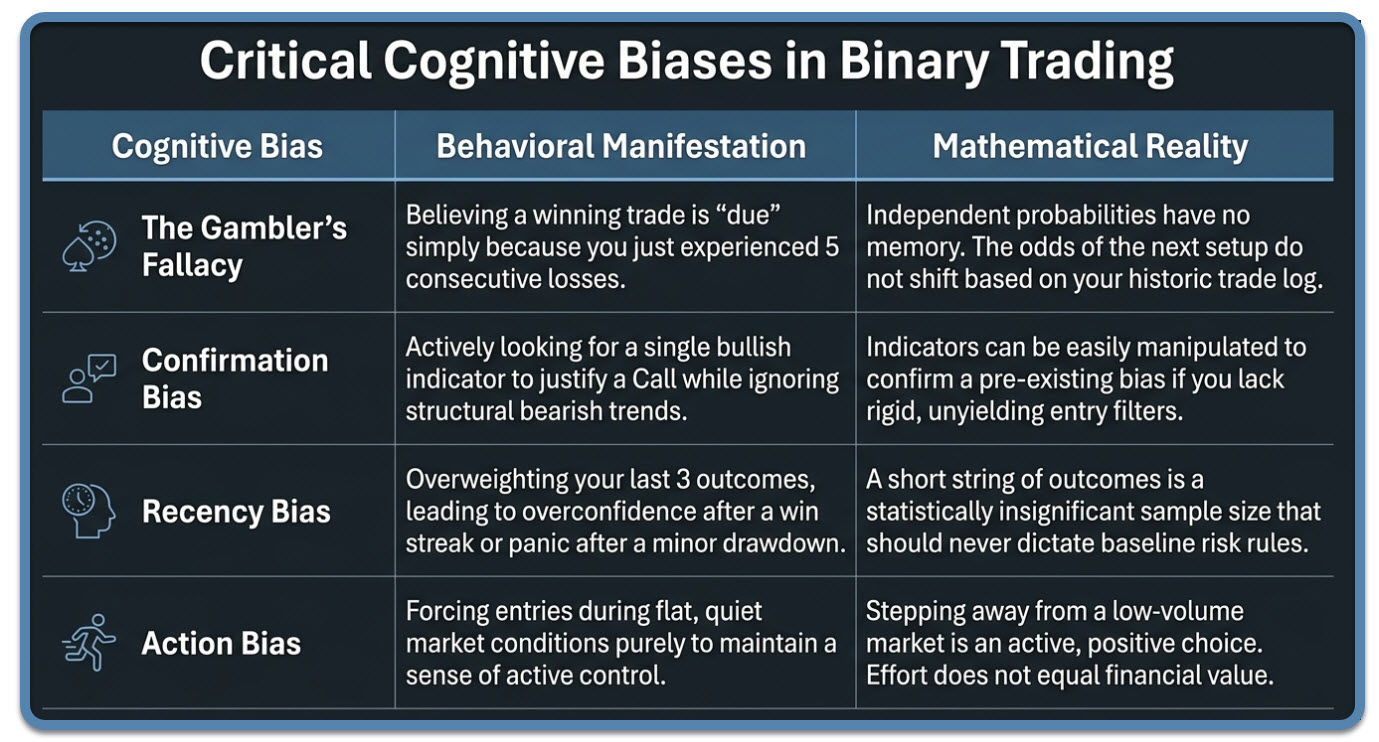
Below, we will look at a few examples of cognitive bias that can come into play for traders, including binary options traders. Being aware of these biases and understanding them well can make it easier for us to spot them in ourselves and pull ourselves away from them.
The Gambler’s Fallacy
The gambler’s fallacy is the belief that after a sequence of one outcome, the opposite outcome has become more likely simply because balance feels due. In roulette terms, people see several reds in a row and start believing black must be coming. In binary trading, the logic often appears after losing streaks. A trader loses four trades in a row and begins to think a win is now more likely because the losses have gone on long enough. This is a serious error because independent trade outcomes do not self-correct in the way the mind wants them to. If the setup has no edge, another loss is entirely possible. If the setup does have an edge, that edge was present before the streak and is not strengthened merely because several losers came first. Probability does not keep emotional accounts.
The ball at the roulette table does not have a memory. It does not know that it has landed on black seven times in a row, and somehow owes the table a red now. The same is true for financial markets and binary options speculation. The underlying price action is not aware that you have lost seven contracts in a row, and the market price will not adjust itself to even out the statistics for you.
The gambler’s fallacy can also appear in any direction. Above, we discussed losses, but a trader who wins several times in a row can fall into the trap of starting to expect a loss because “nothing keeps working forever”. That can lead to abandoning valid setups or reducing stake size without any logicical reason behind it.
In both directions, the same problem exists. The trader is using a sequence pattern as if it changes the underlying expectancy. It is easy to begin seeing the trade log as a story with momentum and fairness built into it. The reality is less poetic. A losing streak is not proof that a winner is due, and a winning streak is not proof that a loss is waiting behind the next click. What matters is whether the next setup has an edge under current conditions and fits into your predetermined trading strategy.
Confirmation Bias
Confirmation bias is the tendency to seek, interpret, and remember information that supports an existing belief while discounting information that challenges it. In binary options trading, this often means the trader decides on direction first and then starts collecting reasons that justify it.
Many binary traders do this a lot, often without even noticing it. The chart is rising, so the trader wants a call. Suddenly every bullish sign looks meaningful while every sign of exhaustion is interpreted as noise. Or the trader becomes convinced a reversal is close, and then treats every tiny red candle as proof that the top is in, while ignoring the fact that higher timeframe structure is still clearly bullish.
Indicators can make confirmation bias worse because they provide many ways to construct supporting evidence after a directional opinion has already formed. A trader who is looking hard enough can usually find some oscillator reading, moving average angle, or candle pattern to support almost any predecided view if enough flexibility is allowed in interpretation. This is one reason rigid trade criteria matter. Without them, analysis can become little more than advocacy.
Confirmation bias is especially dangerous after an especially hurtful loss. We want to recover and therefore wants the next setup to be valid. We also want to find a valid setup right now, to avenge the previous loss quickly and set everything right again. These desires narrow the mind, and conflicting evidence becomes irritating rather than informative. We are no longer analyzing with an open mind, we are just building a case to justify throwing our hat in the ring again.
A practical way to weaken confirmation bias is to stick to rigid trading strategy requirements and also require a disconfirming check before each entry. What would make this trade a bad idea? What is the strongest argument against it? If we cannot answer those questions well, the analysis is probably too one-sided to trust.
Recency Bias
Recency bias is the tendency to overweight the latest outcomes. A trader who has just won several contracts starts to believe the method is stronger than the full sample justifies. A trader who has just lost several trades starts to believe the method is broken. In both cases, the recent sequence hijacks the broader data.
This bias matters in binaries because rapid feedback compresses recent experience into something vivid and emotionally persuasive. A trader who had three clean wins in ten minutes can begin to feel unusually sharp. That feeling often leads to looser filters, more trades, and larger position sizes. The trader mistakes a short, favorable run for proof of mastery.
Illusion of Control & Action Bias
This is the belief that because the trader is active, analytical, or recently successful, the outcome is more governable than it really is. In binary options, this can show up as excessive tweaking, constant switching of indicators, or the belief that one more screen, one more oscillator, or one more minute of analysis will remove uncertainty from a fundamentally uncertain event. The traders are not actually gaining control, they are just keeping themselves busier.
The illusion of control is closely related to action bias. Action bias is the tendency to prefer action over inaction, even when inaction would be objectively better or more rational given the situation. Studies show that in uncertain environments, e.g. trading, many people have a tendency to act just to feel in control, even when stepping away is logically the better choice. There is also the effort heuristic that equals effort with value, and makes us judge outcomes as more valuable if they required more effort. Stepping away from the screen and taking a break from trading is considered low effort, while staying, doing analysis, and opening new positions is considered high effort.
This produces the “grind mindset” where more screen time is interpreted as more seriousness, and traders start believing in a world where more activity makes them entitled to a better result. Research in judgment and decision-making shows that effort is often mistaken for quality or correctness, and traders are no exception to this rule.
This bias is also heavily promoted by various finfluencers online, who push a narrative around money, trading, and entrepreneurship where financial success is portrayed as something achieved through relentless activity, often with a heavy emphasis on doing more, faster, and longer. You have probably already stumbled across seemingly helpful advice telling you to “outwork everyone”, “sleep later, build now”, and “trade every day to learn faster”. They are pushing the narrative of “no days off / no zero days” and “if you’re not grinding, you’re falling behind”. Of course, they are usually getting paid by trading platforms and earn a commission when you sign up, deposit, and lose money. So for them, it is only beneficial if you burn through your account balance quickly and refill it several times. Encouraging overtrading fits nicely into their business strategy.
Overconfidence
A few wins, especially on short expiries, can create the impression that the trader has adapted to the market in some durable way, and the account starts to feel protected by skill rather than exposed to variance. This is usually the point where risk goes up, patience goes down, and the trader begins to break rules, firmly believing that those rules were established for an earlier version of themselves and are no longer necessary.
The antidote is not self-bdoubt for its own sake, but you need to learn how to stick to your trading strategy even when you feel like the smartest person in the market. The trader should assume that recent results may not mean much, that control is always partial at best, and that confidence without long-term evidence is usually just an emotion without much support in reality.
The Trading Plan as Emotional Damage Control
A trading plan is often described as a way to improve consistency. That is true, though in binary options its deeper function is defensive. A good plan does not just tell the trader how to enter, it also helps protect the trader from the versions of themselves most likely to appear under stress, excitement, boredom, or frustration. That is why the plan needs to be concrete. “Trade good setups” is not a plan. “Be disciplined” is not a plan either, though people enjoy writing it down as if that settles the matter.
A usable plan defines factors such as markets, session times, valid setup types, timeframe combinations, expiry rules, risk per trade, maximum daily loss, and stop conditions. In other words, it turns trading from a stream of temptations into a smaller set of permissions.
Why a Rigid Checklist Matters
A checklist matters because memory and judgment degrade under emotion. Traders often assume they will remember their own standards when the screen becomes tense, and then they fail at it. The checklist exists precisely because the trader is not as rational in the moment as they hope to be.
In binary trading, the checklist should be short enough to use and strict enough to matter. It might ask whether the trade aligns with a higher timeframe bias, whether it sits at a valid level, whether the trigger candle is present, whether news risk is nearby, whether the expiry fits the setup, and whether the stake matches the risk plan. If one of those conditions is missing, there should be no trade.
The point is not bureaucracy or to keep you from trading altogether. The point is to create a hindrance between impulse and execution. A trader who must actively verify conditions is less likely to click because the last candle was exciting or because the previous loss was annoying. The checklist slows action down just enough to let the process take charge.
A rigid checklist also helps expose when a trader is drifting. If several recent trades were entered without all checklist conditions met, the problem is visible. That visibility matters because psychological mistakes tend to stay vague. They become easier to challenge once they are written down.
Pre-Trade, In-Trade, and Post-Trade Rules
A useful trading plan separates behavior into three stages. Pre-trade rules decide whether the setup is valid. In-trade rules define what can and cannot be done once the position is live, which is little to nothing when we are trading binary options. Post-trade rules govern review, and the decision to continue trading or to end this trading session earlier than planned.
Pre-Trade Rules
Pre-trade rules are the most obvious. They include factors such as setup qualification, session filters, asset selection, and expiry fit. In binaries, expiry deserves special mention because emotional traders often shorten contracts impulsively. A proper plan defines which expiries belong to which setups.
In-Trade Rules
In other types of trading, e.g. spot forex speculation, in-trade rules matter a lot because traders often interfere manually after entry, even when this goes against the trading strategy. They can, for instance, decide to move a stop-loss because of greed, or close a position earlier than planned because of fear. With a conventional binary option, this type of in-trade meddling is not possible. If you are using binary options where decision-making is possible after purchasing the option, however, in-trade rules come into play and should be well-defined. Example: If the platform has an early exit function, the trader should know in advance under what conditions it may be used.
If no in-trade management is possible or part of your trading strategy, then a smart rule is to step away from the screen once the position has been opened. Once entered, do not check price action and reinterpret the trade every five seconds during the lifespan of the option, since this will only increase your emotions surrounding the trade. Watching a countdown clock while experiencing fear or joy does not improve actual expectancy, and it increases the risk of your mind being a bit messed up before the next trading decision. If staring at that clock and enjoying the rush of dopamine and endorphins pumping through your system is the best part of binary options trading, and you feel reluctant to abstain, you should really start viewing this as a gambling hobby that will cost you money (just like a night out partying would) and not a serious trading project that has the potential to be profitable long term.
Post-Trade Rules
Post-trade rules are where many traders become lazy. A good post-trade process records and analyses factors such as whether the trade followed the plan, whether execution was clean, and whether the outcome was caused by analysis error, rule breaking, or ordinary variance. The goal is not self-punishment; the goal is classification and evaluation. Traders who do not classify mistakes accurately tend to fix the wrong thing.
The plan should also define session stop rules. After a set drawdown, after a certain number of losses, or after clear evidence of emotional drift, the trading session stops, or a mandatory pause kicks in. This is not weakness or laziness; it is containment. One of the more mature signs in a trader is the ability to end a session before emotion gets the final say.
Journaling and Reviewing Without Self-Deception
A trading journal is only useful if it records more than feelings and results. Many journals are really diaries of mood dressed up as analysis. “Felt confident, got unlucky” is not a useful data point unless something more specific sits underneath it. A better journal records factors such as setup type, chart context, timeframe, expiry, stake size, rule compliance, and whether major news or session factors were relevant.
Over time, this allows the trader to identify not only whether the method is working, but whether certain behavioral leaks keep appearing in the same places. Perhaps most losses come from trades taken outside the main session. Perhaps reversals are being forced against strong trends. Perhaps the first trade after a loss is unusually poor. Without records, these patterns remain vague suspicions. With records, they become visible, and the trader can take action.
Review needs honesty more than complexity. Traders are very good at explaining away mistakes after the fact. The market moved oddly. The level almost held. The setup was basically right. This kind of language protects the ego and damages improvement. A review process should ask harsher, cleaner questions. Was the trade in plan? Was the entry premature? Did the expiry fit the setup? Was the trade size consistent with my rules? Would this trade still be taken tomorrow under calmer emotional conditions? The journal and review are not supposed to make the trader feel wise, it is supposed to make the trader harder to fool, especially by themselves.
Discipline, Routine, and Embracing Boredom
Discipline in binary trading is often described as the ability to follow rules during stress. That is true, though another part of discipline gets less attention, the ability to do nothing during dull periods. Many poor trades are not caused by panic or greed under stressful conditions, they are caused by boredom when nothing fits the predetermined criteria and the trader is forced to sit on their hands. The market is unsuitable for the strategy, the trader wants activity, and the platform always offers an easy way to convert restlessness into action and excitement. We have already touched on this in the discussion about cognitive biases in binary options trading, more specifically, the action bias and effort bias.
Routine helps here. A defined session time, a limited watchlist, a checklist, and a fixed review process reduce the amount of space available for impulsive behavior. When trading becomes a repeated routine rather than a hunt for stimulation, emotional leakage tends to shrink. You are not here to be excited; you are here to execute a pre-planned trading strategy that has enough edge to be profitable over time. Go find your excitement in other parts of life.
This matters a lot because retail binary options platforms are designed for over engagement and excitement. The interface is quick and flashy, the outcomes are all-or-nothing, and there is always another contract available at your fingertips. Without routine, the trader can drift from analysis into entertainment without noticing. That usually ends with a chart open, a trade taken, and a slightly embarrassed explanation afterwards about why the setup “looked decent at the time”. A mature routine accepts that good trading will feel boring. Excitement is usually a better signal of danger than of edge.