How to Trade Binary Options 7: Timeframes & Expiry Management
Expiry Is Part of the Trade Thesis
In binary options, inexperienced traders often spend too much time thinking about direction and not enough on timing. That can be a costly imbalance, because expiry time is one of the trade’s main variables. A chart setup can be perfectly reasonable, the directional idea can be correct, and the contract can still lose because the expiry time was poorly chosen. In non-binary trading, you have much more flexibility with your open position. When you do binary options trading, getting the timing even slightly wrong can result in a 100% loss of your stake, since where the price is exactly when the binary option expires is the only thing that matters for a conventional binary option.
This is why timeframe and expiry management deserve their own section in our article series rather than being tucked into strategy notes. Binary options do not reward broad correctness, they reward correctness at a specific moment in time. That changes how charts should be used, how trades should be filtered, and how risk should be thought about. A move that is obvious on the one-hour chart may be completely unusable for a 60-second contract, and a setup that works neatly over the next 20 minutes may become fragile if stretched to end-of-day because too many new variables enter before settlement.
The central mistake beginners make is assuming that expiry should be based on convenience, excitement, or payout. In reality it should be chosen for compatibility. The trade idea and the contract length need to fit each other.
Expiry management answers the “when” of the binary options trade, and that question is as important as direction itself. Ultra short-term contract times demand immediate precision. Intraday contracts offer a better balance between chart structure and session flow. End-of-day and end-of-week binaries often improve results by giving broader market logic more time to work, but come with their own challenges.
Here’s where you are in our 10-step guide to trading binary options:
- The Foundations of Binary Options
- Regulatory Landscape and Safety
- Market Analysis I – Fundamental Drivers
- Market Analysis II – Technical Charting
- Technical Indicators for Binary Options Trading
- The Three Pillars of Binary Options Strategy
- Timeframes & Expiry Management
- Money Management & Probability
- The Psychology of Binary Trading
- Advanced Implementation & Tax Compliance
Chart Timeframes and Contract Lifespans
The chart timeframe is the lens through which price is being observed. For example, a one-minute candle chart compresses one-minute of activity into each candle. A fifteen-minute chart does the same for fifteen minutes. The binary options contract lifespan is the length of time the contract will run. The expiry time is the exact moment when the contract will expire and the price must be right for you to get paid.
Charting timeframes and expiry times are connected and must be compatible, but that does not mean 15-minute chart timeframe analysis can only be used to trade 15-minute options, and so on. A trader can use a one-minute chart to fine-tune an entry and still take a 15-minute expiry. A trader can use a 15-minute chart to identify a support zone and still choose a one-hour contract. The chart tells you how the move is forming. The expiry tells you how long that move has to prove itself. Confusing the two leads is a common way to erode a trading account. Do not fall into the trap of taking 60-second expiries because the one-minute chart printed a nice candle, even though the pattern you think you are trading actually belongs to a much larger market structure.
The relationship between chart timeframe and contract expiry moment should be deliberate. Higher chart timeframes usually imply slower developing setups and can justify longer expiries. Lower chart timeframes show faster detail, but also more noise, which means shorter expiries are not automatically better just because the chart updates more often. In fact, the opposite is often true. The noisier the chart, the more dangerous it can be to use an expiry so short that the contract is essentially decided by micro fluctuations rather than by the actual setup.
This is also why a trader needs to think in terms of expected path. If the trade idea depends on a retest and continuation on the five-minute chart, the market may need several candles to complete that process. A 30-second or 60-second contract is a poor fit even if the final directional idea turns out right later.
Likewise, a one-minute rejection at a major intraday level may not justify an end-of-week expiry because the local rejection says little about what may happen over several sessions. Expiry selection is therefore a form of translation. The trader is translating a chart idea into a contract duration, and poor translation ruins good analysis surprisingly often.
Ultra-Short Binary Options: Up to 5-Minute Lifespans
On most retail binary options platforms, the ultra-short contract lifespans are the most marketed and the most visually exciting, and they appeal to inexperienced traders for a variety of reasons. Feedback is immediate, turnover is high, and the trading experience feels very active. A losing trade is over quickly, which can create the illusion that the damage is somehow lighter.
Traders can keep each individual stake fairly low and tell themselves that they are being responsible, even though they risk very large amounts of money during even just 15-20 minutes of trading, by churning through a very large number of options. Winning trades produce fast reinforcement, and ultra-short expiry binaries can quickly be habit-forming. In many ways, trading ultra-short binary options trading is very similar to putting your money on even/odd at the roulette table, hope for the best, and get the result as soon as the ball drops into a slot.
Predicting market moves with any type of accuracy for very short time periods is notoriously difficult. (And in conditions where it would be easy, the platform is unlikely to provide suitable contracts with high payouts.) The practical problem is that short expiries live closest to noise, and price at the 60-second to 5-minute horizon is heavily influenced by tiny shifts in order flow, short-term liquidity imbalances, brief spread changes, and random fluctuations that have little to do with any meaningful directional thesis.
That does not make profitable ultra-short binary options trading impossible, but it does mean these options demand more precision than most traders have the capacity for, and they offer hardly any tolerance for being approximately right.
For awareness, ultra-short-term expiries typically start at 3 or 5 seconds. These are the shortest timeframes we’ve seen in platforms from our extensive testing over the years. And you can normally change the timeframe either by using a toggle in the platform, selecting from a menu of timeframes, or manually entering the expiry length.
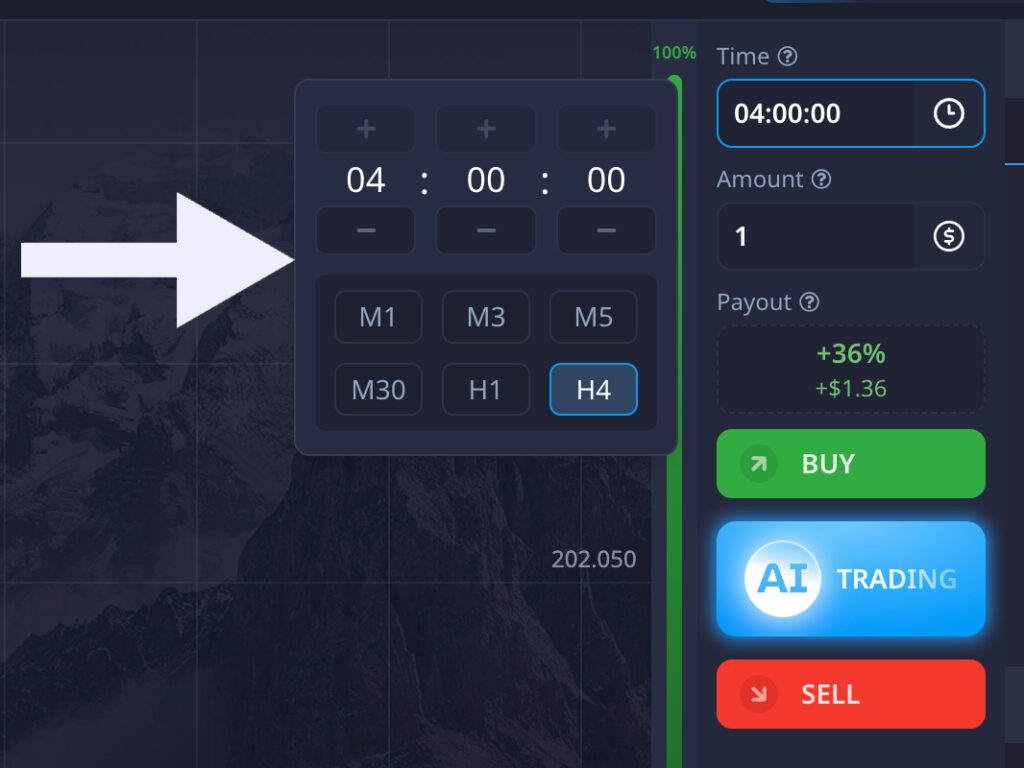
Expiry lengths can be selected in the main trade panel on Pocket Option
What Ultra-Short Contract Times Require
A trader using ultra-short expiries is not simply forecasting direction. The trader is forecasting direction, immediate momentum, and the absence of disruptive noise over a very narrow window. That is a hard set of demands. A five-minute trend continuation contract, for example, may need the market not only to resume upward, but to do so quickly enough and cleanly enough to overcome any small pullbacks before settlement. A one-minute reversal contract may depend on the market rejecting a level instantly rather than merely showing that the zone matters over the next half hour.
This is why many short expiry trades that look logical in hindsight are not actually logical at entry. The chart may later show a clean move, though the path into that move was too erratic to support the contract chosen. The trader sees the eventual direction and concludes the analysis was good but the luck was bad. Often the truth is simpler: the analysis and the expiry were mismatched from the start.
Short expiries tend to work best when three things align:
- First, the level or trigger is unusually clear.
- Second, the market is active enough to move, but not so chaotic that structure breaks down.
- Third, the trade is aligned with a larger bias rather than asking for a full reversal from scratch. That usually means continuation entries after short pullbacks, or local rejection trades at very obvious levels, are more defensible than heroic attempts to pick turning points in fast markets.
Noise, Spread, and Platform Quality
The shorter the expiry, the more a trader is exposed to what might be called false precision. This is the belief that because the chart is updating fast, the trader is seeing something more exact. In reality, fast updates often mean the trader is seeing more noise, not more clarity.
On a 60-second or one-minute horizon, one candle can look decisive and still be little more than a brief burst of orders. A rejection wick can look meaningful and still be undone by the next few ticks. A level can appear to hold and then fail simply because the market has not yet finished probing it. Binary options make this worse by forcing settlement on a hard clock. In spot trading, a trader might allow the noise to clear, but in binaries, the noise may become the whole trade. The retail attraction to 60-second trading comes partly from the idea that skill can be expressed more frequently. In practice, frequency often means paying for more noise.
Spread and execution issues matter more here as well. A small disadvantage in entry-level or contract pricing matters much more when the entire trade is only alive for a minute or two. This is why short expiry trading is often far more sensitive to platform quality than traders like to admit (or sometimes know). A tiny delay, a slightly worse strike, or a widened dealing condition can be the difference between an in-the-money result and an out-of-the-money one. On longer expiries, those small distortions may matter less.
Do Ultra-Short Contract Times Ever Make Sense?
Very short expiries can make sense, though only in narrower conditions than marketing material usually implies. One such condition is a strong trending market where price has pulled back briefly into a clear support or resistance area and then resumed in the dominant direction with visible momentum. Another is a sharp rejection from a widely watched intraday level during an active session, provided the reaction is immediate and the entry is not late.
These examples of when ultra-short contracts could make sense, for a skilled trader and as a part of a stringent strategy, are not broad invitations to “scalp” everything in sight that vaguely reminds you of these conditions. They should be considered exceptions; rare situations where the market’s short-term behavior is actually structured enough for a fast expiry to have a fighting chance of expressing the actual setup rather than random noise. Even then, discipline matters. Short expiries are usually better suited to times when the trader already knows the session rhythm, the asset’s pace, and the behavior of the platform under speed.
For newer traders, the ultra-short contracts often offer more stimulation and excitement than profits. A useful rule is that a trader should be able to explain exactly why the move is likely to happen now, not just soon. If the explanation depends on broad ideas such as “the trend is up” or “it is oversold”, the expiry is probably too short. A very short binary needs a very immediate reason.
15-Minute to 1-Hour Contract Times
Many retail binary options traders who have gotten burned by the ultra-short contracts move on to slightly longer lifespans, typically within the 15-minute to 60-minute span. These binary options require more patience, and trading them is less like playing the roulette table and more like conventional intraday trading (not scalping), but we are still dealing with very short-term market predictions, and the longer timeframe does not change the fact that the price must be right exactly at the moment of expiry.
Contract times in this range are long enough to reduce some of the chaos, but short enough that the original trade idea usually remains relevant from entry to settlement. For many traders, this is the most workable range because it balances technical structure with practical timing.
A 15-minute to 1-hour contract often gives price enough room to complete a local pullback, react to a chart level, or resume with the session trend. It does not remove risk, and it certainly does not make mediocre setups good, but it does reduce the chance that the trade will be decided entirely by a random flicker in the next few seconds.
Balancing Structure With Session Flow
Binaries within the 15 minutes – 60 minutes range tend to work best when they are connected to the natural rhythm of the trading session. This matters because price behavior changes throughout the day. Session opens can be volatile and noisy, while mid session periods often become steadier. Overlap periods, especially in forex and indices, come with their own advantages and challenges, as more participants are active. Toward session close, the market may trend, fade, or become more erratic depending on the asset. As you can see, it is difficult to give any detailed general advice here, and the trader is advised to learn the typical rhythms of the exact market they wish to speculate on.
A trader who is, for instance, using a 15-minute or 30-minute contract needs to think beyond the candle pattern itself. The same bullish engulfing candle can have very different quality depending on when it forms. Printed during a quiet, low-volume lull, it may have little follow-through. Printed during an active session overlap, at a support retest aligned with the broader trend, it may carry much more weight.
The contract is long enough that session flow can help or hurt it, and short enough that the trader still needs a concrete reason for entry. That tends to discourage the worst kind of impulsive clicking, or at least makes it easier to spot when it is happening.
Matching Setups to Intraday Tempo
Not every technical setup suits the same intraday expiry. A simple bounce from support after a shallow pullback may work with a 15-minute contract if the market is already moving and the reaction is crisp. A larger retest on a five-minute or fifteen-minute chart may suit 30 to 60 minutes better because the structure needs time to complete. A reversal after a failed breakout might need enough time for trapped traders to exit and for the opposite side to take control.
This is where traders often improve once they stop treating expiry as a fixed habit. Some retail users pick one expiry, say five-minutes or fifteen-minutes, and apply it to every chart pattern and every market condition. That might feel like praiseworthy consistency, but it is more likely to be laziness. A decent trading process asks how long the setup most likely needs to prove itself and then chooses a contract length that matches that path.
When the lifespan of the option is not ultra-short, you can use multi-timeframe analysis better. The trader can anchor the bias on the one-hour chart, locate the setup on the five or fifteen-minute chart, and still have a contract long enough for that smaller chart structure to matter. This is harder to do with 60-second contracts because the lower noise level of the bigger charts struggles to translate into such tiny settlement windows.
The Practical Strengths and Limits of Intraday Binaries
The main strength of binary options that are intraday without being ultra-short is that they reduce the dominance of random noise without forcing the trader into holding through too many unknowns. That makes them a reasonable fit for trend continuation, support and resistance reactions, and controlled reversal trades. They also tend to align better with ordinary technical analysis because many chart concepts, such as pullbacks, retests, and structure breaks, need more than a minute or two to develop sensibly.
The limit is that intraday binaries are still vulnerable to session events. A contract with 45 minutes to expiry can easily be affected by a scheduled data release, a central bank comment, or a sudden sentiment shift in another market. The trader therefore needs to keep one eye on the clock and one on the calendar. A technically neat setup taken just before an important release may stop being a technical trade the moment the numbers hit.
Intraday binaries can also invite overconfidence because they feel calmer than the ultra-short binaries. Traders may assume that because there is more time, poor entries will be forgiven.
End-of-Day and End-of-Week Expiries
Longer expiries, such as end of day or end-of-week contracts, are less dramatic and often less popular with retail traders. From a probability perspective, though, they can be more forgiving because they give the market more time to align with the broader thesis rather than forcing everything to happen at once. This is why longer expiries often show higher win probabilities for disciplined traders. The trade has more time to absorb minor retracements, short-term noise, and temporary indecision.
A directional view based on a well-defined daily trend or a major support and resistance structure does not have to be perfectly timed to the minute in the same way, it only has to be broadly right. Of course, it is binary options we are talking about, so the price must still be right at the exact moment of expiry, but the market has more time to actually get there, and that is a meaningful reduction in pressure.
Why Longer Contract Times Often Improve Success Rate
The biggest advantage of longer expiries is that they let stronger forces matter more than smaller ones. On a 60-second contract, the result may depend on a brief flicker in order flow. On an end-of-day contract, session trend, macro bias, and major chart levels have a greater chance to exert their influence. That does not guarantee success, but it shifts the balance away from randomness and toward actual market structure.
Longer expiries also suit fundamental and higher timeframe technical analysis better. A daily support zone, a weekly breakout, or a macro-driven directional bias often has little direct value for a five-minute contract. Give the trade until the close or the end of the week, and the idea becomes far more coherent. In this sense, longer expiries are often better aligned with how real market forces operate. Markets do not owe instant expression to every chart pattern. Many ideas need time.
There is also a behavioral benefit. Traders using longer expiries generally place fewer trades because feedback is slower. It is of course still absolutely possible to buy hundreds of end-of-day and end-of-week binary options if you want to, but it is not typical for the retail binary options market. When you have to wait longer for feedback, it can reduce the temptation to overtrade, revenge trade, or trade out of boredom. Fewer trades do not automatically mean better trading, though in binaries they often mean fewer low-quality decisions, which is not a bad start.
What Longer Contract Times Do Not Forgive
Longer expiries are more forgiving of noise, but that does not mean that you will get away with weak analysis. If the broader trade thesis is poor, extra time does not solve that, and it may actually give the market even more ways to disagree. A trader who buys a call near major weekly resistance simply because the one-minute chart turned green may not be saved by choosing end of day instead of five minutes. The contract now has more time, yes, but the logic was weak from the beginning.
Longer expiries also introduce more exposure to new information. A trade held to the end of the week may begin as a pure technical setup and then become hostage to data releases, earnings, central bank comments, geopolitical headlines, or broader risk sentiment changes. The trader gains protection from micro noise but loses some protection from event accumulation.
Longer binaries are definitely not easy or safe, they only move the trade away from the harshest ultra-short-term randomness and closer to broader market logic. For disciplined traders, that is often an improvement, but for undisciplined traders, it can become nothing but a slower way to be wrong.
Another issue is patience. Many inexperienced retail traders do not like longer expiries because they reduce stimulation and the market is not constantly resolving in front of them. If you feel this way but decide to bite the bullet and start buying longer options anyway, you also need to take steps to improve your discipline and work on your impatience. If you don’t, you are likely to fall into the trap of placing extra trades while waiting or by stretching too many ideas into longer horizons without proper filtering. A longer contract helps only if the trader can tolerate a slower process.
Expiry Selection and Risk Management
Expiry choice should be treated as part of risk management. A trader who chooses an expiry that is too short for the setup is increasing the role of randomness. A trader who chooses an expiry that is too long may be increasing exposure to unrelated market events. In both cases, the mismatch is a risk decision whether the trader recognizes it or not.
One practical way to think about expiry is to ask what must happen for the trade to work. If the answer is “price must react immediately from this level”, then the setup may justify a short contract. If the answer is “price needs time to retest and resume”, then the expiry should allow that. If the answer is “the market should be higher by the session close if this trend remains intact”, then end of day may be more sensible than two hours.
This sounds almost too basic, though many traders do not do it. They choose the expiry first because it suits their habit or need for quick feedback, then force the chart idea into that window. It should be the other way around. The setup dictates the expiry. Not the mood, not the payout banner, not the desire for faster action. Done properly, expiry management can reduce unnecessary losses without changing the chart analysis at all.
Where Can I Find Binary Options That Are Longer Than End-of-Week?
Retail Long-Dated Binary Options
Retail traders looking for binary options with expiries longer than end-of-week may run into a structural limitation of how this product is sold on online platforms catering to retail traders. These platforms typically offer shorter duration binary options, for a variety of reasons, though several offer contracts up to one-month.
The absence of long-term retail binaries is not accidental. Pricing a binary option over longer horizons becomes increasingly similar to pricing a standard vanilla option, where probability distributions, volatility modeling, and time decay (theta) dominate valuation. If you are interested in long-term exposure, vanilla options might actually be a better choice for you, and they come with certain advantages compared to binaries, including better routes for risk-management.
For retail traders seeking exposure that is longer than end-of-week, another possible solution is to opt for alternative prediction products that are similar but not identical to binary options. In the United States, the prediction market platform, Kalshi, offers certain products that can be of interest, but while conventional retail binary options tend to be tied to continuously changing financial market prices (e.g. stock prices, indices, and forex), Kalshi is more focused on “yes/no” speculation on events such as political elections, legal case outcomes, and entertainment awards. Economically, Kalshi contracts function very similarly to binary options (they settle at $1 if an event occurs and $0 if it does not), and lifespans typically range from days to months. Traders can for instance take positions on inflation readings, interest rate decisions, or election outcomes far in advance.
There are also conventional binary options platforms that offer longer-term binary options, but finding one that comes with acceptable conditions for the trader can require some hard work. As we have discussed previously in this article, the retail binary options market is filled with loosely regulated actors and outright frauds, and finding a suitable platform is difficult even if you are only looking for normal bread-and-butter binary options. When you add any specific requirement to your wish list, e.g. long-term binary options, you narrow the field even further. In addition to vetting the broker/platform, look at the terms and conditions pertaining to the long-term binary options. The list of available underlying instruments is often short and limited to one or two asset classes, and you can also expect poor odds compared to fair probability.
As mentioned above, retail binary options platforms tend to stay away from long-term binary options for a variety of reasons. Short-term binaries rely heavily on volatility exploitation, high turnover, and the platform’s statistical edge for ultra-short price movements. The pricing model required to keep long-term contracts profitable for the platform would make it clearer to traders how poor the terms and conditions actually are.
For platforms that hedge their exposure, it is also more difficult to hedge well over long time horizons than for short-term options.
Non-Retail Long-Dated Binary Options
Outside the realm of retail trading, longer-dated binary-style instruments do exist in institutional markets, typically referred to as digital options or exotic derivatives. Investment banks and OTC desks can structure binary payouts over weeks, months, or even years, and commonly do so for hedge funds, sophisticated institutional clients and similar, who are looking for hedging or structured exposure.
These products are generally unavailable to retail traders, either due to legal restrictions or because of practical considerations that keep the average hobby trader away, e.g. very large minimum trade sizes, onerous credit requirements, and complex counterparty risk arrangements.
Institutional digital options and similar institution-level exotic derivatives exist in a very different ecosystem than what hobby traders using retail trading platforms are accustomed to. These instruments are typically traded over-the-counter (OTC) through banks, prime brokers, or structured derivatives desks rather than on public exchanges, and they are primarily designed for institutional clients such as hedge funds, asset managers, insurance companies, and large corporations.
Within this context, a digital option is a derivative that pays a fixed amount if a specified condition is met at expiry, and nothing if it is not, which makes it very similar to a conventional binary options. For example, a trader might structure a contract that pays $1 million if the EUR/USD exchange rate is above 1.10 in three months, or if the S&P 500 index is above a certain level at year-end. The contracts are highly customizable in terms of strike level, payout structure, expiry date, and underlying asset.
One of the defining features of OTC digital options is their flexibility in duration. While retail binary options are usually limited to minutes, hours, end-of-week, institutional versions can span much longer horizons, e.g. one month, three months, six months, or even multiple years. This makes them useful for hedging longer-term risks, such as macroeconomic exposure, commodity price uncertainty, or corporate earnings scenarios. An energy company can, for instance, use a digital option to hedge against oil prices staying above a certain level over the next year, while an investment fund might structure a payoff tied to a market index reaching a threshold at year-end.
OTC institutional digital options are not traded on public exchanges, meaning there is no centralized order book. Instead, they are negotiated directly with a financial institution. To participate, clients typically need to open an OTC derivatives account with a prime broker or investment bank, which involves strict onboarding requirements, credit checks, and compliance reviews. Minimum trade sizes are often substantial; sometimes in the hundreds of thousands or millions of dollars in notional value.
Institutional digital options are priced using sophisticated models that incorporate volatility surfaces, interest rate curves, probability distributions, and hedging costs. Banks dynamically hedge their exposure using underlying assets or more liquid derivatives, such as vanilla options. As a result, pricing tends to be closer to theoretical fair value, though it includes bid-ask spreads and dealer margin.
Counterparty risk is also a central consideration. Because OTC contracts are bilateral agreements, the buyer is exposed to the credit risk of the issuing institution. To mitigate counterparty risk, large institutions may require collateral agreements (margining), netting arrangements, or legal frameworks such as ISDA contracts. (ISDA is the International Swaps and Derivatives Association, and an ISDA contract is a standardized legal agreement used for trading derivatives between financial institutions, companies, hedge funds, and other market participants.) The steps taken to mitigate counterparty risk add complexity and costs, but also stability.
Institutional digital options remain niche even within professional markets and are typically only used when a very specific payoff structure is needed, particularly one that depends on a precise threshold outcome rather than a range of prices or continuous exposure. Outside of these very specific situations, even institutional traders tend to prefer vanilla options since they come with greater liquidity, transparency, and standardization.
Advantages of Using Vanilla Options Instead of Binary Options When You’re Looking for Longer Lifespans
If you are a binary options trader looking for longer-term exposure, i.e. more than end-of-day and end-of-week, it can be a good idea to consider conventional options instead. Compared to binary options, conventional options (commonly referred to as vanilla options) can offer not only a much better selection of long-dated options but also better pricing quality, increased strategic flexibility, and reduced counterparty risk. Vanilla options can expire in days, weeks, months, or even years. This allows traders to align positions with broader macro views, earnings cycles, or investment theses.
Another major advantage of vanilla options (compared to binary options) is fairer and more transparent pricing. Vanilla options are priced using widely known mathematical frameworks, so traders can more easily estimate roughly what a “reasonable” price would be.
While OTC vanilla options do exist, it is easy to stay away from them and instead stick to vanilla options that are traded on regulated exchanges and cleared through central counterparties, which increases transparency and reduces counterparty risk. From a regulatory and structural standpoint, vanilla options are more robust and standardized. Exchanges and clearinghouses reduce counterparty risk, and contract specifications are uniform and widely understood. Retail traders benefit from a well-established ecosystem of brokers, data providers, and educational resources, and retail access to vanilla options is legal and well-regulated in many jurisdictions where brokers are banned from selling binary options to retail traders.
Vanilla options will also provide better trade structure flexibility as they allow traders to fine-tune exposure in ways that binaries simply cannot match. With vanilla calls and puts, you can express directional views, but also build spreads, straddles, strangles, iron condors, and many other strategies. This allows traders to profit not only from direction, but also from volatility, time decay, and range-bound markets. Binary options collapse all of this into a single yes/no outcome, removing most of the strategic nuance. Some retail binary options platforms do offer more than the basic high/low binary option, e.g. in/out binary options that can be used to express views on range, but these alternative binary options still do not give us the same flexibility as the vanilla options.
Scalability and risk management are also significantly better with vanilla options. Because positions are continuously valued and can be partially hedged or adjusted, traders can actively manage risk better as the market evolves. In contrast, classic binary options are all-or-nothing by design, and once placed, the trade outcome is fixed unless an early exit feature is offered (which itself is often priced unfavorably on retail platforms).
Finally, vanilla options tend to be more suitable for portfolio construction. They can be combined with stocks, ETFs, or other derivatives to create hedges, income strategies, or asymmetric payoff profiles. Binary options, by contrast, function more like isolated bets with limited integration into broader portfolio strategies.