Prediction Markets: How They Work and Where to Trade
Prediction markets platforms are built around simple questions that many binary traders will understand: an outcome either happens or it doesn’t. But instead of asking “will price go up or down?”, it’s more like “Will interest rates be cut at the next meeting?” or “Will a particular candidate win an election?”
Brokers offering prediction markets go beyond the traditional financial instruments found on binary platforms into macro events, politics, sports, and scheduled economic decisions. We have tested and listed the best prediction markets platforms for those seeking binary-style contracts.
Top Prediction Markets Platforms
Some trading platforms are leaning into the broader event-driven approach, while still offering financial contracts that feel structurally similar to exchange-style binaries popularised by Nadex (since acquired by Crypto.com). Following our tests, these brokers stand out for their excellent prediction market offerings:
| Broker | Min Deposit | Expiry Times | ||
|---|---|---|---|---|
 |
Crypto.com | Varies by payment method | 5 minutes to event cutoffs, can be hours, days and longer depending on contract | » Visit |
Crypto.com Prediction Markets
Crypto.com is a great choice for traders wanting to deal prediction markets on an intuitive app. Regulated by the CFTC, you can place simple yes/no bets on a wide range of events, from presidential elections to movements in the S&P 500, with contracts traded like shares. It doesn’t offer some of the advanced analysis tools and features of prediction markets platforms like IBKR’s ForecastTrader, but for mobile-first retail investors, Crypto.com is a user-friendly fit.
Visit
Why the Nadex Acquisition Matters for Binary and Event Traders
Crypto.com’s move into event-based contracts caught our attention: it acquired Nadex, the long-standing reference point for regulated binary-style trading in the United States.
Nadex helped establish the idea that binary outcomes could be traded in an exchange environment, with transparent pricing and defined risk. For many traders, it was proof that binaries didn’t have to rely on fixed payouts or opaque broker models.
Bringing that experience into a broader prediction-market ecosystem signals a convergence, not a replacement. Financial event contracts, political outcomes, and macro decisions can all sit under the same probability-based framework.
It doesn’t mean prediction markets are suddenly suitable for everyone, or that they carry less risk. But it does show how the mechanics binary traders are comfortable with are being applied well beyond traditional price charts.
How We Selected The Best Prediction Market Trading Platforms
We’ve evaluated a range of prediction markets providers. This includes some of the biggest prediction markets websites like Kalshi through to more traditional financial brokers that have introduced prediction market products.
To compile our rankings, we focused on three things:
- Investigated providers’ regulatory credentials. Some are US-based and authorized by the CFTC to offer event-based contracts and derivatives, while some are registered elsewhere. However, regulatory approval isn’t enough – we only recommend firms we trust because they have been operational for many years with a large, established client base.
- Explored the range of prediction markets available. We paid particular attention to products that will suit binary-type traders, i.e. those with simple all-or-nothing structures that include opportunities on financial markets and events, such as where the S&P will finish at the end of a day. We remain worried that some prediction markets, including on sports events, may encourage gambling-type behavior.
- Tested the platforms and tools. Where possible, we logged into platforms, apps and websites to assess the look, feel and design of websites. We considered factors like how easy it is to find prediction markets we’d be interested in trading, especially financial-based contracts, and the market analysis and social sentiment tools available to help inform decisions. We also explored the availability to set alerts where bets are made linked to particular companies or markets given some may be able to use platforms to get insights into upcoming events that could affect prices.
Prediction markets platforms were assigned an overall rating and ranked based on this.
What Are Prediction Markets?
At a mechanical level, prediction markets are straightforward, especially if you’ve spent any time trading binary options. Each market is built around a single, clearly defined event. Contracts are then priced to reflect the market’s current view of probability.
You’re typically presented with two sides:
- Yes (the event happens). If a “Yes” contract is trading at 62, the market is saying there’s a roughly 62% chance of that outcome before liquidity constraints/other challenges. Buy it, and if the event happens, the contract settles at full value. The “No” side is then worthless.
- No (the event doesn’t happen). If it doesn’t, and you buy it, then this contract settles in full and the “Yes” side is worthless. Essentially, both sides pay out inversely.
Where this can differ slightly from classic broker-style binaries is that pricing isn’t fixed in advance. Prices often move dynamically as traders enter and exit positions, new information hits the market, or sentiment shifts. That makes these markets feel much closer to exchange-style binaries, rather than the fixed-payout models used by some over-the-counter (OTC) platforms.
For example, when we tested event-based contracts at Crypto.com, the structure was instantly familiar. The interface presents a clear yes/no choice with a visible contract price, and an app that strips away complex mechanics.
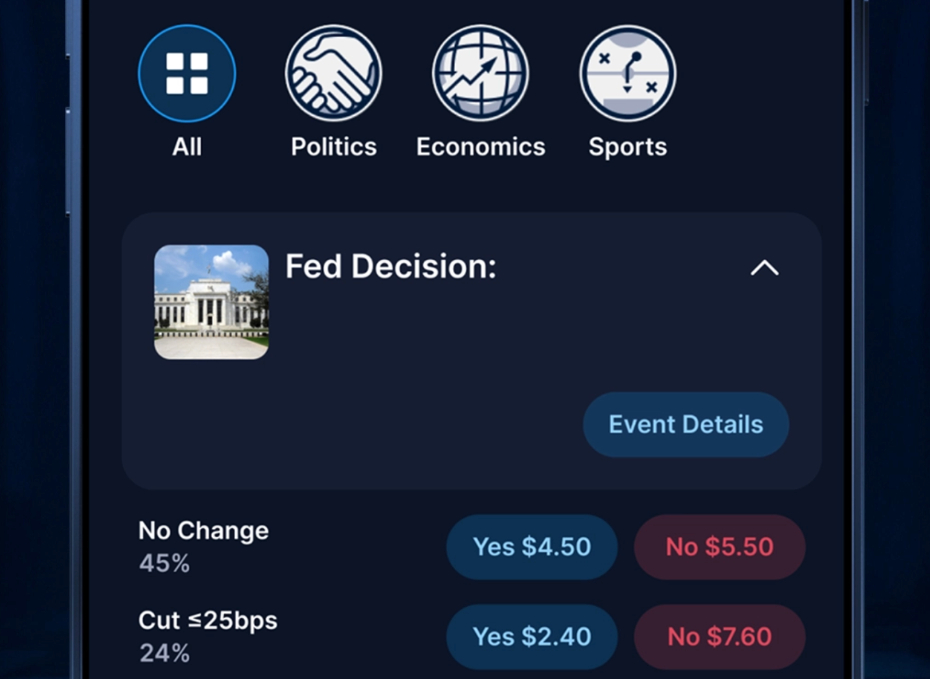
Crypto.com – Prediction Market Trade On Fed Decision
The key thing to note isn’t the event itself, but the binary logic. One outcome settles at full value, the other at zero. Everything else – price movement, timing, positioning – happens before settlement.
For binary traders, this the important shift. You’re still trading outcomes. You’re just letting the market, rather than the broker, decide the odds.
For binary traders coming from regulated exchange-style products, especially those in the US, financial market event contracts are the most familiar type of prediction market.
These contracts are typically built around a clear settlement condition: whether an index closes above a certain level, whether oil finishes within a defined range, or whether a market settles above or below a specific price at a set time.
This is very close to what traders saw on Nadex before it was acquired by Crypto.com. Risk is defined upfront, pricing reflects probability, and contracts resolve cleanly at settlement.
But importantly, the risk is still there – a losing trade could see you lose your entire investment. And presented in a binary-style setup that’s easy to understand, often on slick, intuitive websites, having a disciplined plan rather than wildly speculating is key.
And if not approached carefully, prediction markets can be a form of gambling.
Prediction Markets vs Binary Options
The Similarities
If you strip prediction markets back to their basics, it’s easy to see why they’re catching the attention of some binary traders. The core logic is similar:
- The risk is fixed upfront. Just like with binaries, you know exactly how much you can lose the moment you enter a position. There’s no margin call creeping up on you, no open-ended downside, and no need to manage a stop loss mid-trade. You can still lose 100% of your stake though, so wallet and risk management is still key.
- Settlement is objective. There’s no debate about whether a trade is “close enough” or whether price briefly spiked the wrong way. The event either happens or it doesn’t. That clarity is one of the reasons binaries became popular in the first place, and prediction markets preserve it.
- Timing matters more than magnitude. In both cases, you’re not rewarded for how far something moves, only for being right about the outcome at the moment of settlement. Whether an index rockets higher or just scrapes past a level doesn’t matter, as long as the condition is met.
- The mindset is familiar. Binary traders are used to forming an idea, committing a fixed amount of risk, and waiting for resolution. Prediction markets follow the same rhythm, just applied to a wider range of events.
That’s why, when we started trying event contracts, the learning curve was minimal. The mechanics felt intuitive. The difference wasn’t how trades worked; it was more about what we could trade on, how some of these websites presented opportunities, and the evolving regulatory scrutiny of the industry.
The Differences
The differences are what actually change how you trade them. The biggest shift is pricing. With some traditional broker-style binaries, especially offshore providers, payouts are often set by the platform. You know in advance that a winning trade might return 70% or 80%, regardless of how confident the market feels about the outcome. In prediction markets, prices are set by traders themselves. As sentiment shifts, prices move. You’re effectively buying and selling probabilities, not accepting a fixed deal.
That leads to the second difference: flexibility. In many prediction markets, you’re not locked in until settlement. If your view changes or new information hits the market, you can often exit early by selling your position back into the market. For binary traders used to waiting for expiry no matter what, this is a meaningful change in trade management.
There’s also a difference in how information matters. In classic binaries, short-term price action and timing often dominate decision-making. In prediction markets, narrative, data releases, and evolving consensus can be just as critical. A single news headline can reprice a contract long before the event itself occurs.
Finally, the range of events is much broader. You’re no longer limited to charts and price levels. Elections, policy decisions, macro releases, and even non-financial outcomes become tradable, each with the same binary settlement logic.
None of this necessarily makes prediction markets a better option than binaries. It means they reward a slightly different skill set: understanding probabilities, reacting to information flow, and thinking in terms of odds rather than payouts.
We’ve done a deeper-dive into how prediction markets compare to binary options.
Key Regulatory Developments
Prediction markets have been the focus of intent scrutiny, both from regulators concerned about their use and companies looking to get in on the action. Here is a breakdown of the key developments:
| Development | Details | When | Source |
|---|---|---|---|
| InTrade Enforcement | The CFTC sues the offshore platform for offering unregistered binary options to residents of the U.S.. | Nov 2012 | CFTC Release 6423-12 |
| PredictIt No-Action Relief | The CFTC issues relief allowing a non-profit academic market with strict trader limits. | Oct 2014 | CFTC Letter 14-130 |
| Kalshi DCM Designation | The CFTC designates Kalshi as a Contract Market, the first for dedicated event contracts. | Nov 2020 | CFTC KalshiEX LLC Designation as a Contract Market |
| Polymarket Settlement | Polymarket pays a $1.4M fine and ceases U.S. operations for failing to register as a DCM. | Jan 2022 | CFTC Release 8478-22 |
| Kalshi Election Ban | The CFTC blocks Kalshi’s “Congressional Control” contracts, citing public interest concerns. | Sep 2023 | CFTC Release 8780-23 |
| ForecastEx Approval | Interactive Brokers’ ForecastEx is approved by the CFTC for economic and climate events. | Jun 2024 | CFTC Release 8926-24 |
| Kalshi Judicial Victory | D.C. District Court Judge Cobb vacates the CFTC ban on election-related event contracts. | Sep 2024 | U.S. District Court Opinion |
| Polymarket U.S. Path | Polymarket acquires CFTC-licensed exchange QCX ($112M deal) to facilitate regulated U.S. access. | Jul 2025 | Polymarket Press Release |
| Proposed Rule Withdrawal | The CFTC formally withdraws its May 2024 proposal to ban event contracts involving gaming. | Feb 2026 | Federal Register |
| Nasdaq ORO Filing | Nasdaq MRX files with the SEC to list “Outcome-Related Options” (OROs) on the Nasdaq-100. | Mar 2026 | SEC Release 34-104966 |
| STOP Corrupt Bets Act | Lawmakers introduce the STOP Corrupt Bets Act (H.R. 8123 / S. 4226) to ban CFTC-registered exchanges from listing event contracts on elections, government actions, sports, or military actions. | Mar 2026 | Rep. Raskin Press Release |
| Federal Preemption Ruling | The Third Circuit rules that federal law preempts state gambling bans for CFTC-regulated DCMs. | Apr 2026 | Third Circuit Opinion |
| Nasdaq ORO Final Order | The SEC grants final approval for Nasdaq to list and trade binary index options (OROs). | May 2026 | Federal Register / SEC Release 34-105342 |
| State vs. Federal Jurisdiction Clash | The Ninth Circuit rules that CFTC federal regulation does not grant prediction markets blanket immunity from state gambling laws. With over a dozen states locked in litigation against platforms like Kalshi and Polymarket, this sets up a likely Supreme Court battle over preemption. | Aug 2026 | 9th Circuit Ruling |
Check our state-level tracker to see the legal status of prediction markets in every one of the 50 United States.
FAQ
Are Prediction Markets The Same As Binary Options?
They’re similar, but not identical. Both use binary outcomes and fixed-risk trades, but prediction markets are priced by participants rather than preset payouts. That means prices move as probabilities change, which feels closer to exchange-style binaries than traditional broker models.
Prediction markets also benefit from a somewhat cleaner bill of health, though there has been CFTC enforcement against operators like Polymarket, which has also been banned in several countries, including Brazil, France, and Italy. Still, offshore binaries especially have long been plagued with scams, fraud and regulatory crackdowns over the years.
How prediction markets evolve, and how regulators police them, will help determine whether prediction markets will attract the same stigma as binaries have in some regions.
Their mechanics also have important differences depending on the strategy you use. For example, placing arbitrage trades on prediction markets platforms requires a different approach and a solid understanding of how these products and platforms differ.
Are Prediction Markets Legal?
Availability and regulation vary by jurisdiction and by the type of event being traded. Some regions allow financial event contracts but restrict political or sports markets. In can even vary by state level in the US, with a judge temporarily blocking Tennessee from enforcing its cease-and-desist/barring Kalshi’s sports events contracts.
It’s important to check local rules before trading, especially as requirements governing these websites are still evolving.
Muslim traders should also consider whether prediction markets are halal or haram. We’ve done a deep-dive into this, weighing both sides of the argument after reviewing extensive guidance from religious scholars.
Are Prediction Markets Safer Than Binary Options?
Not necessarily. Risk is capped, but that doesn’t remove risk. Entering a contract at an unfavorable price or in a thin market can still lead to losses. The structure is different, not inherently safer.