60 Second Binary Options Guide For Beginners
60-second binary options are fast-paced contracts; they’re typically a simple yes/no decision where the trade settles in just one minute. You’re predicting whether the price of an asset (EUR/USD, gold, S&P 500, BTC, etc.) will finish higher or lower at the end of 60 seconds.
However, the timeframe means micro-moves matter, reaction time matters, and chart alignment matters. A one-second delay in execution, a mis-timed candle close, or a broker feed that doesn’t align with any third-party charts you’re using can turn a solid setup into a losing trade.
This beginner’s guide explains how 60-second binaries work, their advantages and risks, the best brokers offering them, and practical tips based on our experience exploring them.
3 Best Brokers For Trading 60 Second Binary Options
We’ve opened accounts, placed short-term binary trades of 1-minute across various markets, and based on our tests, these providers stood out as the best platforms with 60 second binaries:
| Broker | Min Deposit | Expiry Times | ||
|---|---|---|---|---|
 |
Pocket Option | $5 | 3 seconds - 4 hours | |
 |
Deriv | $5 | 15 seconds - 365 days | |
 |
Quotex | $10 | 5 seconds - 4 hours |
Visit
Why 60-Second Binary Trading Is Popular
The appeal of 60-second binaries is obvious the moment you try them: fast feedback and clear outcomes. New traders like them because you don’t need to sit in front of charts for hours; you see the result almost instantly.
But the same features that make 60-second trades exciting also make them dangerous. You’re not just battling market direction; you’re battling noise, micro-volatility, and execution speed.
Ultra-short-term derivatives may lead to significantly higher loss rates because traders struggle to manage impulse-driven decisions.
60-second markets often spike around news events or liquidity gaps, which can make the chart look choppy even when the trend is clean. So experienced binary traders often use 60-second contracts only during highly liquid periods and with well-tested entry rules.
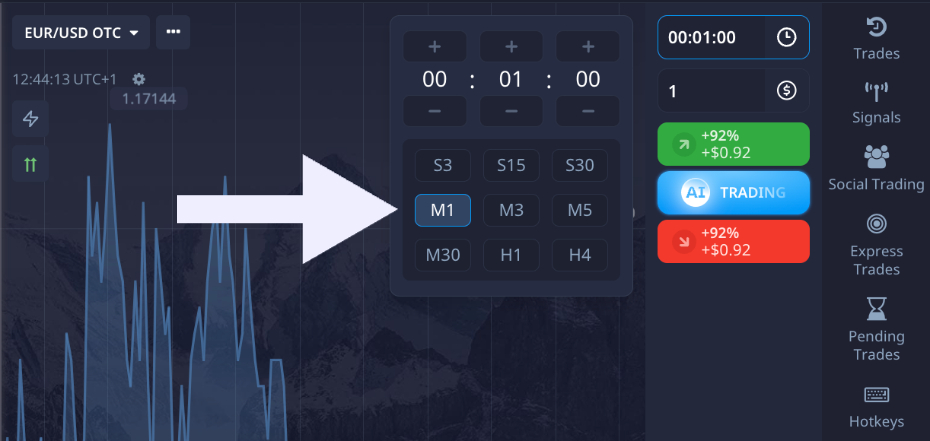
On some platforms, like Pocket Option above, the 1-minute expiry may be labeled ‘M1’ – don’t confuse expiry selection with chart timeframe
Who 60-Second Binary Options Are And Aren’t Suitable For
They work best for people who are comfortable making quick decisions, reading short-term chart behavior, and sticking to a strict plan even when the candles move fast. If you treat them as a structured, rules-based form of binary day trading, they can fit neatly into a larger strategy.
Problems begin when traders use 60-second binaries as a shortcut or as a way to make back losses after a bad day. Anyone who struggles with discipline, risk management, or rapid decision-making will find these contracts unforgiving.
60-second binary trading is not ideal for complete beginners. New traders would be better off learning on longer expiries first because the price structure is easier to read, mistakes are slower and less costly, and the market is less volatile.
Once you begin to get to grips with how binary markets behave across different timeframes, moving down to 60-second contracts becomes safer.
The Charting Tools You Need For 60-Second Trading
If there’s one non-negotiable in 60-second trading, it’s chart quality. You cannot make good decisions on slow, low-detail charts.
During our testing across several brokers, the trades with the highest consistency came from setups analysed on TradingView or Deriv’s native tick charts, then executed on the broker’s platform. But only after confirming the feeds were aligned.
Short-expiry trading needs clean candles, fast updates, and the ability to zoom far enough to see the micro-movements that matter. This is where broker charts often fall short. Some lag, others smooth out the price feed, and some simply refresh too slowly. Even a half-second delay can change the entire outcome of a 60-second contract.
We’ve found TradingView works best for forex, indices, crypto, and commodities because the data is often drawn from proper market feeds, though always verify latency and alignment with the broker’s feed. With BinaryCent, you can actually choose TradingView to fit within the proprietary chart options.
The Best Market Conditions
Not every market environment suits 60-second binaries. In our tests across forex pairs, crypto, indices, and synthetic markets, the most reliable results came during periods of steady liquidity and predictable movement. Think London or New York sessions for forex, or times when spreads tighten and the chart moves cleanly rather than in jagged bursts.
Most losing 60-second trades happened in messy conditions: choppy candles, sudden gaps, or low-volume drift where price flicks back and forth without direction. Short expiries amplify that noise. A tiny pause or spike can wipe out what would have been a solid entry on a longer timeframe.
We avoid trading around scheduled news releases entirely. Even a small data surprise can send price shooting through levels before the chart fully updates. Crypto behaves the same way during weekend volatility, where spreads and slippage become more noticeable.
If you want the highest-quality setups, stick to liquid sessions, avoid news windows, and only take trades where the chart shows a clear rhythm. Fast trades demand calm conditions but not chaos.
Strategies
Short-expiry trading is about spotting small, reliable patterns that repeat.
- Price-action around clear levels is one approach. When price taps a well-tested support or resistance zone, the reaction is usually fast. That snap-back effect helps in a 60-second window. Clean rejection candles or micro break-and-retest behavior work far better than stacking indicators.
- Trend continuation can also perform well. If the market is already moving in a steady direction, it’s often safer to follow the existing flow rather than trying to time reversals. Short expiries don’t give you the luxury of being early, the momentum needs to be visible right now.
- Trading momentum bursts on liquid forex pairs is another approach. When volatility expands for a few seconds, that push often continues long enough to carry a 60-second contract to expiry.
What consistently fails? Over-engineered templates, late counter-trend entries, and anything based purely on lagging indicators.
For more detail, members of our team have also written deep dives into their own 60 second binary trades and strategies:
- My 60 second binary options strategy
- 1-minute binary strategy
- 60 second trades
- 1 minute example trades
- 60 second trades on EUR/USD
Money Management
The fastest way traders burn through a binary options account is by pairing 60-second contracts with poor money management. Because these trades settle so quickly, wins and losses stack fast and a small mistake turns into a big problem if you size positions too aggressively.
During our day-to-day testing, we’ve found the most stable approach is to stick to 0.5–2% per trade. That keeps your account alive long enough to let any strategy play out properly. Traders who jump to 5% or more during a losing streak often wipe out within a session.
Another key rule is avoiding ‘revenge timing’. A lot of traders try to win back a loss by taking the next candle immediately, even when the setup isn’t there. With 60-second binaries, that’s a common path to trading emotionally.
A simple routine helps: fixed stake size, fixed number of trades per session, and a daily stop-loss. When the stop-loss is hit, walk away. It’s boring, but it protects your edge far more than any technical indicator ever will.
Common Mistakes Traders Make With 1-Minute Binaries
Many traders lose 60-second binary trades not because their strategy is bad, but because the pace tricks them into taking low-quality setups.
One of the biggest mistakes we’ve made ourselves early on was entering trades during noise candles. On ultra-short expiries, random micro-spikes account for a large share of losing trades, especially around minor news or thin liquidity.
Another common error is trading straight through volatility pockets. Even on reliable brokers, prices can jump several ticks in under a second. If the market isn’t stable, the outcome becomes luck rather than analysis.
Over-reliance on indicators is another trap. Many beginners lean on RSI or MACD as if they’re traffic lights. On 60-second binaries, indicators lag and the move is often over by the time the signal prints.
Bottom Line
60 second contracts are one of the most popular expiries, and are available on almost every platform we’ve used. However, they are high-risk – a fast broker, a solid strategy, responsive charts, and strict risk management are essential.
Finishing off with a simple rule I always follow: If the chart looks messy on the 1-minute timeframe, avoid 60-second expiries entirely. Clean charts equal clean decisions.
FAQ
Are 60-Second Binaries Suitable For Beginners?
Not really. Without a consistent process, beginners tend to overtrade, chase candles, and trade noise by reacting emotionally. Traders could learn faster by starting with longer expiries like 2–5 minutes before stepping down to 60 seconds.
Can You Trade 60-Second Binaries Profitably?
It’s possible but most binary traders lose money, regardless of timeframe, as pointed out by regulators like ESMA. Traders who limit themselves to a small number of high-quality setups tend to perform far better than those trying to trade every candle. Conditions matter more than strategy.
What Markets Work Best For 1-Minute Binary Trades?
In our experience, forex majors (EUR/USD, GBP/USD, USD/JPY) and indices (NASDAQ, S&P 500 micro-moves) behave most consistently for 1-minute binary trades. Crypto is the least predictable for 60-second expiries due to sudden spikes.
How Many 60-Second Trades Per Session Are Sensible?
We believe binary traders who cap themselves at 5–10 well-selected 1-minute trades per session can better avoid the emotional tilt that comes with rapid losses. With short expiries, less is more.