Risk Management In Binary Options
Binary options, just like any other form of financial trading, have an element of risk involved. The element of risk is larger when you’re trading binary options than it is with most other types of trading. You could lose all or most of your money in an instant if you are careless or greedy.
As such, risk management is something that every binary trader should take seriously. It separates profitable traders from the large percentage of losing traders.
In this beginner’s guide, we’re going to focus on risk control while trading. However, it’s very important to be risk-aware while you’re looking for a broker and software to trade with, as well as when you choose how to deposit the money, when you consider using any trading aids, and so on.
You should always be aware that there’s a lot of fraud in the binary options business and one of the main purposes of BinaryOptions.net is to protect you and help you avoid fraud and other unnecessary losses.
Key Takeaways
- Binary options outcomes are fixed and you can’t exit trades early, so position sizing and expected value matter more than with most financial products.
- Money management is the sizing part of risk management, basically how much you’ll stake per trade/day so a bad streak doesn’t blow your account.
- We recommend risking no more than 0.5% per trade, e.g. with a $1,000 account that’s $5 per trade. This can help insulate you from a run of losses.
- You also need to know your break-even rate. Let’s say binaries are paying out 79%, you’d need about 55.9% wins (≈56%) just to break even.
- With 55% wins and a 79% payout, your expected value is still negative, at around -1.55% of the stake per trade. Only disciplined sizing slows losses unless or until you have a real edge.
- Per-trade limits protect you from one mistake, but daily limits can help protect you from overtrading. Some of our team pause after just two wins or losses in a session.
- Download our free binary options money management sheet to log your trades and risk parameters. Click ‘File’, ‘Make a copy’, then get stared.
Why Does Risk Management Matter?
A dollar not lost is worth just as much as a dollar gained. This is why risk management is so important. To be able to become a successful, profitable trader, you need to be able to minimize your losses, not just maximize your gains.
Your result after all is the net difference between your losses and your gains. If you make fewer losses, you need to make fewer gains to make a profit. If you make more losses, you need to make more gains to make a profit. This increases the risk and makes binary options trading more like gambling and less like trading.
Not understanding and applying good risk management is one of the main reasons why such a high percentage of binary options traders are losing money. If all traders understood how to manage risk, the percentage of winning traders would be considerably higher.
To be able to correctly manage risk, you need to first understand how binary options work.
Understanding Binary Options Risk
It is very important that you understand how binary options work to correctly control risk while trading them. It’s important to understand the binary nature of the option. You will either make a profit or you will lose your entire stake.
It is not like forex or stocks where you can cut your losses early if you see that you are probably in a bad trade. This has to be reflected in your risk management, and this is why it’s important to limit your positions in size.
The binary nature of binary options makes it very easy to understand and calculate risk and risk management for your trading. You know there are only two outcomes. You do not have to calculate any other scenarios.
This means that the size of the trades you make will directly affect the risk you assume. Larger trades will introduce more uncertainty and more risk. Chance will play a larger role in your success or failure.
Smaller trades, on the other hand, will increase the influence of your skill level. You should, therefore, always choose a stake size that allows your skill, not luck, to decide the outcome.
Money Management
Money management is the position sizing element of risk management. Essentially, it’s about defining how much you’ll stake per trade and per session so that one mistake or a bad streak (which everyone encounters at some point) doesn’t wipe out your entire account.
Before we dive into practical risk control measures you can take, a word of warning – avoid Martingale strategies where you double your position size after a losing trade. Chasing losses like this is extremely high risk and can lead to a wipe out very quickly, especially if you’re trading ultra-short-term binaries that last mere seconds.
Trade Size
In old guides, you often see that the generally accepted risk management rule adopted by professional traders is that no more than 5% of the account size should be exposed to the market at any given point in time.
This advice is outdated and this rule is extremely aggressive; most traders will find that they become more successful if they lower the amount they risk on each transaction.
Many modern guides recommend 2%, but even that exposes you to more risk than ideal.
For long-term success, we suggest risking no more than half a percent (0.5%) on each binary trade.
You should also set limits for how much you are allowed to risk and lose on a certain day.
The table below shows what 5%, 2% and 0.5% look like at various account sizes. We generally recommend staying closer to 0.5% per trade.
| Account size | 5% per trade (old rule) | 2% per trade (common) | 0.5% per trade (recommended) |
|---|---|---|---|
| $500 | $25 | $10 | $2.50 |
| $1,000 | $50 | $20 | $5 |
| $2,000 | $100 | $40 | $10 |
| $5,000 | $250 | $100 | $25 |
| $10,000 | $500 | $200 | $50 |
If you make bigger trades, there is a high risk that random chance and you just being unlucky will make you lose your entire bankroll, even if you are an otherwise skilled trader.
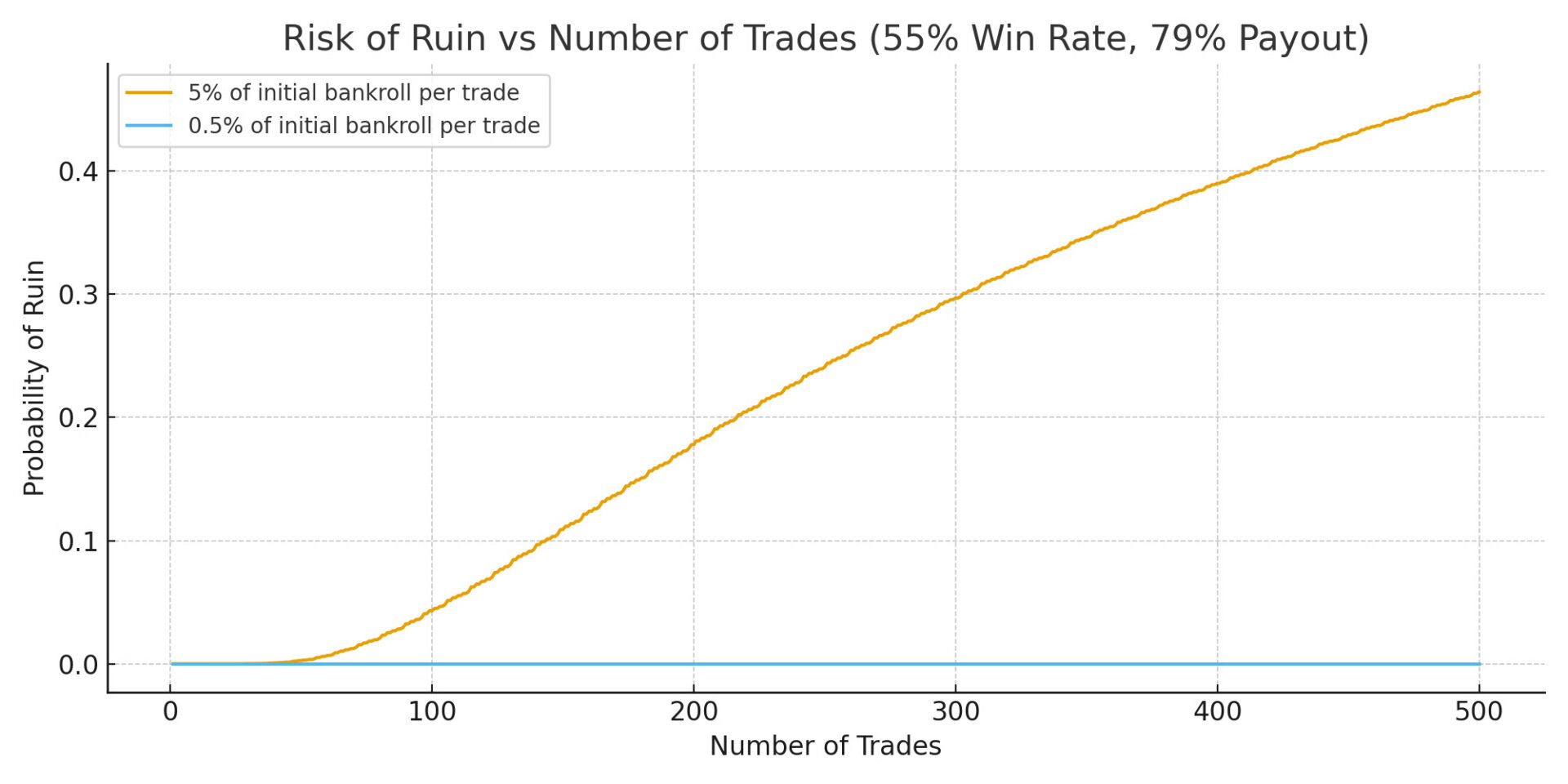
If you bet 5% on each trade, then a streak of 20 bad trades is enough to wipe you out. This has a low percentage chance of happening, but it’s still more common than you might believe. It has a near 50% chance of happening in 500 trades if you have a 55% success rate.
If you only invest 0.5% in each trade. Then you need a streak of 200 bad trades to wipe you out. This is statistically very unlikely to happen if you’re otherwise skilled at choosing the right trades. The chances of this happening in 500 trades are near zero.
Let’s look at a couple of examples:
In both the following examples, we assume that you get a 79% return if the option matures in the money. We also assume that you’re able to achieve a 55% success rate. In other words, 55% of the options you buy will mature in the money.
| Scenario | Assumptions | What it implies for bust risk |
|---|---|---|
| 5% per trade | 79% payout, 55% win rate | ~4% risk of bust within 100 trades; ~46% within 500 trades |
| 0.5% per trade | 79% payout, 55% win rate | Risk of bust within 100 trades is essentially zero; remains near zero even out to 500 trades |
Example 1
In this scenario, we assume that you bet 5% of your initial bankroll in each transaction.
In this scenario, you have a:
- 4% risk of going completely bust within 100 trades.
- 46% risk of going bust within 500 trades
You will, in other words, face a non-trivial chance of going bust within 100 trades and roughly a coin-flip chance if you push it out to 500 trades at 5% per trade.
The risk of going bust will only increase as you do more trades. You would need to increase your success rate to 55.9% to be able to break even. That might seem like a small difference, but it’s hard to achieve in reality. The higher the success rate you have, the larger risk you can assume without a large risk of going bust.
It’s very hard to keep a high success rate over time, so it’s better to assume a lower success rate to be able to be a successful trader over time.
Example 2
In this scenario, we assume that you follow our rules and bet only 0.5% of your initial bankroll on each trade.
- In this scenario, the risk of your going bust within a hundred trades is essentially zero and it remains near zero even if you run it out for 500 trades.
This is why a smaller stake size is so important. It reduces the randomness of your trading.
How Do You Calculate Risk Of Ruin?
To calculate the risk of ruin, we can use the simplified formula for calculating the risk of ruin in binary options trading. Let’s continue to use a 55% success rate for these calculations and let’s assume you only risk 0.5% per trade.
We use a classic gambler’s ruin approximation where each trade is treated as one “unit” risked:
- p = win probability (here p = 0.55). As in the examples above, we assume a 55% success rate.
- q = loss probability = 1 − p (here q = 0.45). This is the assumed failure rate based on the success rate.
- f = fraction of the initial bankroll risked per trade (e.g. f = 0.005 for 0.5%). How large a percentage of a bankroll you risk on each trade
- B0 = initial bankroll (normalized to 1)
Number of loss-units your bankroll can withstand:
N = B0 ⁄ (f × B0) = 1 ⁄ f
The approximate risk of eventual ruin (continuing to trade indefinitely in a favorable game p > q) is:
R= Ruin
R ≈ (q ⁄ p)N (a standard result from the gambler’s ruin problem in probability theory)
Ruin ≈ (loss probability ⁄ win probability)Number of losing trades it takes to ruin you
Formula with example values:
- p = 0.55
- q = 0.45
- f = 0.005 (0.5% of the initial bankroll per trade)
N = 1 ⁄ 0.005 = 200
R≈(0.45 ⁄ 0.55)200
Using these values, the risk of ruin, is as earlier mentioned very, very close to zero. However, it’s worth noting that the expected values of your trades will be negative at a 55% success rate and a 79$ return on investment.
Using these numbers, you would eventually run out of money. You would therefore, in this example, eventually go bust. That’s why you need to be able to either achieve a higher success rate or find a broker that offers you a higher return on investment.
We will teach you more about how to calculate the necessary success rate and the expected value of a trade at a certain payout rate below.
Break Even
This is how you calculate your break-even point, like using the break-even win rate formula for binary options:
Let R be the return on a winning trade as a decimal.
For a 79% payout, R = 0.79.
The general break-even win rate is:
P = Break Even
p = 1 ⁄ (1 + R)
With R = 0.79: (79% payout rate)
P= 1 ⁄ (1 + 0.79) = 1 ⁄ 1.79 ≈ 0.559
So you need to win at least ≈ 55.9% of your trades to break even with a 79% payout.
Expected Value
You also need to know how to calculate the expected value of each trade using the formula for the expected value of binary options trades:
For this example, we assume 55% win rate and 79% return (per $1 stake):
Let:
- p = win probability (here p = 0.55)
- R = return on a winning trade (here R = 0.79)
The general expected value (EV) per $1 stake is:
EV = p × R + (1 − p) × (−1)
Insert p = 0.55 and R = 0.79:
EV = 0.55 × 0.79 + 0.45 × (−1)
EV = 0.4345 − 0.45 = −0.0155
So the expected value is EV = −0.0155, i.e. a loss of 1.55% of the stake per trade on average. In other words, even though you win more trades than you lose, you still lose money on average with a 79% payout.
You will, as we calculated above, for break-even, need 55.9% of the trades to mature in the money to break even, to get a neutral expected value at a 79% payout rate.
Risk management can never beat a negative expected value. You need to make sure that you have a positive expected value to be able to earn money. Otherwise, you will just slow down how quickly you lose money.
Never open a trade that has a negative expected value and only trade with brokers that have a payout rate that’s high enough for you to be able to expect a positive expected value.
Using the Formulas
By using these formulas you can calculate the risk of ruin yourself, as well as expected value and breakeven points. This allows you to develop a strategy that’s suitable for you and that makes you assume a risk you feel comfortable assuming.
Higher risk allows you to earn more money quickly, but it also increases the risk of you getting ruined. As well as the risk of you quickly losing a lot of money without getting ruined. We recommend a modest approach that allows you can maximize the effect of your skill and minimize the chance of randomness.
Remember, it doesn’t matter how skilled a trader you are, all traders have bad runs. Great traders prepare for this and use risk management so that they are able to stay on top even after a bad run.
As a trader, it’s also very good to know the expected break-even and expected value on each trade. Both these numbers make it easier to develop a strategy and to decide how much risk you want to assume. Let’s look at how we calculate break even and expected value.
Recommended Brokers
The brokers below are filtered to show brokers that accept traders in your region. Please note that this might mean that we display offshore brokers in regions where there are no locally regulated binary option brokers. Trading with offshore brokers does come with increased risk, but we try to help reduce that risk by pointing to the offshore brokers that have the best reputation for paying out and not abusing clients. In other words, the brokers we display are the ones we have found to be the best, safest options for traders who want to trade binary options in your region.
| Broker | Min Deposit | Expiry Times | ||
|---|---|---|---|---|
 |
CloseOption | $5 | 30 seconds - 1 month | » Visit |
 |
Capitalcore | $10 | 1 minute - 1 hour | » Visit |
 |
AZAforex | $1 | 30 seconds - 1 day | » Visit |
Visit
Further Reading
- “A New Interpretation of Information Rate”, J. L. Kelly jr, Bell System Technical Journal, 1956
- The Kelly Betting System for Favorable Games