Binary Options Trading in the US
Binary options are used by some traders in the United States, providing short-term opportunities on domestic and global markets. Rather than the fixed-payout style of binaries offered directly by many overseas brokers, US-authorized binary options are structured as exchange contracts with transparent pricing, defined risk, and regulated clearing. US-regulated exchange binary options should therefore not be seen as the same as the over-the-counter (OTC) binaries offered by lots of offshore brokers.
This guide explains how binary options work for traders in the US, along with details on the regulations and tax implications of dealing with these high-risk, high-reward products. We also list the top binary options platforms for US-based traders and walk through the steps to getting started.
Best Binary Options Brokers in the US
Due to regulatory requirements, generally only exchange-regulated platforms are permitted to provide binaries to traders in the US.
- Nadex was the primary CFTC-regulated binary options platform for US retail investors looking to trade binary options. But in December 2025, it announced it was transitioning to Crypto.com and is no longer accepting new clients. It was a Designated Contracts Market (DCM), registration number 34536. Its contracts were priced between 0 and 100 and could be bought or sold before expiry, allowing traders to manage risk dynamically rather than being locked into a fixed outcome. The Nadex platform offered binaries from $1 spanning currencies, indices, commodities, and events. Binary-style products like up/down contracts are still available through Crypto.com.
- CME Group is the other main CFTC-regulated exchange group that offers binary-style contracts. That said, it doesn’t offer traditional retail binary options, rather contracts that are generally aimed at more experienced traders, although the CFTC lists them under the ‘binary options’ subcategory. The CME platform provides event-based contracts on economic indicators, macro events, and sports in some jurisdictions.
There also exist some other firms that offer yes/no style contracts, such as Kalshi (DCM: 42993 designated 2020) and ForecastEX (DCM: 48213/DCO: 50835 designated in 2024), both of which are DCMs registered with CFTC. However, they are better known as ‘prediction markets platforms‘, focusing on events, many of which aren’t financial, so they differ from typical binary options platforms.
Prediction markets, also known as ‘event contracts’ by regulators, have a lot in common with gambling and it is not impossible that these yes/no prediction options may be reclassified as gambling in the future, especially in categories like sports and elections. While federal courts in 2024-2025 largely cleared the way for election markets, in 2026, several states and the “Prediction Markets Are Gambling Act” (S. 4160) are seeking to reclassify such contracts under state gambling laws. This is something that CME Group themselves acknowledge in their own risk disclosure. If that happens then it would echo the history that some binary option-style retail products were initially offered by online casinos before they were developed and regulated as financial instruments.
What Are Binary Options?
Binary options are financial contracts that typically have only two possible outcomes at expiry: a fixed return or a total loss of the amount staked. Each trade is based on a simple yes-or-no question, such as whether the price of an asset, such as the USD/JPY currency pair, will be above or below a specific level at a set time.
When a trader opens a binary option, they are not buying the underlying asset. Instead, they are speculating on the outcome of a price movement or event.
- If the prediction is correct, the contract settles in profit.
- If it is wrong, the trade expires worthless.
In the United States, binary options are structured as exchange-traded contracts rather than fixed-payout bets offered by an online broker. Contracts are normally priced between 0 and 100, with the price reflecting the market’s assessment of the probability that the option will finish in the money. At expiry, winning contracts settle at 100 and losing contracts settle at 0.
This exchange-based structure makes US binaries more transparent than offshore alternatives. Prices are visible, risk is capped in advance, and traders can often exit positions before expiry.
The US pricing model can make it harder for uninformed traders to work out potential profits and expected value. This is because the trader doesn’t see a quoted payout percentage, like on most offshore platforms. Instead, traders using exchange-regulated binaries in the US have to calculate the percentage return themselves by comparing what they pay for the contract with what it will pay if it expires ‘in the money’. It’s an extra step, requiring more maths, and potentially catching out inexperienced traders.
Despite these differences, the core concept remains the same: binaries offer a straightforward way to speculate on short-term market movements with clearly defined risk and reward.
An Example Trade
To show you how a fixed-payout option works, let’s use an example based on Crypto.com.
Let us suppose that after firing up the app, I see the EUR/USD trading at 1.0825. I opt for an option with a strike price of 1.0830 and an expiry time of 5 minutes.
The question I need to answer is: Will EUR/USD be above 1.0830 when the contract expires?
Based on the charting analysis I’ve done, I believe the EUR/USD will stay below that level, so I select No.
It is $42 to enter one position, and the fixed settlement value at expiry is $100 if my prediction is correct. This means I’m risking the $42 entry cost (plus any applicable trading fees), and the maximum payout I could receive for one contract is $100. This means my potential gross profit is $58.
If, when we get to the expiry, the EUR/USD sits at 1.0828, my ‘No’ position finishes in the money because the pair did not finish above 1.0830. The contract therefore settles at $100 and my account receives a bump of $58 before fees.
However, if the EUR/USD had instead expired at 1.0834, my prediction would have been wrong. The contract would expire worth nothing, and my account would have been docked $42.
Tip: A neat feature of the Crypto.com app is that you don’t have to wait until the contract expires. So if EUR/USD moved in a favorable direction and the $42 contract price was now $70, then I could sell it right away and lock in the $28 profit.
Can I Trade US Assets With Binaries?
Yes, US-related assets can be traded using binary options, but availability depends on where the trade is placed and how the platform operates.
On US-regulated exchanges, binaries are typically offered on major US indices, select commodities, and economic events tied to the US economy. These contracts are exchange-traded and follow strict pricing and settlement rules.
Offshore binary options platforms often list a wider range of US-related assets, including individual equities like Tesla and other forex pairs that contain the US dollar. However, these platforms are not legally permitted to accept US residents and operate outside US regulatory oversight.
| Broker | US Forex Pairs (e.g. EUR/USD) | US Indices (e.g. S&P 500) | US Stocks (e.g. Apple) | US Commodities (e.g. Crude Oil) | US Economic Events (e.g. Fed Decision) | Notes |
|---|---|---|---|---|---|---|
| Nadex (now Crypto.com) | Yes | Yes | No | Yes | Yes | Exchange-traded binaries |
| CME Group | No | No | No | No | Yes | Event contracts only |
Can I Open a Binary Account in US Dollars?
Yes, most binary options platforms we’ve tested operate an account in US dollars, with contracts priced and settled in USD. This removes the need for currency conversion and simplifies funding and withdrawals for US-based traders.
| Broker | US-Based Trading Account | Notes |
|---|---|---|
| Nadex (now Crypto.com) | Yes | US regulated (CFTC) |
| CME Group | Yes | US regulated (CFTC) |
Which US Binary Brokers Offer Support in English?
English-language support is standard across platforms offering binaries to US traders. US-regulated exchanges provide full English documentation, platform guidance, and customer support.
| Broker | English-Speaking Support | Support Options | Notes |
|---|---|---|---|
| Nadex (now Crypto.com) | Yes | Live chat, email (direct address) | Regulated exchange |
| CME Group | Yes | Help centre/knowledge base, phone, email | Professional focus |
Is Binary Options Trading Legal in the US?
Binary options trading is legal in the United States, but only when it takes place on a regulated US exchange. This is typically a CFTC-registered Designated Contract Market (DCM), with trades subject to exchange rules, oversight, and clearing requirements.
Some binary options websites that accept US customers are off-exchange and unregistered, which US regulators have repeatedly warned may be illegal and running frauds and scams. These brokers are not allowed to accept US traders but some still do.
While enforcement typically focuses on the operators and promoters, US residents should not assume that participating carries no legal or compliance risk – especially if they misrepresent identity/residency, facilitate solicitation, or move funds through questionable channels.
If you ignore our and the CFTC’s warning not to register with an offshore broker then it is important to remember that you still have a legal responsibility to declare any profits you make from your trading and that you might have to report money you keep in your foreign account within the trading platform.
An example of this is that FinCEN requires US citizens to file an FBAR (Foreign Bank Account Report) if foreign accounts exceed $10,000 aggregate at any time during the year. You can read more about this further down on this page where we talk about taxation.
Please note that there is also a risk that offshore platforms use prohibited intermediaries to be able to receive your deposit which can open you up for additional legal liabilities.
Promoting or referring US persons to unregistered/off-exchange binary options schemes can create serious legal exposure (especially if compensated or if marketing is misleading).
Avoiding Unregulated Brokers
The Commodity Futures Trading Commission (CFTC) oversees US derivatives markets, including exchange-traded binary options. Depending on how a product is structured and marketed, the Securities and Exchange Commission (SEC) may also play a role in supervision and enforcement.
Before funding an account, verify the firm’s status using CFTC registration and background checks through NFA’s BASIC database.
It’s also worth consulting the CFTC RED List, which warns against unregistered providers. Below is a quick check we did for ‘binary options’, which revealed six pages of brands the CFTC cautions against.
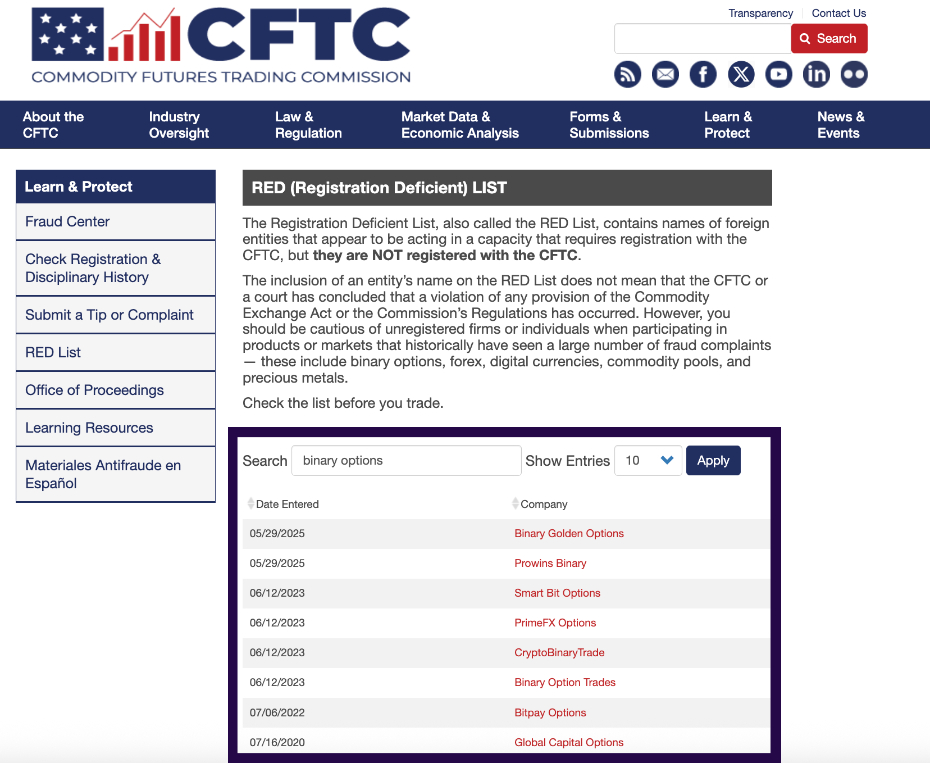
CFTC Red List – “Binary Options” Search
US regulators have warned traders for years about the risks of unregistered platforms and fraudulent schemes involving binary options. You can read some of these here:
- Beware of Off-Exchange Binary Options Trades
- Avoid Unregistered Binary Options Trading Platforms
- CFTC/SEC Investor Alert: Binary Options and Fraud
- Binary Options Fraud (CFTC)
- Investor Alert: Binary Options Websites may be Used for Fraudulent Schemes
Is Binary Options Trading Taxed in the US?
Profits (and losses) from binary options trading are generally reportable and may be taxable in the United States. If you’re a US citizen or resident, you typically must report worldwide income.
How it’s taxed depends on what you actually traded and your tax status:
- Many individual investors report retail trading gains/losses as capital gains/losses, following IRS Topic No. 409 (Capital gains and losses). Publication 550 (Investment Income and Expenses) is for investment and options-related topics.
- Certain exchange-traded derivatives may be subject to special rules (for example, Section 1256 contracts) and may be reported using
IRS guidance on Form 6781 (Gains and Losses From Section 1256 Contracts and Straddles). Classification can depend on the venue and contract.
Reporting considerations:
- If you trade through a US-based binary broker, you may receive Form 1099-B (Proceeds from Broker and Barter Exchange Transactions). Many taxpayers reconcile transactions on Form 8949 (Sales and Other Dispositions of Capital Assets) and then carry totals to Schedule D (Form 1040), Capital Gains and Losses as part of filing their annual Form 1040.
- Offshore brokers often don’t generally issue US tax forms like Form 1099-B, so you may need to rely on your own statements and trade history logs to prepare Form 8949/Schedule D, but the reporting obligation will still apply. Also, depending on the facts (for example, if you have a foreign financial account), additional reporting may be required such as FBAR reporting (as explained by the IRS) filed through FinCEN’s FBAR e-filing system, and in some cases Form 8938 (Statement of Specified Foreign Financial Assets).
Given the complex tax landscape in the US and varying obligations depending on your personal circumstances, we recommend consulting a professional tax advisor before trading binaries.
Getting Started
- Choose a Broker Carefully: US traders can only trade binary options legally on regulated exchanges. A binary demo account is a great way to test drive a brokerage before risking funds.
- Deposit Funds: Funding is typically done via bank transfer or debit card, with accounts held in US dollars. ACH transfers, which are available at some US-regulated venues, are not provided by most overseas binary brokers from our evaluations.
- Learn the Platform: Exchange-traded binaries use live pricing and order-based execution. Taking time to understand how contracts move before expiry is essential. Also investigate the charts and indicators provided, as binaries are typically short-term instruments spanning seconds or hours, where technical analysis can play an important role.
- Place Your First Real Trade: Most traders start with a single contract and defined risk. Discipline and position sizing matter more than trade frequency. It’s also vital to develop and follow a binary options trading strategy, as wild speculation is effectively gambling.
Always trade binaries responsibly. If you feel it’s damaging your mental or financial health, stop and seek help.
Prediction Markets: Binary Options 2.0
As prediction markets, also known as event contracts, explode in the US with $1.2B in trading volume in early 2025 skyrocketing to over $20B by January 2026, the lines between binaries and prediction-style contracts are blurring. This was accelerated in 2026 when the SEC approved Nasdaq MRX’s Outcome-Related Options (OROs) on the Nasdaq-100 and Nasdaq-100 Micro indexes. The move allows for cash-settled, European-style binary options with all-or-nothing payouts, but listed on a regulated US options exchange as opposed to taking place on offshore platforms.
We remain cynical – prediction markets are largely binary-style contracts that have been repackaged with a cleaner bill of health and slick marketing from US operators. Nonetheless, the direction of travel, for now at least, appears to be that US regulators aren’t focusing so much on whether a product has a yes/no payout, and more on where it trades, who supervises it, how customers are protected, and if it falls under securities, commodities, or gambling laws. CFTC-regulated platforms like Kalshi position event contracts as federally supervised derivatives, while Nasdaq’s ORO approval shows binary-style contracts can also move into mainstream exchange markets.
We are actively tracking prediction market developments in the US because we believe it could significantly impact the binary options industry in the country, as the two products continue to meld together.
FAQ
Is Binary Options Trading Legal In The US?
Yes, but only through CFTC-regulated exchanges (DCMs), in line with our binary options legality tracker.
Can United States Residents Still Trade Binaries With Offshore Brokers?
Yes, but they are strongly recommended not to do so. Offshore brokers are not authorized to accept US residents and you may not get any legal protection if you register with one.
Is It Safe To Trade Binary Options In The USA?
Binary options should never be considered safe for US traders. They are high-risk investments where you could lose any money you deposit. That said, regulated exchanges provide greater protection than offshore platforms, which are used by some traders in other countries.