How to Succeed with Binary Options Trading 2024
- Top Brokers
- What Is A Binary Option?
- Introduction Video – How to Trade Binary Options
- Binary Option Types
- How to Trade Binary Options – Step by Step Guide
- Choose A Broker
- Asset Lists
- Expiry Times
- Regulation
- ESMA
- Strategies and Guides
- Signals and Other Services
- Beginners Guides
- Types of Trades
- How to Set Up a Trade
- Mobile Apps
- FAQ
- What Does Binary Options Mean?
- How Does a Binary Options Stock Trade Work?
- What Are Put and Call Options?
- Are Binary Options a Scam?
- How Do I Protect Myself When Trading Binary Options?
- Which Are The Best Binary Trading Strategies?
- Are Binary Options Gambling?
- Advantages of Binary Trading
- Managing Financial Risk
- Flexibility
- Simplicity
- Greater Control Of Trades
- Higher Payouts
- Accessibility
- Disadvantages of Binary Trading
- Reduced Trading Odds for Sure-Banker Trades
- Lack Of Good Trading Tools
- Limitations On Risk Management
- Cost Of Losing Trades
- Trade Corrections
- Spot Forex vs Binary Trading
- References And Further Reading
Welcome to the largest expert guide to binary options and binary trading online. BinaryOptions.net has educated traders globally since 2011 and all our articles are written by professionals who make a living in the finance industry and online trading.
We have close to a thousand articles and reviews to guide you to be a more profitable trader in 2024 no matter what your current experience level is.
If you wish to discuss trading or brokers with other traders, we also have the world’s largest forum with over 20 000 members and lots of daily activity. Read on to get started trading today!
BinaryOptions.net will never contact anyone and encourage them to trade. If someone is claiming to work for Binaryoptions.net, it is a scam. Read the scams page to ensure you stay protected while trading.
Top Brokers
Quick Links
What Is A Binary Option?
A binary option is a fast and extremely simple financial instrument which allows investors to speculate on whether the price of an asset will go up or down in the near future, for example the stock price of Google, the price of Bitcoin, the USD/GBP exchange rate, or the price of gold.
The time span can be as little as 60 seconds, making it possible to trade hundreds of times per day across any global market.
Before you place a trade you know exactly how much you stand to gain if your prediction is correct, usually 70-95% – if you invest $100 you will receive a credit of $170 – $195 on a successful trade.
This makes risk management and trading decisions much more simple. You also know exactly how much you will lose on a single trade.
The outcome is always a Yes or No answer – you either win it all or you lose it all – hence it being a “binary” option. The risk and reward is known in advance and this structured payoff is one of the attractions.
Exchange traded binaries are also now available, meaning traders are not trading against the broker.
To get started trading you first need a regulated broker account (or licensed). Pick one from the recommended brokers list, where only brokers that have shown themselves to be trustworthy are included. The top broker has been selected as the best choice for most traders.
If you are completely new to binary options you can open a demo account with most brokers, to try out their platform and see what it’s like to trade before you deposit real money.
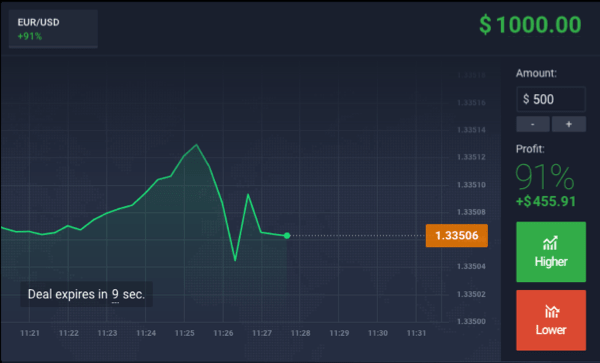
Introduction Video – How to Trade Binary Options
These videos will introduce you to the concept of binary options and how trading works. If you want to know even more detail, please read this whole page and follow the links to all the more in-depth articles.
Binary trading does not have to be complicated, but as with any topic you can educate yourself to be an expert and perfect your skills.
Binary Option Types
The most common type of binary option is the simple “Up/Down” trade. There are however, different types of option. The one common factor, is that the outcome will have a “binary” result (Yes or No). Here are some of the types available:
- Up/Down or High/Low – The basic and most common binary option. Will a price finish higher or lower than the current price a the time of expiry.
- In/Out, Range or Boundary – This option sets a “high” figure and “low” figure. Traders predict whether the price will finish within, or outside, of these levels (or ‘boundaries’).
- Touch/No Touch – These have set levels, higher or lower than the current price. The trader has to predict whether the actual price will ‘touch’ those levels at any point between the time of the trade an expiryNote with a touch option, that the trade can close before the expiry time – if the price level is touched before the option expires, then the “Touch” option will payout immediately, regardless of whether the price moves away from the touch level afterwards.
- Ladder – These options behave like a normal Up/Down trade, but rather than using the current strike price, the ladder will have preset price levels (‘laddered’ progressively up or down).These can often be some way from the current strike price.As these options generally need a significant price move, payouts will often go beyond 100% – but both sides of the trade may not be available.
How to Trade Binary Options – Step by Step Guide
Below is a step by step guide to placing a binary trade:
- Choose a broker – Use our broker reviews and comparison tools to find the best binary trading site for you.
- Select the asset or market to trade – Assets lists are huge, and cover Commodities, Stocks, Cryptocurrency, Forex or Indices. The price of oil, or the Apple stock price, for example.
- Select the expiry time – Options can expire anywhere between 30 seconds up to a year.
- Set the size of the trade – Remember 100% of the investment is at risk so consider the trade amount carefully.
- Click Call / Put or Buy / Sell – Will the asset value rise or fall? Some broker label buttons differently.
- Check and confirm the trade – Many brokers give traders a chance to ensure the details are correct before confirming the trade.
Choose A Broker
Options fraud has been a significant problem in the past. Fraudulent and unlicensed operators exploited binary options as a new exotic derivative.
These firms are thankfully disappearing as regulators have finally begun to act, but traders still need to look for regulated brokers.
Note! Don’t EVER trade with a broker or use a service that’s on our blacklist and scams page, stick with the ones we recommend here on the site. Here are some shortcuts to pages that can help you determine which broker is right for you:
- Compare all brokers – if you want to compare the features and offers of all recommended brokers.
- Bonuses and Offers – if you want to make sure you get extra money to trade with, or other promotions and offers.
- Low minimum deposit brokers – if you want to trade for real without having to deposit large sums of money.
- Demo Accounts – if you want to try a trading platform “for real” without depositing money at all.
- Halal Brokers – if you are one of the growing number of Muslim traders.
Asset Lists
The number and diversity of assets you can trade varies from broker to broker. Most brokers provide options on popular assets such as major forex pairs including the EUR/USD, USD/JPY and GBP/USD, as well as major stock indices such as the FTSE, S&P 500 or Dow Jones Industrial. Commodities including gold, silver, oil are also generally offered.
Individual stocks and equities are also tradable through many binary brokers. Not every stock will be available though, but generally you can choose from about 25 to 100 popular stocks, such as Google and Apple.
These lists are growing all the time as demand dictates.
The asset lists are always listed clearly on every trading platform, and most brokers make their full asset lists available on their website.
This information is also available within our reviews, including currency pairs.
Trading cryptocurrency via binary trades is also booming. The volatile nature of cryptos makes them a popular binary asset. Bitcoin and Ethereum remain the most traded, but you can find brokers that list 50 or more alt coins.
Expiry Times
The expiry time is the point at which a trade is closed and settled. The only exception is where a ‘Touch’ option has hit a preset level prior to expiry. The expiry for any given trade can range from 30 seconds, up to a year.
While binaries initially started with very short expiries, demand has ensured there is now a broad range of expiry times available. Some brokers even give traders the flexibility to set their own specific expiry time.
Expiries are generally grouped into three categories:
- Short Term / Turbo – These are normally classed as any expiry under 5 minutes
- Normal – These would range from 5 minutes, up to ‘end of day’ expiries which expire when the local market for that asset closes.
- Long term – Any expiry beyond the end of the day would be considered long term. The longest expiry might be 12 months.
Regulation
While slow to react to binary options initially, regulators around the world are now starting to regulate the industry and make their presence felt. The major regulators currently include:
- Financial Conduct Authority (FCA) – UK regulator
- Cyprus Securities and Exchange Commission (CySec) – Cyprus Regulator, often ‘passported’ throughout the EU, under MiFID
- Commodity Futures Trading Commission (CFTC) – US regulator
- Australian Securities and Investments Commission (ASIC)
- Financial Industry Regulatory Authority (FINRA)
There are also regulators operating in Malta, Japan and the Isle of Man. Many other authorities are now taking a keen a interest in binaries specifically, notably in Europe where domestic regulators are keen to bolster the CySec regulation.
Unregulated brokers still operate, and while some are trustworthy, a lack of regulation is a clear warning sign for potential new customers.
ESMA
Recently, ESMA (European Securities and Markets Authority) moved to ban the sale and marketing of binary options in the EU. The ban however, only applies to brokers regulated in the EU.
This leaves traders two choices to keep trading: Firstly, they can trade with an unregulated firm – this is extremely high risk and not advisable. Some unregulated firms are responsible and honest, but many are not.
The second choice is to use a firm regulated by bodies outside of the EU. ASIC in Australia are a strong regulator – but they will not be implementing a ban. This means ASIC regulated firms can still accept EU traders. See our broker lists for regulated or trusted brokers in your region.
There is also a third option. Traders who register as ‘professional’ are exempt from the new ban. The ban is only designed to protect ‘retail’ investors.
A professional trader can continue trading at EU regulated brokers. To be classed as professional, an account holder must meet two of these three criteria:
- Open 10 or more trades per quarter, of €150 or more.
- Have assets of €500,000 or more
- Have worked for two years in a financial firm and have experience of financial products.
Strategies and Guides
We have a lot of detailed guides and strategy articles for both general education and specialized trading techniques. Below are a few to get you started if you want to learn the basic before you start trading. From Martingale to Rainbow, you can find plenty more on the strategy page.
- The best binary options books
- Goals for New Binary Traders
- Binary Options Jargon You Should Know
- How to Become a Binary Options Millionaire
- Trading times
- How to Trade Stocks
- Simple Strategies for Newbies
- The After Hours Trading Strategy
- The Simple Balanced System
- Trader Beware! Is That A Tool Or A Strategy?
- Introduction to trends and timeframes
- Trend analysis for short term traders
- Three Tools All Traders Should Know
- How To Trade Butterfly Patterns
- Binary Options Markets
Signals and Other Services
- What should you look for when searching for a strategy, system or service?
- Even Good SSP’s Aren’t Worth Your Time
For further reading on signals and reviews of different services go to the signals page.
Beginners Guides
If you are totally new to the trading scene then watch this great video by Professor Shiller of Yale University who introduces the most basic concepts of options trading.
Education for beginners:
- Lesson 1: Best Time to Trade
- Lesson 2: Tools for Trading
- Lesson 3: Trading Breakouts using Pivot Points
- Lesson 4: How to Use the Fibonacci Tool
- Lesson 5: Risk Management
- Lesson 6: Variable Binary Options
- Lesson 7: How to Postpone Expiration Times
- Lesson 8: When Not to Trade
- Lesson 9: Going Mobile
- Lesson 10: Using the FX Helpers System
- Lesson 11: Using the FX Turbo Marksman Indicator
- Lesson 12: Analysing a Trade
Visit our Education page for other online learning options.
Types of Trades
How to Set Up a Trade
The ability to trade the different types of binary options can be achieved by understanding certain concepts such as strike price or price barrier, settlement, and expiration date. All trades have dates at which they expire.
When the trade expires, the behaviour of the price action according to the type selected will determine if it’s in profit (in the money) or in a loss position (out-of-the-money).
In addition, the price targets are key levels that the trader sets as benchmarks to determine outcomes. We will see the application of price targets when we explain the different types.
There are three types of trades. Each of these has different variations. These are:
- High/Low
- In/Out
- Touch/No Touch
Let us take them one after the other.
High/Low
Also called the Up/Down binary trade, the essence is to predict if the market price of the asset will end up higher or lower than the strike price (the selected target price) before the expiration. If the trader expects the price to go up (the “Up” or “High” trade), he purchases a call option. If he expects the price to head downwards (“Low” or “Down”), he purchases a put option. Expiry times can be as low as 5 minutes.
Please note: some brokers classify Up/Down as a different types, where a trader purchases a call option if he expects the price to rise beyond the current price, or purchases a put option if he expects the price to fall below current prices. You may see this as a Rise/Fall type on some trading platforms.
In/Out
The In/Out type, also called the “tunnel trade” or the “boundary trade”, is used to trade price consolidations (“in”) and breakouts (“out”). How does it work? First, the trader sets two price targets to form a price range. He then purchases an option to predict if the price will stay within the price range/tunnel until expiration (In) or if the price will breakout of the price range in either direction (Out).
The best way to use the tunnel binaries is to use the pivot points of the asset. If you are familiar with pivot points in forex, then you should be able to trade this type.
Touch/No Touch
This type is predicated on the price action touching a price barrier or not. A “Touch” option is a type where the trader purchases a contract that will deliver profit if the market price of the asset purchased touches the set target price at least once before expiry.
If the price action does not touch the price target (the strike price) before expiry, the trade will end up as a loss.
A “No Touch” is the exact opposite of the Touch. Here you are betting on the price action of the underlying asset not touching the strike price before the expiration.
There are variations of this type where we have the Double Touch and Double No Touch. Here the trader can set two price targets and purchase a contract that bets on the price touching both targets before expiration (Double Touch) or not touching both targets before expiration (Double No Touch).
Normally you would only employ the Double Touch trade when there is intense market volatility and prices are expected to take out several price levels.
Some brokers offer all three types, while others offer two, and there are those that offer only one variety. In addition, some brokers also put restrictions on how expiration dates are set.
In order to get the best of the different types, traders are advised to shop around for brokers who will give them maximum flexibility in terms of types and expiration times that can be set.
Mobile Apps
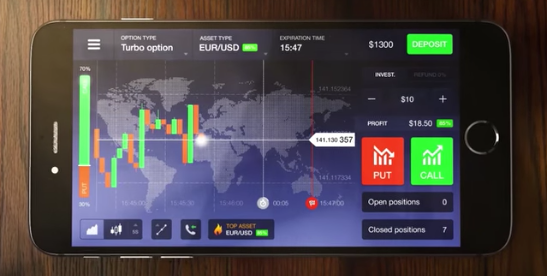
Trading via your mobile has been made very easy as all major brokers provide fully developed mobile trading apps. Most trading platforms have been designed with mobile device users in mind.
So the mobile version will be very similar, if not the same, as the full web version on the traditional websites.
Brokers will cater for both iOS and Android devices, and produce versions for each. Downloads are quick, and traders can sign up via the mobile site as well.
Our reviews contain more detail about each brokers mobile app, but most are fully aware that this is a growing area of trading.
Traders want to react immediately to news events and market updates, so brokers provide the tools for clients to trade wherever they are.
FAQ
What Does Binary Options Mean?
“Binary options” means, put very simply, a trade where the outcome is a ‘binary’ Yes/No answer. These options pay a fixed amount if they win (known as “in the money”), but the entire investment is lost, if the binary trade loses. So, in short, they are a form of fixed return financial options.
How Does a Binary Options Stock Trade Work?
Steps to trade a stock via a binary option;
- Select the stock or equity.
- Identify the desired expiry time (The time the option will end).
- Enter the size of the trade or investment
- Decide if the value will rise or fall and place a put or call
The steps above will be the same at every single broker. More layers of complexity can be added, but when trading equities the simple Up/Down trade type remains the most popular.
What Are Put and Call Options?
Call and Put are simply the terms given to buying or selling an option. If a trader thinks the underlying price will go up in value, they can open a call. But where they expect the price to go down, they can place a put trade.
Different trading platforms label their trading buttons different, some even switch between Buy/Sell and Call/Put. Others drop the phrases put and call altogether.
Almost every trading platform will make it absolutely clear which direction a trader is opening an option in.
Are Binary Options a Scam?
As a financial investment tool binary options are not a scam, but there are brokers, trading robots and signal providers that are untrustworthy and dishonest. The point is not to write off the concept of binary options, based solely on a handful of dishonest brokers.
The image of these financial instruments has suffered as a result of these operators, but regulators are slowly starting to prosecute and fine the offenders and the industry is being cleaned up. Our forum is a great place to raise awareness of any wrongdoing.
How Do I Protect Myself When Trading Binary Options?
These simple checks can help anyone identify dishonest marketing and avoid scams:
- Marketing promising huge returns. This is clear warning sign. Binaries are a high risk / high reward tool – they are not a “make money online” scheme and should not be sold as such. Operators making such claims are very likely to be untrustworthy.
- Know the broker. Some operators will ‘funnel’ new customer to a broker they partner with, so the person has no idea who their account is with. A trader should know the broker they are going to trade with! These funnels often fall into the “get rich quick” marketing discussed earlier.
- Cold Calls. Professional brokers will not make cold calls – they do not market themselves in that way. Cold calls will often be from unregulated brokers interested only in getting an initial deposit. Proceed extremely carefully if joining a company that got in contact this way. This would include email contact as well – any form of contact out of the blue.
- Terms and Conditions. When taking a bonus or offer, read the full terms and conditions. Some will include locking in an initial deposit (in addition to the bonus funds) until a high volume of trades have been made. The first deposit is the trader’s cash – legitimate brokers would not claim it as theirs before any trading. Some brokers also offer the option of cancelling a bonus if it does not fit the needs of the trader.
- Do not let anyone trade for you. Avoid allowing any “account manager” to trade for you. There is a clear conflict of interest, but these employees of the broker will encourage traders to make large deposits, and take greater risks . Traders should not let anyone trade on their behalf.
Which Are The Best Binary Trading Strategies?
Binary trading strategies are unique to each trade. We have a binary options strategy section, and there are ideas that traders can experiment with. Technical analysis is of use to some traders, combined with charts, indicators and price action research.
Money management is essential to ensure risk management is applied to all trading. Different styles will suit different traders and strategies will also evolve and change.
There is no single “best” strategy. Traders need to ask questions of their investing aims and risk appetite and then learn what works for them.
Are Binary Options Gambling?
This will depend entirely on the habits of the trader. With no strategy or research, then any short term investment is going to win or lose based only on luck. Conversely, a trader making a well researched trade will ensure they have done all they can to avoid relying on good fortune.
Binary options can be used to gamble, but they can also be used to make trades based on value and expected profits. So the answer to the question will come down to the behavior of the individual trader. Any investment or trade will be a gamble if done with no skill or knowledge.
Advantages of Binary Trading
The main benefit of binaries is the clarity of risk and reward and the structure of the trade.
Managing Financial Risk
If you have traded forex or its more volatile cousins, crude oil or spot metals such as gold or silver, you will have probably learnt one thing: these markets carry a lot of risk and it is very easy to be blown off the market.
Things like leverage and margin, news events, slippages and price re-quotes, etc can all affect a trade negatively. The situation is different in binary options trading.
There is no leverage to contend with, and phenomena such as slippage and price re-quotes have no effect on binary option trade outcomes.
Tax implications may also be beneficial, depending on your location.
This reduces the risk in binary option trading to the barest minimum.
Flexibility
The binary options market allows traders to trade financial instruments spread across the currency and commodity markets as well as indices and bonds.
This flexibility is unparalleled, and gives traders with the knowledge of how to trade these markets, a one-stop shop to trade all these instruments.
Simplicity
A binary trade outcome is based on just one parameter: direction. The trader is essentially betting on whether a financial asset will end up in a particular direction.
In addition, the trader is at liberty to determine when the trade ends, by setting an expiry date.
This gives a trade that initially started badly the opportunity to end well. This is not the case with other markets. For example, control of losses can only be achieved using a stop loss.
Otherwise, a trader has to endure a drawdown if a trade takes an adverse turn in order to give it room to turn profitable. The simple point being made here is that in binary options, the trader has less to worry about than if he were to trade other markets.
Greater Control Of Trades
Traders have better control of trades in binaries. For example, if a trader wants to buy a contract, he knows in advance, what he stands to gain and what he will lose if the trade is out-of-the-money.
This is not the case with other markets. For example, when a trader sets a pending order in the forex market to trade a high-impact news event, there is no assurance that his trade will be filled at the entry price or that a losing trade will be closed out at the exit stop loss.
Higher Payouts
The payouts per trade are usually higher in binaries than with other forms of trading. Some brokers offer payouts of up to 80% on a trade. This is achievable without jeopardising the account.
In other markets, such payouts can only occur if a trader disregards all rules of money management and exposes a large amount of trading capital to the market, hoping for one big payout (which never occurs in most cases).
Accessibility
In order to trade the highly volatile forex or commodities markets, a trader has to have a reasonable amount of money as trading capital. For instance, trading gold, a commodity with an intra-day volatility of up to 10,000 pips in times of high volatility, requires trading capital in tens of thousands of dollars.
However, binary options has much lower entry requirements, as some brokers allow people to start trading with as low as $10.
Disadvantages of Binary Trading
Reduced Trading Odds for Sure-Banker Trades
The payouts for binary options trades are drastically reduced when the odds for that trade succeeding are very high.
While it is true that some trades offer as much as 85% payouts per trade, such high payouts are possible only when a trade is made with the expiry date set at some distance away from the date of the trade.
Of course in such situations, the trades are more unpredictable.
Lack Of Good Trading Tools
Some brokers do not offer truly helpful trading tools such as charts and features for technical analysis to their clients.
Experienced traders can get around this by sourcing for these tools elsewhere; inexperienced traders who are new to the market are not as fortunate.
This is changing for the better though, as operators mature and become aware of the need for these tools to attract traders.
Limitations On Risk Management
Unlike in forex where traders can get accounts that allow them to trade mini- and micro-lots on small account sizes, many binary option brokers set a trading floor; minimum amounts which a trader can trade in the market.
This makes it easier to lose too much capital when trading binaries. As an illustration, a forex broker may allow you to open an account with $200 and trade micro-lots, which allows a trader to expose only acceptable amounts of his capital to the market.
However, you will be hard put finding many binary brokers that will allow you to trade below $50, even with a $200 account. In this situation, four losing trades will blow the account.
Cost Of Losing Trades
Unlike in other markets where the risk/reward ratio can be controlled and set to give an edge to winning trades, the odds of binary options tilt the risk-reward ratio in favour of losing trades.
Trade Corrections
When trading a market like the forex or commodities market, it is possible to close a trade with minimal losses and open another profitable one, if a repeat analysis of the trade reveals the first trade to have been a mistake. Where binaries are traded on an exchange, this is mitigated however.
Spot Forex vs Binary Trading
These are two different alternatives, traded with two different psychologies, but both can make sense as investment tools. One is more TIME centric and the other is more PRICE centric. They both work in time/price but the focus you will find from one to the other is an interesting split.
Spot forex traders might overlook time as a factor in their trading which is a very very big mistake. The successful binary trader has a more balanced view of time/price, which simply makes him a more well rounded trader.
Binaries by their nature force one to exit a position within a given time frame win or lose which instills a greater focus on discipline and risk management.
In forex trading this lack of discipline is the #1 cause for failure to most traders as they will simply hold losing positions for longer periods of time and cut winning positions in shorter periods of time.
In binary options that is not possible as time expires your trade ends win or lose. Below are some examples of how this works.
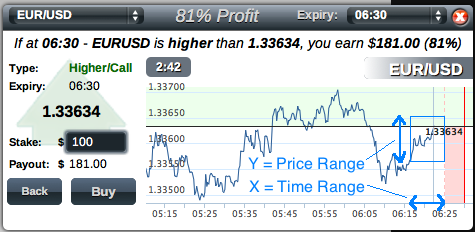
Above is a trade made on the EUR/USD buying in an under 10 minute window of price and time. As a binary trader this focus will naturally make you better than the below example, where a spot forex trader who focuses on price while ignoring the time element ends up in trouble. This psychology of being able to focus on limits and the dual axis will aid you in becoming a better trader overall.
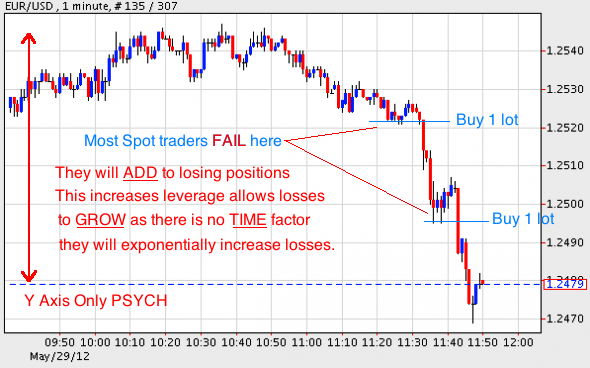
The very advantage of spot trading is its very same failure – the expansion of profits exponentially from 1 point in price.
This is to say that if you enter a position that you believe will increase in value and the price does not increase yet accelerates to the downside, the normal tendency for most spot traders is to wait it out or worse add to the losing positions as they figure it will come back.
The acceleration in time to the opposite desired direction causes most spot traders to be trapped in unfavourable positions, all because they do not plan time into their reasoning, and this leads to a complete lack of trading discipline.
The nature of binary options force one to have a more complete mindset of trading off both Y = Price Range and X = Time Range as limits are applied. They will simply make you a better overall trader from the start.
Conversely on the flip side, they by their nature require a greater win rate as each bet means a 70-90% gain vs a 100% loss. So your win rate needs to be on average 54%-58% to break even.
This imbalance causes many traders to overtrade or revenge trade which is just as bad as holding/adding to losing positions as a spot forex trader. To successfully trade you need to practice money management and emotional control.
In conclusion, when starting out as a trader, binaries might offer a better foundation to learn trading. The simple reasoning is that the focus on TIME/PRICE combined is like looking both ways when crossing the street.
The average spot forex trader only looks at price, which means he is only looking in one direction before crossing the street.
Learning to trade taking both time and price into consideration should aid in making one a much overall trader.
References And Further Reading
- A Study of Optimal Stock and Options Strategies (Dash, Mihir and V., Kavitha and K.M., Deepa and S., Sindhu, 2007)
- Is There Money to Be Made Investing in Options: A Historical Perspective (Doran, James and Fodor, Andy, 2006)
- An Investor’s Guide to Trading Options (Virginia B. Morris, Bess Newman – Lightbulb Press, Inc., 2004)
- Trading Binary Options: Strategies and Tactics (Abe Cofnas – John Wiley & Sons, 2011)
- Binary Options: Fixed Odds Financial Bets (Hamish Raw – Harriman House Limited, 2011)
- Binary Options: Strategies for Directional and Volatility Trading (Alex Nekritin – John Wiley & Sons, 2012)
- How to Trade Binary Options Successfully: A Complete Guide to Binary Options Trading (Meir Liraz – Liraz Publishing)
- Option Trading and Individual Investor Performance (R Bauer, M Cosemans, P Eichholtz – Journal of banking & finance, Vol 3 Issue 4, 2009)
- Binary Option Pricing Using Fuzzy Numbers (A Thavaneswaran, S.S Appadoo, J Frank – Applied Mathematics Letters, Vol 26, Issue 1, 2013)