Binary Options Trading in Thailand
Binary options trading is accessible to residents in Thailand, providing short-term opportunities on global financial markets. The catch is that there aren’t any local binary options platforms regulated by the Securities and Exchange Commission (SEC) of Thailand, meaning citizens generally use offshore platforms, which leaves users with limited regulatory protections.
Still, some Thai traders are attracted to binaries by their straightforward structure, allowing users to speculate whether the value of the Thai baht (THB), for example, will rise or fall versus other currencies by a defined expiry time, either earning them a pre-defined payout or losing their stake.
This beginner’s guide to trading binary options in Thailand explains how contracts work and dives into the legal and tax landscape.
Best Binary Options Brokers in Thailand
After the hands-on tests of our experienced binary traders and industry experts, these stood out as the top binary options platforms for traders in Thailand. However, while these brokers accept Thai traders, they may be based offshore and are not authorized by Thailand’s SEC.
| Broker | Min Deposit | Expiry Times | ||
|---|---|---|---|---|
 |
CloseOption | $5 | 30 seconds - 1 month | » Visit |
 |
Capitalcore | $10 | 1 minute - 1 hour | » Visit |
 |
AZAforex | $1 | 30 seconds - 1 day | » Visit |
 |
Crypto.com | Varies by payment method | 5 minutes to event cutoffs, can be hours, days and longer depending on contract | » Visit |
 |
Binarium | $5 | 60 seconds - 3 months | » Visit |
Visit
What Are Binary Options?
Binary options are simple, fixed-outcome trades. Each trade generally comes down to one question: will the price of an asset, say a stock, finish above or below a set level when the trade expires?
- If the prediction is correct, the trade pays a fixed return. This is usually displayed as a percentage, e.g. 60%.
- If it’s wrong, the stake is lost. Minimum stakes can be as low as $1 on many binary platforms we’ve used.
Platforms typically offer short expiry times, starting from just a few seconds, with payouts shown upfront before you hit the ‘High’ or ‘Low’ or equivalent buttons. This relative simplicity compared to some financial derivatives and the all-or-nothing mechanics has made them popular with retail investors.
Once a trade is opened, it typically runs until expiry. That said, we’ve seen some platforms introduce features like ‘Early Closure’, allowing traders to lock in gains or cut losses before expiry. Equally, some firms offer a ‘Rollover’ feature, essentially extending the expiry time.
While the mechanics are easy to understand, the all-or-nothing structure of binaries means losses can build quickly without a trading strategy and risk management.
An Example Trade
To show you how binary options trading online can play out in practice for traders in Thailand, let’s walk through a 1-minute trade on the Pocket Option platform, which I placed to help build this guide.
I selected USD/THB (US dollar vs Thai baht) and set the expiry to 1 minute (a popular expiry time with binary traders).
The setup was simple: would the price finish higher than the current price when the timer hit zero?
I placed a Buy (Call) trade and risked $25. The platform showed a 92% payout before I confirmed the order, which you can see below, so a winning trade would return $48 in total ($25 stake + $23 payout).
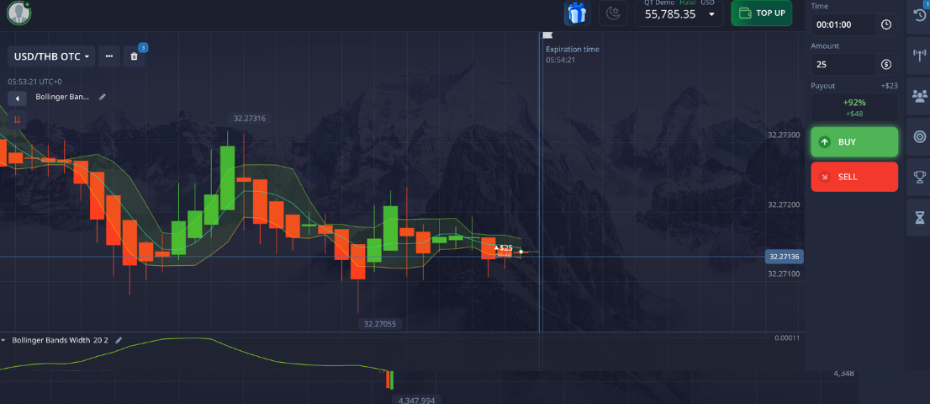
Pocket Option – USD/THB
This time, the move went my way. The US dollar pushed higher vs the Thai baht after 60 seconds, and when the countdown ended, USD/THB finished above my entry level.
The trade settled in the money, as you can see in the ‘Closed’ trades section of the Pocket Option platform below, and the $23 payout was credited to my account instantly.
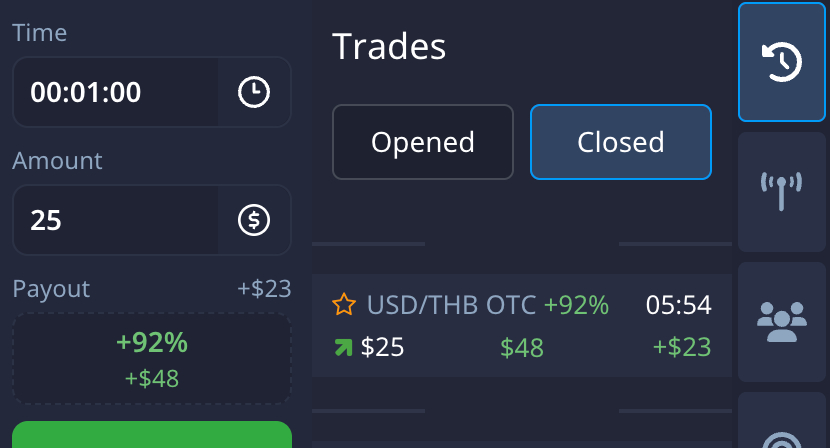
Pocket Option – USD/THB binary trade results
That’s the appeal for many traders. In 60 seconds, the outcome was settled, the risk was capped from the start, and the result was clear.
It also shows why timing matters so much with short expiries; when you’re right, the payoff is immediate, but when you’re wrong, the loss is just as fast.
Can I Trade Thai Assets With Binaries?
Sometimes, but they’re rare. We checked every platform in our binary broker database, and none offered binaries on equities listed on the Stock Exchange of Thailand (SET) nor the SET index.
That said, after logging into their platforms and searching through their instrument lists, we found several platforms offering binaries on currency pairs containing the Thai baht. These are almost always paired with the US dollar, with the USD/THB considered an exotic currency pair.
| Broker | THB Currency Pairs (e.g. USD/THB) | Thai Stocks (e.g. PTT) | Thai Indices (e.g. SET50) | Global Financial Markets (e.g. commodities & crypto) |
|---|---|---|---|---|
| Pocket Option | Yes | No | No | Yes |
| IQ Option | Yes | No | No | Yes |
| BinaryCent | Yes | No | No | Yes |
| AZAforex | Yes | No | No | Yes |
Can I Open a Binary Account in Thai Baht?
We checked all the binary platforms in our active broker directory, and the wider market, and most do not offer a trading account denominated in Thai baht. Accounts are primarily based in US dollars, though euros, other fiat currencies, and sometimes even crypto are used.
Residents can still deposit and withdraw in Thai baht, but funds will normally be converted before they are credited. This conversion will either take place via the bank, card provider, payment processor handling the exchange, or sometimes the broker. And crucially, it may come with a charge.
That said, we did find a couple of binary brokers that offer a THB-based trading account. And after combing through their supported payment methods, we also found a provider with Thai-focused payment solutions, providing more convenient deposits and withdrawals.
| Broker | THB Account | Thailand-Specific Deposit Solutions |
|---|---|---|
| AZAforex | Yes | No |
| Quotex | Yes | No |
| Pocket Option | No | Yes (Thailand QR banking) |
Which Binary Options Brokers Offer Support in Thai?
We’ve run deep dive tests on the customer service provided by each broker we’ve reviewed – contacting them on different channels, such as live chat and email, measuring response times, and investigating the different languages and regions supported.
The majority provide English-language support as standard, although a few brokers offer partial localization through translated interfaces which we verified from their websites, client areas, or by checking with customer service agents.
| Broker | Support in Thai | Website in Thai |
|---|---|---|
| Pocket Option | Yes (automatic translation to Thai when activated in client area) | Yes |
| Binarium | Yes (Thai email address) | Yes |
| ExpertOption | Yes (Thai via live chat) | Yes |
| BinaryCent | Yes (Thai support number) | Yes |
| OlympTrade | Yes (Thai live chat and email) | Yes |
Is Binary Options Trading Legal in Thailand?
Binary options trading is a grey area in Thailand, in line with our binary legality tracker.
Thailand legislates derivatives activity through the Derivatives Act, with the Thai Securities & Exchange Commission (SEC) having the authority to supervise derivatives trading and derivatives businesses. However, the Derivatives Act or accompanying rules do not specifically target binaries.
- To offer a derivatives product business in Thailand, i.e. as an online binary broker, you typically need a license. If a company is offering binary options to Thai residents from Thailand without authorization, it can become unlawful for the provider.
- Thai residents placing trades on an offshore website aren’t necessarily committing a crime by placing trades, but they are likely using an unlicensed provider. This means Thai investor protections probably won’t apply, and things like withdrawal disputes can be hard to resolve.
Is Binary Options Trading Taxed in Thailand?
Profits from binary options trading may be taxable in Thailand, depending on Thai tax residency and how and where the income is sourced.
Thailand generally taxes Thai tax residents on:
- Income from sources in Thailand. This will likely apply less if traders are using overseas platforms.
- Foreign-sourced income that is brought into Thailand. This will likely appeal to resident traders using overseas platforms.
Guidance from the Revenue Department affects foreign-source income remittances from 1 January 2024 onward, and the treatment can vary depending on when the foreign income was earned and when it is brought into Thailand.
Thailand’s Revenue Department has clarified that the updated “remittance rule” approach applies to foreign-sourced income earned from 1 January 2024 onward; foreign income earned before 1 January 2024 is generally treated under the prior approach even if remitted to Thailand later.
The correct tax classification and reporting approach can also depend on the facts, notably whether trading is occasional or resembles a business activity. Many gains are taxed as ordinary income in Thailand.
Importantly, brokers do not generally provide Thailand-specific tax forms, so traders should keep records of trades, payments, and net results.
Given the nuances, we recommend consulting a local tax professional in Thailand for advice tailored to your binary trading activities and circumstances.
Getting Started
Getting started with binary options from Thailand is straightforward and follows the same process as much of the world:
- Choose a Broker: Most Thai traders will use international platforms given the lack of domestic-authorized providers. This makes careful selection of a provider crucial. Consider key factors like how user-friendly the platform is, maximum payouts, mobile trading, and whether they have a track record of paying withdrawals without issues.
- Deposit Funds: Deposits are usually made using cards, e-wallets, or occasionally cryptocurrencies. We recommend beginners start with a binary options platform that has a low minimum deposit. Keep in mind minimum deposits are usually displayed in US dollars, not Thai baht.
- Learn the Platform: Binary options platforms are designed to be simple, but they still take time to learn. You need a good grasp of expiry times, payout percentages, and risk management. Most brokers offer binary demo trading accounts where you can explore platform features and place trades with paper money before putting real Thai bahts down.
- Place Your First Live Trade: When moving to live trading, most experienced traders, our team included, keep things simple and trade binaries responsibly. Small trade sizes, short sessions, and consistent position sizing matter more than trading frequently, which can encourage overtrading. Because outcomes are usually all-or-nothing, discipline is critical. A few poorly timed trades can wipe out gains quickly, especially on short expiries.
FAQ
Is Binary Options Trading Legal in Thailand?
Binary options trading is a grey area for residents in Thailand. There are no locally licensed binary options trading platforms and these providers may be operating without Authorization from Thailand’s SEC. This raises the risks for Thai traders who may not be protected in the event of legal disputes.
Can Thai Residents Trade Binary Options With Offshore Brokers?
Yes. Most offshore brokers accept traders from Thailand, and accounts can usually be opened online in minutes.
However, these platforms operate outside Thai regulation, which means there is no local investor protection, and disputes are often handled under the broker’s own terms, which may not go in the way of the trader.
What Payment Methods Do Thai Traders Usually Use for Binary Options?
Thai traders typically fund accounts using bank cards, e-wallets, and in some cases cryptocurrencies, but there’s a long list of payment methods available to binary traders.
Some providers, such as Pocket Option, offer specific payment solutions geared towards Thai traders, such as Thailand QR banking, with zero commission.
Is It Safe to Trade Binary Options in Thailand?
Binary options remain high-risk products, and trading online sessions from Thailand adds extra risk because most platforms residents use are based offshore and not regulated locally.
While some Thai traders use these platforms without issue, there is ultimately no regulatory safety net. Careful broker selection and starting with small trade sizes are essential.