Bitcoin on the Ropes as Clarity Act Debate Drags On
Bearish flag formation signals downside risk.
The hopes of a quick resolution to the Middle East conflict are dwindling with each passing day, weighing on Bitcoin and risk-on assets in general. Earlier during the week, U.S. President Trump proposed a 5-day break from violence, following “very good and productive conversations” with Iran.
However, sentiment soon turned negative, as Iran rejected the peace talk narrative and instead issued its own conditions. In a TruthSocial post, President Trump said, “The Iranian negotiators are very different and “strange.” They are “begging” us to make a deal, which they should be doing since they have been militarily obliterated”. At least for now, a resolution of the conflict is not in sight, which will create more volatility, but without a clear trend for Bitcoin thus far. Even before the war started, Bitcoin had been trading in a tight range, without substantial moves to either side. However, it did create a higher high and a higher low, which is a good sign.
The Clarity Act hits another hurdle
A new draft of the Clarity bill has emerged, outlining a compromise on the yields on stablecoins, which has been the biggest friction point between banks and crypto companies thus far. The compromise proposes that regulators would issue guidelines for stablecoin rewards at a later time, but for now, such rewards would not be available.
This compromise did not sit well with most crypto companies and raised concerns regarding the degree of autonomy the crypto industry would have when it comes to such rewards. Coinbase pushed back against the compromise, which was expected, considering that its CEO left the negotiating table during another round of talks earlier in the year.
Circle shares fell 20% on Tuesday, as the new draft emerged. Circle is the issuer of USDC, the second-largest stablecoin, trailing Tether’s USDT.
Chart Analysis – BTC/USD
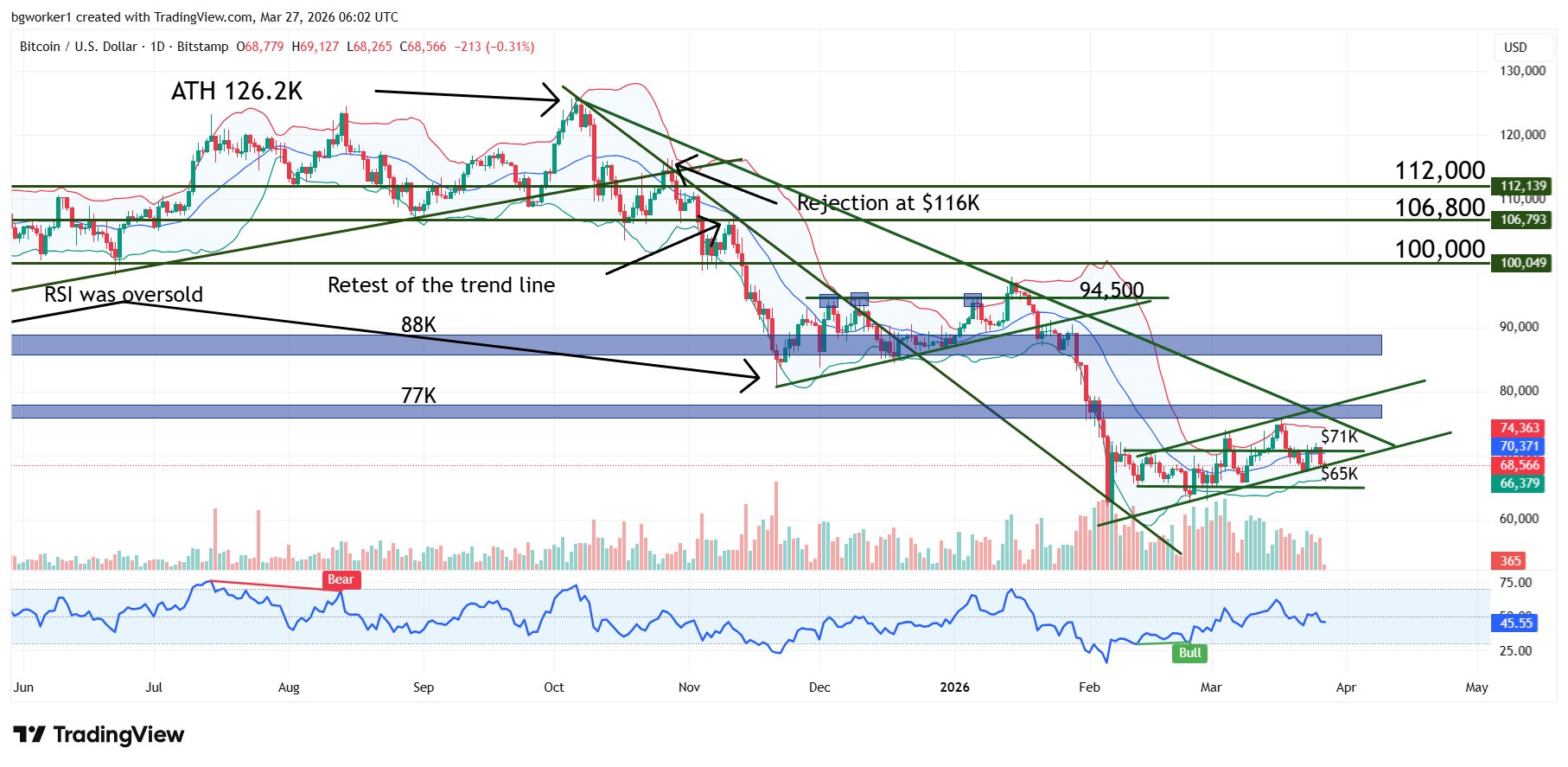
Bitcoin was rejected once more at resistance, and unless we see a vigorous break soon, it looks like the next destination is $65K support. After the low at $60K, reached on February 26, Bitcoin has been trading in a relatively tight range. A similar behavior was seen after a sharp drop in November 2025.
After that drop, BTC traded in a narrow range with an upward bias before dropping to new lows. This type of pattern is known as a bearish flag, and it can be observed during the current price action as well. A break of the lower part of the pattern could open the door for a much bigger drop than just $65K.
For a bullish scenario to unfold, we need to see a strong climb above $71K, sustained by momentum and volume. Such a move would open the door for $77K and above.