How to Trade Binary Options 1: The Foundations of Binary Options
Important: In this article series, we will focus chiefly on the traditional type of binary option, the one that is actually binary, i.e. only has two possible outcomes. In recent years, many binary options platforms have launched alternative products that are marketed as binary options even though there are actually more than two possible outcomes. This includes, among other things, the ladder option, which is a set of multiple binary bets at different price levels, each with its own risk/reward. There are also platforms where you, under certain circumstances, can close a binary option in advance to realize a profit or loss, which means the option is no longer really fixed in time. Add to this the platforms that offer traders rebates on losing binary options, and the situation gets even more complex.
However, to fully understand these new not-so-binary options and how they work, we need to start with the original binary option; the one that is truly binary (all-or-nothing) and comes with a pre-determined lifespan that can not be changed. This is still the most commonly purchased binary option on retail platforms and the common entry point for new traders interested in binary options. Unless otherwise indicated, the term binary option will, in this article series, refer to the conventional all-or-nothing binary option with a fixed timeframe.
Here’s where you are in our 10-step guide to trading binary options:
- The Foundations of Binary Options
- Regulatory Landscape and Safety
- Market Analysis I – Fundamental Drivers
- Market Analysis II – Technical Charting
- Technical Indicators for Binary Options Trading
- The Three Pillars of Binary Options Strategy
- Timeframes & Expiry Management
- Money Management & Probability
- The Psychology of Binary Trading
- Advanced Implementation & Tax Compliance
Introduction
Binary options look simple, but are easy to misunderstand. The structure feels clean: choose the underlying asset, direction, expiry, and stake. Wait for settlement. You know in advance exactly how much you will lose if you lose, and how much you will make if you profit.
Compared to more conventional forms of trading, e.g. stocks trading or spot forex, there are fewer moving parts on the screen. No position sizing matrix, no trailing stop logic, no Greeks, no margin call in the classic sense. The trade seems stripped down to a yes or no question, and this has proven to be very appealing to inexperienced traders.
The simplicity is real, but only at the surface. Underneath it sit several problems that can be difficult to notice and understand, especially for a trader without much experience. With a binary option, the trader is not just forecasting direction. The trader is forecasting direction within a fixed time window, against a strike set by the broker, and at a payout ratio that usually bakes in a negative expectancy unless the win rate is high enough to overcome it. A serious introduction to binary options needs to take the underlying math into account, even though that is certainly not what binary options marketing materials like to focus on.
Many of the stricter jurisdictions around the world have banned brokers from selling retail binary options, or put very strong limits on the practice. One example of the latter is Canada, where retail binary options are still allowed, but only when the lifespan is 30 days or longer. While the intention is consumer protection, the bans have also helped push retail traders in strict jurisdictions toward foreign binary options platforms, and the platforms that accept retail traders from strict jurisdictions are normally based in very lax offshore locations where trader protection rules are absent or not enforced.
This is therefore also something a prospective trader must take into account when considering risk. Can you find a binary options platform that is licensed within your own jurisdiction, and is that a jurisdiction with strong trader protection rules? Or will you need to introduce jurisdictional complexity by picking a foreign broker? Why sticking to properly licensed and supervised brokers are important is a point that we will look into more deeply later in this article series. With retail binary options, your “broker” is typically your counterpart in each trade, which means your loss is their gain and vice versa. Since the broker also controls the entire platform, including the price feeds, this built-in conflict of interest can lead to major financial losses for the trader when a broker is not properly supervised by a strict financial authority.
Binary options are not complicated in the way a butterfly spread or an iron condor is complicated. Their difficulty lies elsewhere. A conventional retail binary option will compress risk into a simple interface, fix the reward below the loss, and determine the exact lifespan of the position in advance instead of keeping it flexible. The screen looks simple, so the product is assumed to be simple and suitable for beginners. It is not.
Binary options are neither a secret shortcut nor an automatic scam by definition. They come with blunt settlement logic, structurally demanding payout math, and, in much of the world, an access path that runs through foreign brokers and weaker legal protections. Traders who choose to use them should at least know what game they are in and manage risk accordingly.
The All-or-Nothing Proposition
At its core, a conventional binary option is a derivative contract with only two possible settlement outcomes.
- If the contract expires in the required state, the trader receives a fixed return.
- If it does not, the trader loses the entire stake.
You can see a simple example of how this plays out below, where I placed a 30-second Buy/Higher trade on the Advanced Micro Devices stock. Because the price was lower at the 30-second mark, I lost my $10 investment.
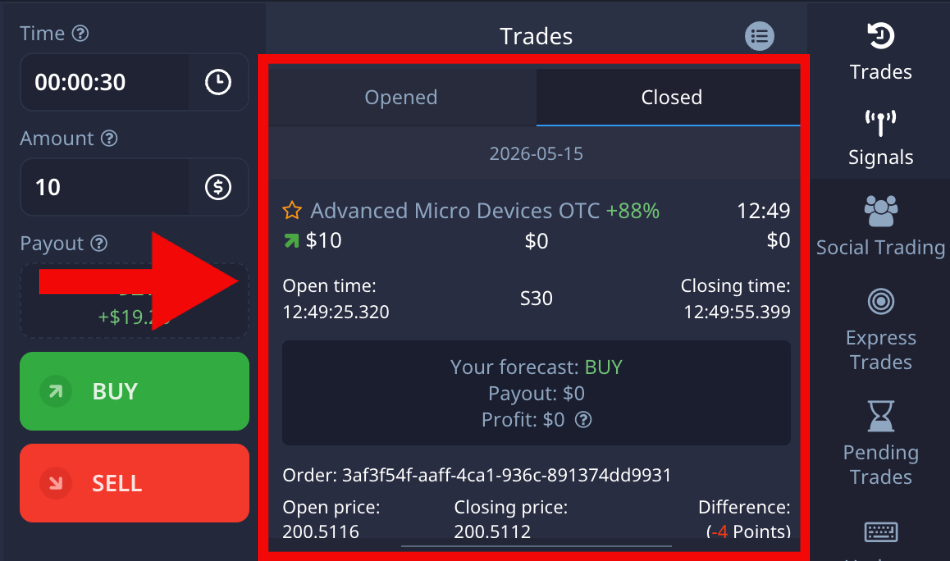
A losing trade in my binary options account resulted in me losing my $10 stake
Unlike spot trading, profit is not based on the size of the move after entry. A one tick win at expiry and a one hundred point win at expiry yield the same profit if both finish on the correct side of the strike. The same goes for losses: it does not matter if you are one tick wrong or one hundred ticks wrong, you will lose your entire stake either way.
Outside the world of binary options trading, outcomes are usually not binary. If you, for example, open a spot forex position, a very large number of outcomes are possible, including small profits and small losses. Distance will matter, and a 100 tick move in the right direction will be much more beneficial than a 1 tick move in the right direction.
With a standard binary option, only the final moment of settlement is important. Price can travel far in your favor, then reverse seconds before expiry, and the contract still settles as a full loss. You have no way to close the contract and realize the profit early. Price can also drift in the wrong direction or sideways for most of the trade and cross the line in the last second, and the contract settles as a full win.
This is one of the reasons why binary options often feel emotionally harsher than their simple interface suggests. The trade does not reward being mostly right, or being right about direction, but not at the exact moment. It rewards being right at the exact deadline, and everything that happens before that is unimportant.
The binary outcome is what gives the instrument its name. At expiry, the contract settles into one of two states. Settlement conventions, pricing source, and even the exact timestamp used can change results at the margin, which is why platform rules matter more here than many beginners expect. (Some brokers also allow an at-the-money result to settle as a push, meaning the stake is returned if the final price lands exactly on the strike, but this is the exception and not the rule.)
Fixed Risk
The fixed risk side is one reason the product continues to attract retail interest. The maximum loss is known in advance and limited to the amount paid for the contract. There is no open-ended downside of the kind seen in some leveraged products. That makes bankroll planning easier. A trader can say, with total clarity: “I am risking $50 on this trade”. That part is clean.
Of course, there is no need to use binary options to achieve this clarity. You can simply stick to trading without leverage. You can open a $50 spot forex position, use zero leverage, and know that you can not possibly lose more than the $50 you put on the line. If you buy $50 worth of Turkish lira, and the value of the Turkish lira by some miracle drops to zero before you decide to close the position, you have only lost $50.
The same is true for stocks. If you purchase $1,000 worth of Apple shares, you can not lose more than $1,000 on that position, not even if Apple files for bankruptcy and the stock price drops to zero.
Binary options marketing often highlights the fixed risk as a selling point, making the binary option sound like a sensible choice for beginners who want a capped downside. In reality, it is not. If you had opened a $50 stock position for a liquid stock, you could have put in a stop-loss order. The stop-loss orders automatically put the position out for sale if the stock price drops below the stop-loss order point. That way, you can get at least part of your money back, instead of suffering the complete loss that comes with a binary option that expires out-of-the-money.
Fixed Reward
The fixed reward side feels good to many beginners, but the odds are not in the trader’s favor. The broker quotes a payout, often as a percentage of stake. Example: If the payout is 80%, a winning $50 trade returns the original $50 plus $40 profit. If the trade loses, the trader loses the full $50. That imbalance matters. It means a trader can be right half the time and still lose money over a large sample.
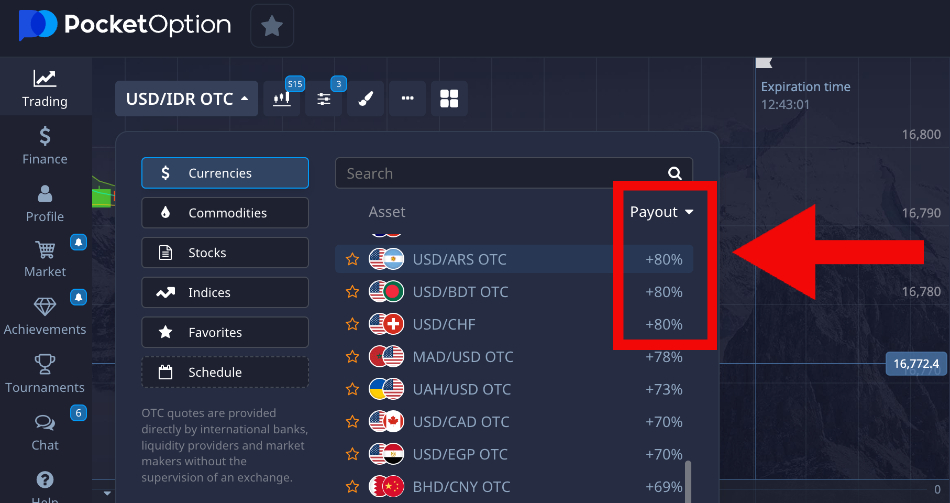
Pocket Option, like most binary platforms, shows the percentage payout before you place a trade
Further down in this article, we will look more closely at the math and why a conventional binary option is so beneficial for the platform. Each time the trader loses, the platform always gets 100% of the stake. When the trader wins, the platform only has to fork out the payout, which is typically in the 60%-90% range.
Would you like to play a game of toss-a-coin with a friend, where you lose $100 each time you lose, but only win $80 each time you win?
Strike Price
The strike price is the reference level set when the binary option trade is opened. On a call style binary (High Binary Option), the trader needs the underlying asset to be above the strike price at expiry. On a put style binary (Low Binary Option), the asset price must finish below the strike price for the trader to get paid.
The strike price at expiry is the thing that matters. Whether the market trends strongly, chops around, or spikes violently does not matter, as long as the price is above the strike price (for a High option) or below the strike price (for a Low option) at expiry.
This sounds obvious, though the practical point is easy to miss. Many losing binary trades are not bad market reads in a broad sense. The trader actually predicted the trend right, but the price did not climb high enough or low enough before expiry. Sometimes, just one pip makes all the difference.
Examples: A trader may correctly identify that EUR/USD is firm for the session, buy an upward binary with a 60-second expiry, and still lose, because the market needed 2 minutes instead of 1 minute to reach the necessary price point. Another trader may buy a daily expiry during a volatile headline event, see the trade move sharply into profit, and then watch a late reversal erase it by settlement.
The trade is always an argument about price and time, and the only time that matters with a conventional binary option is the exact expiry time. Settlement terminology is straightforward but worth stating clearly. A trade is in the money when the final settlement price is on the correct side of the strike. It is out of the money when it is on the wrong side. It is at the money when it lands exactly on the strike, and not every broker treats that state the same way. Some return the stake, but pay no profit. Some take your stake, since the terms stipulate that the price must be beyond this point for you to get paid. In a product decided by tiny margins, knowing the exact settlement rules is a necessary part of risk management.
Expiry Time
Expiry is the most unforgiving variable in the product. In traditional trading, time can often be renegotiated by the trader. A stop-loss order can be widened or exchanged for a trailing stop-loss, a take-profit target can be adjusted, a position can be carried, hedged, or partially closed. With conventional binary options, time is locked in from the start. You can not see that the market trend is moving in the right direction, and decide to keep the binary option open for a little longer.
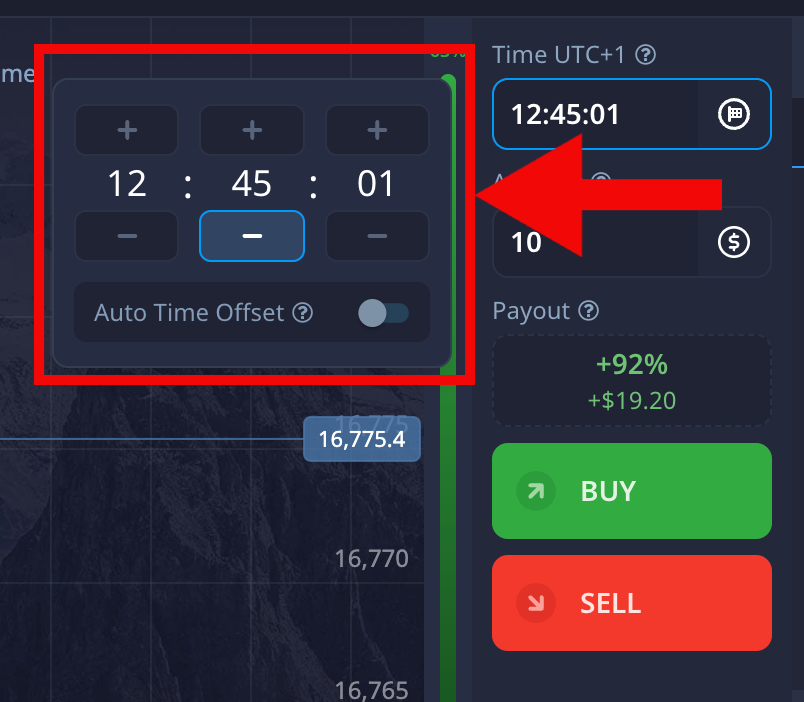
Most platforms allow you to toggle the expiry time or manually enter it within upper and lower limits
Short-term expiries, such as 30-second, 60-second, or 5-minute contracts, amplify noise. They are highly sensitive to spread changes, random ticks, order bursts, and short-lived volatility. The appeal is obvious. Feedback is immediate, position turnover is high, and the platform feels active. The problem is that micro timeframes have more influence on noise and execution quirks. The trader is no longer reading only direction. The trader is also trying to outguess the market’s shortest and messiest fluctuations. That is a rough game, and it is definitely not easy. Still, both novice traders and binary options sellers tend to favor these really short-term binary options, making the trading experience more similar to putting your money on red at the roulette table than actually predicting markets.
Longer expiries, such as hourly, daily, or weekly contracts, change the problem but do not remove it. Noise matters less than on a 60-second chart, but event risk matters more. Economic releases, earnings, central bank comments, political headlines, and overnight sentiment shifts can reshape the probability distribution before settlement. A longer expiry gives a thesis more room to play out, but it also gives the market more time to find reasons to disagree with it, and that is a problem for a position that can not be closed or reduced prematurely.
Price Feed
This is another detail that is more important than you might think. What is actually the source of the price feed on this platform? Where does it come from, how are prices determined, and how resistant is the feed to tampering?
Traders sometimes talk as if the market price is one universal thing. As if one particular price feed published by the World Trade Organization would be the one and only source of price on the financial markets, and those prices would be beyond repute. The reality is much messier than this, and the price feed used by the binary options platform might not match what you get from another source.
A binary option platform may, for instance, use its own feed, a liquidity provider’s feed, or a specific reference mechanism for settlement, and some platforms are deliberately vague about this. In fast markets, tiny feed differences can matter, especially since it is ONLY the price exactly at expiry that matters for a conventional binary option. Arguments over “the chart was higher on another site” rarely go anywhere useful. The only chart that settles the contract is the one defined in the broker’s rules.
This also introduces additional risk, because the brokerage company in charge of the trading platform is also in control of the price feed. Even if it comes from an external source (it usually does), the entity that controls that platform can make minute changes to the price feed. With binary options, simply delaying the feed a few seconds can be enough to turn your profit into a loss, and these minute manipulations are notoriously difficult to notice and even harder to prove. This is yet another reason why it is so important to use a trading platform supervised by a strict financial authority that actually has the legal powers to audit platforms and enforce trader protection rules.
Underlying Asset Classes
Many binary options platforms offer binary options on four main asset groups:
- Forex pairs
- Stock indices
- Commodities
- Individual stocks.
Asset choice changes the nature of the mistake a trader is likely to make. In forex, the common error is overconfidence in very short-term noise. In indices, it is underestimating how fast macro sentiment can reverse. In commodities, it is confusing volatility with clean directional opportunity. In single stocks, it is underestimating event complexity and assuming that “good news equals up” or “bad news equals down” on a predictable schedule.
To become skilled, specialization is usually necessary, especially in the beginning. Do not think you will somehow master all asset classes from the get-go. A common beginner mistake is to jump at every opportunity. Spotting an opportunity and actually turning it into a profit are two very different things.
Forex Pairs
Forex pairs are the most common starting point because they are liquid (especially the major pairs), widely quoted, and available across most trading hours during the business week. Major FX pairs such as EUR/USD, GBP/USD, and USD/JPY have very high liquidity, which often leads to more attractive percentage payouts and deeper underlying markets. Minor forex pairs have less liquidity, and for the exotic pairs, it is even lower.
For binary traders, forex majors are often preferred because their trading rhythm is easier to observe and because the market is less prone to sudden structural gaps than single-name stocks. Major FX pairs tend to be the most stable pairs, but even major pairs can become disorderly around central bank releases, inflation prints, labor data, and geopolitical shocks. Minors and exotics can offer larger intraday moves, but they also bring wider pricing and lower liquidity. The payout percentage for binary options based on minors and exotics is often high, but it is because the markets are more difficult to predict.
Individual Stocks
Individual stocks are impacted by both wider market sentiment and factors pertaining to the specific company, industry, or geography. Earnings releases, guidance revisions, product announcements, regulatory headlines, analyst calls, buybacks, and management comments can all move a single stock sharply.
That creates a clear use case for binary options: a trader may not know how far Apple, Tesla, or NVIDIA will move after earnings, but may want to express a view that the first reaction will be up or down by a certain cutoff. But single-name event trading is crowded with professionals and advanced algo bots, and stocks can reprice very quickly. The binary trader often arrives late, pays a broker-defined price, and still faces gap risk in sentiment between now and expiry.
Stock Indices
Stock indices sit one level higher. Instead of trading a single company, the trader is taking a time-bound directional view on a basket that reflects a wider economy or sector. Contracts linked to the S&P 500, Nasdaq 100, DAX 40, FTSE 100, or Nikkei 225 often react to macro data, rate expectations, earnings season, and broad risk sentiment.
For some traders, this makes index binaries easier to frame. You are not asking whether one company’s guidance will shock the tape. You are asking whether the index as a whole is leaning risk on or risk off across a defined window. The catch is correlation. Indices can move cleanly for hours, then turn hard on one surprise data point or policy comment. On short expiries, they can be brutally whippy. On longer expiries, they often reflect macro narratives more clearly.
Commodities
Commodities bring a different profile. Gold and oil are the obvious examples because they are widely offered and respond to distinct drivers. Gold often trades as a rate-sensitive, USD-sensitive risk barometer and, at times, as a safe haven. Oil responds heavily to growth expectations, inventory data, supply decisions, transport disruptions, and geopolitical stress. Both can produce sharp directional moves, which binary platforms naturally market as opportunities.
That is true, but the same volatility that makes a chart look tradable also makes settlement more fragile. Commodity binaries can look easy after the fact because the chart later shows a decisive move. In real time, the path is often noisy and mean-reverting before the break arrives.
The Math of the Payout: Expected Value
This is the part that should come before strategy, not after it. Binary options are often presented as a way to earn big profits quickly. Why hope for an index to go up 3% when you can buy a binary option and make an 80% profit in 2 minutes? But before you get swept away by this, you really should do the math to give yourself a clear picture of how frequently you need to be right to make a profit from binary options trading over time.
The clean way to analyze a binary trade is with expected value.
Expected value = (Pwin × Profit) − (Ploss × Stake)
Pwin is the probability of winning, Ploss is the probability of losing, Profit is the net gain on a win, and Stake is the amount lost on a loss. Since Ploss = 1 − Pwin, the whole problem comes down to whether the payout compensates you fairly for the chance of being wrong.
Take a common setup. A broker offers an 80% payout. You stake $100. If you win, you make an $80 profit. If you lose, you lose $100. Suppose your win rate is exactly 50% over a large sample. Your expected value is:
EV = (0.5 × 80) − (0.5 × 100) = 40 − 50 = -10
On average, you lose $10 per trade for every $100 risked. That is the part many newcomers miss because the product feels balanced. It is not balanced. When the loss side is larger than the win side, a 50% hit rate is not enough to break-even.
The break-even win rate can be written simply as:
W = 1 / (1 + payout ratio)
If the payout ratio is 0.80, then:
W = 1 / 1.80 = 0.555…
So with an 80% payout rate, the trader needs to win about 55.6% of trades just to break-even. At a 70% payout rate, the break-even rate rises to about 58.8%. At 60%, it is 62.5%. The lower the payout, the less room there is for ordinary noise and human error.
This is where the phrase “house edge” enters the discussion. It is a structural feature of how many retail binary contracts are priced. The broker does not need you to be wrong all the time. The broker only needs the payout schedule to be less favorable than the true fair odds available to you.
None of this means that no trader can ever produce a positive sample in binaries. It only means the threshold is higher than the product’s simplicity suggests.
Okay, so why not just stick to binary options with a 95% payout rate?
High payout rates exist, and they are common in marketing material, but you need to look carefully at the details. A platform advertising 90% or 95% payouts is not being charitable. The richer payout is usually attached to contracts, assets, or moments where the pricing risk is nastier, liquidity is thinner, or volatility is higher.
A trader can be lured by the high payout and miss the fact that the setup itself has become much harder to model.
Overtrading
Overtrading is when a trader takes more trades than their strategy, discipline, or statistical edge can support, often leading to random or emotionally driven entries rather than planned ones. Instead of waiting for clear conditions in the market, the trader keeps clicking into positions repeatedly, sometimes because of boredom, frustration after losses, excitement after wins, or the feeling that more activity will somehow improve results.
Inexperienced traders are especially prone to this because they usually do not yet have a tested system that defines when not to trade, so their decision-making is driven more by impulse than structure. They also tend to misunderstand randomness in markets, interpreting short winning streaks as skill and short losing streaks as something that must be corrected immediately by “trading back” losses.
Overtrading is definitely not limited to the world of binary options, but it can be extra dangerous here because of how the payout structure affects expected value. As we looked at higher up in this guide, you would be risking $100 to possibly profit $80 on a binary option with an 80% payout rate. You therefore need to be right more than 50% of the time to just break even.
When the expected value is negative, overtrading accelerates losses. The more trades a person takes in this environment and with this mindset, the more closely their results converge toward the underlying negative expectancy of the system. This is why increasing frequency does not help, but instead compounds the disadvantage over time.
If you pick one of the binary options platforms that are designed more like a casino than a trading platform, the risk of overtrading increases. These platforms tend to push binary options with extremely short lifespans and strongly market instant re-entry after each outcome. This creates a feedback loop where the trader is constantly exposed to the urge to “try again”, and this is similar to rapid betting cycles in casino environments. The speed of results reduces reflection time, and the simplicity of choosing up or down removes structural barriers that might otherwise slow down decision-making. As a result, inexperienced traders are not only more likely to overtrade psychologically, but are also placed in an environment that continuously encourages quick repetition.
Learn more about why the responsible trading of binaries is vital.
Global Market Reality: The Offshore Landscape
The modern binary options discussion cannot be separated from regulation. In the European Union membership countries, brokers are banned from marketing, distributing, and selling binary options to retail clients. Around the world, many other countries have enacted similar bans, including the United Kingdom, Israel, and Australia.
There are also countries that have put limitations on using slightly different constructions, e.g. Canada, where retail binary options must have lifespans of at least 30 days, and the USA, where binary options can only be legally traded on formal exchanges that hold the right permits.
When the stricter jurisdictions banned retail binary options, retail traders could no longer use binary options brokers based in and supervised by those stricter jurisdictions. Many of the companies that wanted to keep selling retail binary options did not opt for a move to second-tier jurisdictions, since those jurisdictions could still have a problem with the companies marketing their options to consumers in countries with bans. Instead, they moved to so-called offshore paradise locations where brokerage supervision and trader protection rules are really lax. In these locations, they do not run into trouble with the authorities even though they are marketing their options heavily towards consumers in countries where bans are in place.
Many retail traders who still trade binary options are now doing it on platforms owned by companies registered in jurisdictions such as Vanuatu, the Seychelles or St. Vincent and the Grenadines. This is a part that should be discussed plainly. Foreign access exists, even for consumers living in countries with prohibitions. It is common. It also changes the risk profile in ways that beginners often underweight.
Legality
In many countries (but not all) with binary option prohibitions, the onus is placed on the broker. It is illegal for the broker to market, distribute and sell retail binary options. It is not illegal for a retail trader to buy. This distinction is important to remember. Some brokers use it to make it seem like what they are doing is above board. In essence, they are saying: “Buy binary options from us. It is not illegal for UK traders to buy binary options from this platform”. An inexperienced trader can easily think that this means the broker is actually authorized to sell retail binary options in the UK.
It is also important to note that a court can consider retail binary options gambling products instead of financial products. The relevant gambling laws can therefore apply, including any prohibition that makes gambling illegal for both the gambler and the provider. Right now, this stance is typically not enforced in any country, but there are several countries where we can see a tendency to move closer to this application, particularly countries where the legal system is strongly influenced by Sharia law and gambling is haram.
Trader Protection Rules
If you use a binary options broker based in a jurisdiction where trader protection rules are weak, you lose a lot of the protections that exist in stricter jurisdictions.
This becomes especially important when your broker is also your counterpart in the trades, which is typically the case on retail binary options platforms online. This model creates an obvious conflict of interest. Your payout is their expense and your loss is part of their revenue model.
A broker also being your counterpart is not automatically a bad thing. It is actually quite common among brokers that accept small-scale traders. But it is important that the firm manages the conflict through transparent rules, proper risk management, and clear settlement procedures, and that a strong financial authority is keeping an eye on the firm. In lax jurisdictions, the risk of falling into the hands of a sketchy broker is much higher.
Supervision, Auditing and Enforcement
Having strict trader protection rules on the books is not enough. There also needs to be a financial authority (or equivalent) that actually supervises and audits brokers, and takes complaints from traders seriously. The financial authority and the wider legal system must be able to actually carry out deep investigations and enforce the rules, and being caught breaking the rules must be painful for the broker. Without all these things in place, you only have a bunch of laws and rules that lack teeth and won’t actually keep brokers in line.
Brokerage Company Insolvency
What will happen to the money in your account if the broker becomes insolvent? In stricter jurisdictions, brokers are typically required to keep client funds segregated from company funds. In case of company insolvency, it will be easier to pay back the money to each client, since the funds have not been co-mingled. Many of the stricter jurisdictions also have an investor protection scheme in place, which means retail traders within that jurisdiction can be compensated (up to a certain amount) if they lose money because a locally licensed broker fails to honor its obligations.
Before you sign up with a broker, it is important to look up if money segregation is mandatory, if an investor compensation scheme exists, and if this scheme actually covers you. Without these protections in place, it is not advisable to keep more than the bare minimum sitting in your trading account.
Common Terminology and Professional Jargon
- Counterparty risk: Counterparty risk is the risk that your counterpart (in this context, your binary options broker) does not honor its obligations.
- Directional trade: Any trade based on predicting up or down movement (core of binary options).
- Early exit feature: An early exit feature allows the trader to close the position before expiry for a partial gain or partial loss. In theory, this adds flexibility and lets the trader manage risk dynamically. In practice, the quoted early exit value is set by the broker and can be poor during volatile conditions. It is useful to have, but it should not be confused with the cleaner exit mechanics of exchange-traded products.
- Edge (trading edge): A statistical advantage that makes long-term profit possible.
- Fakeout: In technical analysis, the fakeout is a short-lived price move that breaks a resistance or support level but reverses quickly.
- Knock-on effect: Market reaction triggered by news or major price movement in another asset.
- Noise (market noise): Random price fluctuations that do not reflect the real trend direction.
- Rebate: A rebate is a partial return of stake on a losing trade. Some brokers offer this on selected contracts. It softens the loss, but traders should not treat it as generosity. The contract will usually be priced with that feature in mind. A 10% rebate on losses may reduce variance, though it does not magically turn a bad setup into a good one.
- Tick: Smallest price movement in an asset.
- Zero-sum perception (misleading concept): Binary options are often incorrectly perceived as zero-sum products. In reality, the broker’s payout structure means it is usually negative-sum for traders since stake loss is 100% and payout ratios are less than 100%.
Binary Option Variants
The most common type of binary option is the High/Low binary option, also known as the Call/Put binary option. You buy a High (Call) binary option if you believe the asset price will be above the strike price at expiry, and you buy a Low (Put) binary option if you believe the asset price will be below the strike price at expiry.
Today, many binary options platforms are also offering other types of binary options that deviate from the standard format in various ways. It is always important for traders to understand exactly which type of binary option they are buying, and also exactly what the terms and conditions are on this specific platform. Two binary option types advertised under the same name at two different platforms can have widely different rules of operation.
Below, we will take a look at a few alternatives to the High/Low binary option. These variants differ from classic high/low binaries mainly in how they define the winning condition. For the examples below, it is not only the asset price at expiry that is important; how the price moves during the entire duration of the option is also important. This creates a very different dynamic. These variants are all less widely supported on trading platforms these days – we’ve observed them drop off many platforms over the years.
| Name | How It Works | Example | Who It Suits |
|---|---|---|---|
| High/Low | Predicts price vs. strike at expiry. | Gold > $2,000 at 4 PM. | Trend followers. |
| One-Touch | Price must hit target once before expiry. | Hits $50 at any time. | Volatility hunters. |
| No-Touch | Price must never hit target level. | Avoids $100 entire session. | Stability hunters. |
| In-Range | Price stays within a set “tunnel.” | Stays between $1.05–$1.10. | Sideways markets. |
| Out-of-Range | Price breaks out of the “tunnel.” | Jumps above $15 or below $5. | News traders. |
| Ladder | Multiple strikes with a payout that scales with distance. | Higher return at every $5 jump. | Aggressive traders. |
One-Touch
In this type, the trader does not need the price to remain above or below a certain level at expiry. Instead, the asset price only needs to “touch” a predetermined level at any point before expiration for you to get paid. This makes it very different from high/low binaries because the outcome depends on whether a price level is reached at any time during the contract, not where it finishes. This often increases the probability of a payout, but usually comes with adjusted pricing to reflect that.
No-Touch
This is essentially the opposite of the one-touch option. With a no-touch, the trader profits if the price does not reach a specified level at any time during the contract period. Compared to high/low binaries, this shifts focus from direction to volatility control, because stability or lack of movement becomes the winning condition rather than directional prediction.
In-Range
In-Range binary options are also known as (in) boundary options or (in) range-bound binaries. In these contracts, the trader predicts that the price will stay within a defined range and never break out of it during the lifespan of the option. This differs significantly from high/low because success depends on low volatility behavior during the entire contract and not on a single directional outcome at expiry.
Out-of-Range
This is the opposite of the in-range binary. With an out-of-range binary, the trader predicts that the price will not stay within a defined range. You get paid if the price breaks out of the range during the lifespan of the option, and it does not matter if the breakout occurs at the top of the range or at the bottom. Just as with in-range binaries, success depends on volatility behavior rather than a single directional outcome at expiry. Out-of-Range binaries are also sold as (out) binary options or (out) range-bound binaries.
What Is A Ladder?
This is a more complex product because with a ladder, multiple strike levels exist with different payout tiers. The further the price moves in the predicted direction, the higher the payout. This introduces a scaling reward structure that is absent in classic binaries. While the ladder is marketed as a binary, it is strictly speaking not a binary since there are more than two possible outcomes.
What Is An Early Exit Binary Option?
An early exit binary option is a binary option that lets you close the trade before its expiry time instead of waiting for the final yes/no outcome. Any type of binary option can be offered with this added feature.
With an early exit feature, the platform allows you to close your position before expiry and receive a partial payout or reduced loss, depending on market conditions. Example: You stake $100 on a binary option with an 80% payout rate. Before expiry, the trade is going your way, and the platform offers you an exit for $130 instead of waiting for $180. If the trade is not going your way, you might instead be offered to exit for $40 and lose $60 instead of the full $100.
Still, it is not the same as actually using stop-loss and take-profit orders, since you can only act when offered by the platform, and you have to accept whatever the terms are if you want to go through with the early exit.