Binary Options Trading in Nigeria
Binary options trading is not offered through regulated markets in Nigeria. There are no locally licensed binary options brokers operating under the country’s financial regulators, including the Securities and Exchange Commission of Nigeria.
Many Nigerians trade binaries through offshore platforms. International brokers continue to accept clients from Nigeria, often with low minimum deposits, mobile-friendly platforms, and fast onboarding. This has made binaries popular with retail traders in Nigeria looking for short-term trades and simple outcomes.
The trade-off is regulation. Because these platforms operate outside Nigeria, there is no Nigerian capital-market oversight of the binary provider nor domestic investor protection. As a result, Nigerian traders rely more on broker reputation, payment reliability, and personal risk control than on formal safeguards.
Best Binary Options Brokers in Nigeria
Based on our hands-on tests, where we opened accounts and placed trades on their platforms, these are the top binary options platforms for Nigerian traders. However, it’s important to remember that accepting Nigerian residents does not equal authorization in Nigeria.
| Broker | Min Deposit | Expiry Times | ||
|---|---|---|---|---|
 |
CloseOption | $5 | 30 seconds - 1 month | » Visit |
 |
Capitalcore | $10 | 1 minute - 1 hour | » Visit |
 |
AZAforex | $1 | 30 seconds - 1 day | » Visit |
 |
Crypto.com | Varies by payment method | 5 minutes to event cutoffs, can be hours, days and longer depending on contract | » Visit |
 |
Binarium | $5 | 60 seconds - 3 months | » Visit |
Visit
What Are Binary Options?
Binary options are simple, fixed-outcome trades. Each trade comes down to one question: will the price of an asset finish above or below a set level when the trade expires?
- If the prediction is correct, the trade pays a fixed return, often shown as a percentage of the initial take.
- If it’s wrong, the stake is lost.
There’s not usually any partial profit or loss, nor exposure beyond the amount placed on the trade.
Platforms typically offer short expiry times, clear Buy and Sell (Call and Put or High and Low) buttons, and payouts that are shown upfront before a trade is placed. Once a position is opened, it usually runs until expiry and can’t be closed early, though some platforms offer early close or similar features.
Binary options are often used for short-term speculation on markets like forex, indices, commodities, or cryptocurrencies. The mechanics are easy to understand, but the all-or-nothing structure means results can change quickly, especially on very short timeframes.
An Example Trade
To show how binary options trading works in practice, here’s an example using Pocket Option. I selected the Nigerian naira/US dollar and set the expiry time to 4 hours.
The decision was simple: would the price finish higher than the current level when the timer ran out?
As you can see below, I placed a Call (Buy) trade, expecting a short-term rise, and risked $25. The platform displayed a 92% payout upfront, meaning a winning trade would return $48 in total.
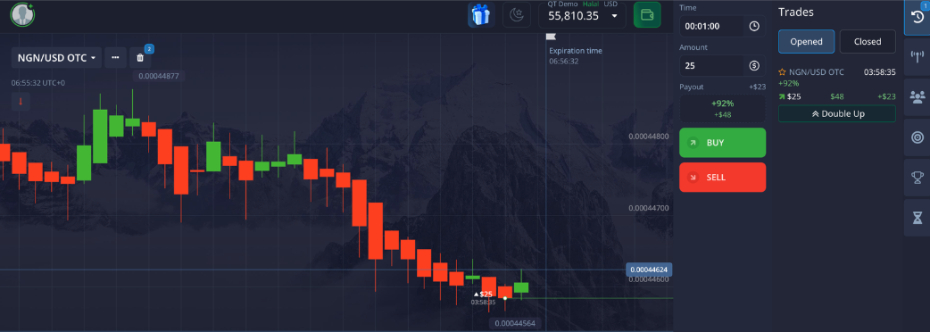
Pocket Option – NGN/USD Chart
Once the trade was placed, there was nothing to adjust. In this case, the move went my way, and I banked profit. The price finished above my entry level at expiry, the trade settled in the money, and the full $48 return was credited instantly.
This example highlights both sides of binary options. The outcome was clear, fast, and settled the same day, with risk capped from the start.
At the same time, the result hinged entirely on short-term price movement, which is why this style of trading can swing very quickly in either direction.
Also note that advertised payouts can vary based on market conditions and asset.
Can I Trade Nigerian Assets With Binaries?
From Nigeria, you can’t trade binary options on Nigerian-listed stocks or local indices – we checked every platform in our binary broker database. Assets listed on the Nigerian Exchange (NGX) are not offered as true binary contracts on offshore platforms.
However, some platforms do offer binaries on currency pairs that contain the Nigerian naira (NGN), typically NGN/USD. These are very rare though, and as of our latest check, Pocket Option and Quotex are among the only platforms offering binaries on NGN forex pairs.
What is widely available instead is indirect exposure via global markets that are popular with Nigerian traders and active during local trading hours. In practice, that usually includes:
- Major forex pairs such as EUR/USD, GBP/USD, and USD/JPY
- Global indices like the US 500 and US 30
- Commodities, including gold and crude oil
- Cryptocurrencies on some platforms
Some brokers may label assets with regional names, but these are typically synthetic products, not contracts linked to Nigerian companies or the NGX.
So while Nigerian traders can access a wide range of international markets using binary options, there is no direct way to trade Nigerian stocks or indices via binaries.
Can I Open a Binary Account in Nigerian Naira?
Most aren’t, no. Binary options platforms used by traders in Nigeria generally do not offer NGN (Nigerian naira) as a base account currency. The exceptions from our investigations are Quotex and Pocket Option, which either let you select NGN as the base currency when you sign up for an account, or you can switch to it once you have a profile.
Still, binary accounts are usually held in US dollars, and sometimes in euros or cryptocurrencies, depending on the broker. In practice, this means deposits made in naira are converted before they reach the trading account.
Banks, card providers, or payment processors handle the exchange, though sometimes the broker does. The same process applies when withdrawing funds back to a Nigerian bank or wallet.
Some platforms also advertise local-friendly payment methods. For example, Pocket Option offers NGN payment solutions like PalmPay, catering to Nigerian residents.
Which Binary Options Brokers Offer Support in English for Nigerian Traders?
English-language support is standard across most binary options platforms used by traders in Nigeria. Platforms, help centres, and account dashboards are typically in English, and live chat and email are the main support channels.
But most of the binary platforms we’ve tested don’t offer support in other indigenous languages spoken in Nigeria, such as Yoruba and Igbo. That said, Quotex does provide website interface language in Hausa, which you can see below, specifically serving Nigerian traders.
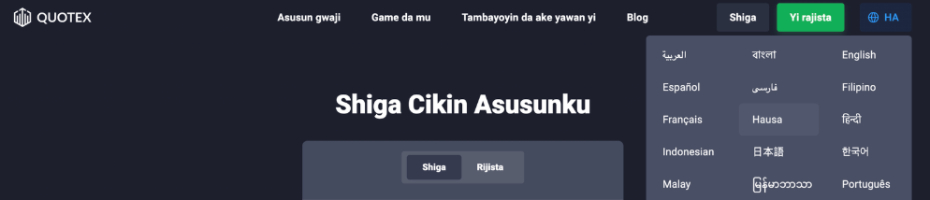
Quotex Website in Hausa
In practice, the difference between brokers isn’t language availability but how responsive support is, especially for withdrawals, verification, or account restrictions. Because these platforms operate offshore, customer support is often the only route to resolving issues.
Is Binary Options Trading Legal in Nigeria?
There is no framework that allows binary options to be offered through Nigerian exchanges, and there are no locally licensed binary options brokers operating under Nigerian financial regulators such as the Securities and Exchange Commission Nigeria.
Nigerian authorities have also issued warnings in the past about unlicensed online trading platforms, including binary options websites, particularly where products are marketed to retail traders without oversight.
Despite this, many Nigerians still access binary options through offshore platforms. These brokers operate outside Nigeria and are not subject to local supervision. While accounts can usually be opened and funded from Nigeria, traders do not receive any domestic investor protection.
In practical terms, binary options trading in Nigeria is accessible, but it’s not authorized as a capital-market product and there’s no SEC investor protection covering the contract. Anyone considering trading binaries from Nigeria should understand this distinction before committing funds.
Is Binary Options Trading Taxed in Nigeria?
Profits from binary options trading may be taxable in Nigeria. From a Nigerian tax perspective, what matters is whether income is earned. Any profits made from offshore trading platforms are generally treated as taxable income and fall under the rules of Nigeria Revenue Service, known as the NRS, which handles federal taxes, alongside the relevant state internal revenue service, which focuses on individual taxes.
How profits are classified can depend on individual circumstances, such as how frequently trades are placed and whether trading forms a regular source of income. Because binary options are not recognized as regulated investment products in Nigeria, profits may be treated as personal income rather than capital gains.
Since brokers used by Nigerian traders operate offshore, there is no automatic reporting to Nigerian authorities. Platforms do not provide Nigeria-specific tax statements, which means traders are responsible for keeping their own records of deposits, withdrawals, profits, and losses.
Tax rules can change and enforcement varies, so this section is general information only. Traders should consult a local tax professional or refer directly to guidance from the Nigeria Revenue Service.
Getting Started
Getting started with binary options from Nigeria is straightforward in practice:
- Choose a Broker: Most Nigerian traders often use well-known international platforms. But because none are licensed locally, it’s important to look beyond marketing claims and focus on platform reliability, withdrawal history, and support responsiveness.
- Deposit Funds: Deposits are usually made via cards, e-wallets, or sometimes cryptocurrencies. Funds deposited in naira are often converted before reaching the trading account, which is typically held in US dollars. Starting with a small deposit helps reduce early risk.
- Learn the Platform: Binary options platforms are simple to use – we know we’ve spent hundreds of hours using them, but small details matter. Spend time understanding expiry times, payout percentages, risk management, and how prices behave as expiry approaches. Demo binary trading accounts are helpful for getting comfortable without risking real money.
- Place Your First Real Trade: When moving to live trading, most experienced traders keep trade sizes small and sessions short. They might keep a trading journal and look to trade responsibly. Because outcomes are all-or-nothing, discipline and position sizing tend to matter more than trade frequency.
FAQ
Is Binary Options Trading Legal in Nigeria?
Binary options are not regulated or approved in Nigeria, and there are no locally licensed binary options brokers. Nigerian regulators, like the Securities and Exchange Commission of Nigeria have warned about unlicensed online trading platforms.
Can Nigerian Residents Trade Binary Options With Offshore Brokers?
Yes. Many offshore platforms accept Nigerian traders, but they operate outside Nigerian regulation and offer no local investor protection.
What Payment Methods Do Nigerian Traders Usually Use?
Nigerian traders typically use cards, e-wallets, and sometimes cryptocurrencies. Some firms we’ve tested, such as Pocket Option, cater to Nigerian traders with NGN payment solutions like PalmPay.
Can I Trade Nigerian Stocks or Indices Using Binary Options?
No. Nigerian-listed stocks and NGX indices are not available as binary contracts from our investigations, which involved us logging into the platforms of firms in our directory and looking for NGN-focused assets.
Instead, Nigerian traders often use binaries to trade global markets, including forex, gold, oil, and major international indices. Some binary websites offer NGN currency pairs too.
Is It Safe to Trade Binary Options in Nigeria?
Binary options are high-risk products, and trading from Nigeria adds extra risk because platforms are offshore and unregulated locally. Careful broker selection, small trade sizes, and strict risk control are essential.