Low Minimum Deposit Binary Options Brokers 2026
Choosing a broker with a low minimum deposit is one of the most accessible ways to start trading binary options without committing too much capital. When we began testing binary firms years ago, dropping $250 or $500 into an unfamiliar platform felt over the top and risky, but was sometimes required. Today, many brokers require deposits of under $50.
Below is a list of the lowest deposit binary options brokers. Every provider has been personally vetted by our testing panel, which comprises experienced binary traders and industry experts.
Top Low Deposit Binary Options Platforms
| Broker | Min Deposit | Expiry Times | ||
|---|---|---|---|---|
 |
AZAforex | $1 | 30 seconds - 1 day | |
 |
World Forex | $1 | 1 minute - 7 days | |
 |
Binarium | $5 | 60 seconds - 3 months | |
 |
CloseOption | $5 | 30 seconds - 1 month | |
 |
Deriv | $5 | 15 seconds - 365 days | |
 |
Pocket Option | $5 | 3 seconds - 4 hours | |
 |
Capitalcore | $10 | 1 minute - 1 hour | |
 |
GC Option | $10 | 1 minute - 48 hours | |
 |
Quotex | $10 | 5 seconds - 4 hours | |
 |
OlympTrade | $10 | 5 seconds - 23 hours | |
 |
ExpertOption | $10 | 5 seconds - 24 hours | |
 |
Binomo | $10 | 1 minute - 60 minutes | |
 |
IQ Option | $10 | 60 seconds - 1 month |
Visit
Why New Traders Should Choose A Low Deposit Broker
Lower Barriers to Entry
Most beginners hesitate at the idea of committing hundreds of dollars to a broker they’ve never used. A low deposit limit removes that barrier.
Starting with a binary account that requires just $1–$50 changes the starting hurdle; you can explore the interface, test expiry times, understand how trades confirm, and get a sense of execution without risking serious sums.
Learning the Platform Without Big Risk
Most binary platforms are different. Some require multiple clicks to open a trade, others have odd expiry increments, and some delay confirmations during volatility. A small balance lets you experiment with less cash at risk.
It also reveals subtle quirks you may never notice in a demo environment:
- Do prices refresh instantly?
- Does the expiry countdown behave predictably?
- Are there sudden “greyed out” periods during market spikes?
You only discover these things live, and low deposits make that affordable.
Testing Your Strategy and Your Broker
Before you trust a broker with real funds, you want answers to two things:
- Does your binary strategy work on this platform?
- Does the broker pay out when you request a withdrawal?
Avoiding Psychological Pressure
Bigger deposits produce bigger expectations – I know this from my own experience trading binaries with real money.
Traders often feel the need to justify their investment and often push themselves into poor decisions. Low deposits keep your expectations reasonable, your stress levels low, and your focus sharp.
Don’t forget, at this level, you’re not trading to make money, you’re trading to build structure, so developing a resilient mindset is key.
What Counts as a “Low” Deposit in 2026?
- We analyzed minimum deposits across every provider in our around 20-strong binary broker database. The average minimum deposit is roughly $110, with a median of $10.
- Minimum deposits in our directory range from $0 to $1,000. The low end reflects firms like AZAforex at $1, while the high end reflects Dukascopy at $1,000.
- Low-deposit brokers make up most of our directory: around 13 have minimum deposits of under $50, including entry points of $1, $5, and $10 at several platforms.
- Only a handful still require higher starting balances, such as multiple $250-minimum brands like BinaryCent, which push the average up despite a low median.
We’ve put minimum deposits into three categories:
| Deposit range | Positioning | Notes |
|---|---|---|
| $1–$50 | True beginner-friendly low deposit | Entry-level for new traders |
| $50–$100 | Mid-tier | For users ready to step up modestly |
| $250+ | Premium or aggressive-upgrade accounts | Often tied to enhanced perks like boosted maximum payouts |
Pro tip: The first group is where beginners should start.
Payment Method Differences
We’ve noticed some platforms advertise “$5 deposits,” but only for crypto. Bank cards or e-wallets may require $20–$50. Always check the real minimum for your chosen payment method.
As an example, below is a screenshot I took in the Pocket Option payment area, which shows the ‘Min’ deposit can vary by payment method, e.g. it’s $20 by Visa and Mastercard, $5 through ByBit, and $30 via Tether (TRC-20).
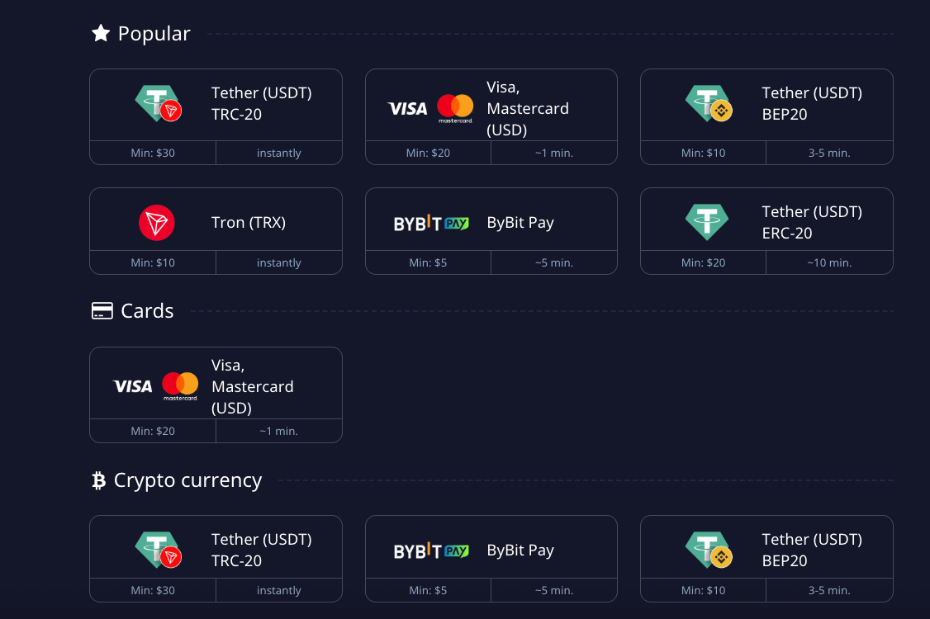
Pocket Option – Cashier Portal
How to Choose a Safe Low-Deposit Broker
- Licensing: Regulated brokers typically offer safer environments but higher deposits. Offshore platforms, which account for most binary providers these days following a wave of regulatory restrictions in the late 2010s and early 2020s, are more accessible but require more scrutiny and safety precautions. For example, they don’t generally provide access to statutory mandated investor compensation schemes. Deriv is a good blend of accessibility and reputation with a wider regulatory structure for its traditional financial products, although its binaries are offered through offshore entities.
- Payout Consistency: We monitor payouts throughout the day when we test binary firms. Reliable brokers keep payouts steady; weaker ones drop payouts during quiet hours. We also test whether payouts differed based on deposit type. We’ve found low deposit binary firms like Pocket Option keep payouts consistent. Weaker brokers sometimes lower payouts for card-funded accounts.
- Small Withdrawal Testing: To test a provider carefully, we suggest placing some low-value trades and then immediately attempting a partial withdrawal. If the broker struggles to return $10–$15, you know not to deposit more.
- Bonus Traps: Low-deposit traders are the main targets for bonus traps like deposit matches, risk-free trades, or cashback programs. They sound appealing, but often lock your funds behind wagering requirements where you have to place a certain number of trades before you can request a withdrawal. This can encourage overtrading so caution is needed. It’s also why many tier-1 regulators have banned such incentives for retail investors.
- Platform Stability: Deriv and Pocket Option offered the most stable feeds during our tests, especially around volatile events, making them appealing to newer traders with less starting capital.
- Minimum Trade Size: A $10 deposit means nothing if the smallest trade is $10. For those starting out, consider sticking to brokers offering $1 trades, which is the majority of the low-deposit platforms in our toplist.
A Trading Plan for a $1–$50 Account
- Safe Position Sizing: Aim for a very small percentage of your portfolio, e.g. 1–2% per trade, which is a popular approach in traditional financial markets. Small enough to survive losing streaks, large enough to learn.
- Best Expiries for Beginners: Expiries of hours or days offer more structure and clarity than ultra-short expiries, such as those that are 60 seconds or less, which can be emotionally stressful and harder to master early.
- Avoid Martingale: We’ve tested double-up systems extensively; small accounts blow up quickly.
- When to Scale Up: Scale when you can follow your rules without bending, complete a clean withdrawal, avoid tilt after losses, and identify your strongest setups.
- Learning vs Gambling: Small accounts can create “casino mode.” Your goal is not to double the account; it’s to learn how to act when real money is at stake.
- Track at Least 30–50 Trades: Patterns appear only when you have enough data: which times of day work best, which assets give cleaner signals, where you tend to rush entries, and which expiries give you the clearest rhythm.
A $10 account is your laboratory, so treat it that way.
Should You Start With a Low-Deposit Broker?
Yes – if you want to learn safely and build discipline. Low deposits give you the perfect environment to learn timing, structure, risk control, and broker behaviour.
No – if you expect fast profit. A $1–$20 account is a training ground, not a shortcut to income.
Traders who start small learn faster because the stakes are low enough to reveal mistakes without punishing them severely. You learn yourself before you scale.
Scale when:
- You’ve proven you can follow rules
- You understand your best setups
- Your withdrawals have been smooth
- Emotional tilt no longer dominates your trading
FAQ
What’s The Lowest Deposit To Open A Binary Options Account?
$1 is generally the lowest deposit you need to open a binary account based on our research, offered by providers like AZAforex and World Forex.
Is $1–$10 Enough To Start Trading Binary Options?
Yes, for learning, not for making significant profit.
Are Low-Deposit Binary Options Brokers Safe?
Some are secure, but binaries will always be a high-risk financial product and you could lose any money you invest. Test withdrawals early.
Which Binary Brokers Offer $1 Trades?
Pocket Option, Deriv, and Capitalcore are three binary brokers that allow small trade sizes from $1.
Are Bonuses Worth It With Small Binary Options Accounts?
Almost never; they usually restrict withdrawals and can encourage bad habits like overtrading.
Should I Use A Low-Deposit Binary Account Or A Demo Account?
Use a demo binary account to learn the mechanics, then open a $1–$20 live account to learn real market behaviour.
Important Notes & Disclaimers
- All figures and observations are based on our testing using small deposits/trades in 2026. Broker policies, payout rates, and payment methods can change; always verify before you deposit.
- Payout percentages vary with asset, volatility, and time and the ranges given are typical outcomes under normal conditions.
- Minimum deposit/trade and payout reliability do not guarantee profits; binary options remain high-risk. Always trade responsibly.