Are Binary Options Halal or Haram? An In-Depth Analysis
Over the last decade, online trading apps have turned complex financial products into something that fits neatly on a phone screen. Currency pairs, stock indices, commodities, crypto and synthetic “price bets” are now available through a few taps. Among these products, binary options have been heavily marketed as an easy way to “trade the markets” without needing much capital or technical background.
For many Muslims, this creates a real tension. On one hand, there is a growing desire to participate in modern financial markets, to invest and trade in a way that grows wealth. On the other hand, there is a clear duty to stay within Sharia rules, avoiding riba (interest), maysir (gambling) and gharar (excessive uncertainty). Those concerns are not vague. Contemporary Islamic finance guidelines emphasise avoiding both interest and gambling-like structures when building a halal portfolio.
That leads directly to the question many people ask themselves and look to get answered: “Is binary trading haram?” and “Are binary options halal or haram?” The short answer is that the majority of scholars and Sharia boards who have analysed binary options consider them impermissible, mainly because of their similarity to betting (maysir) and their excessive uncertainty (gharar). A 2025 academic paper on “binary options in Pakistan”, for example, concludes that they conflict with core Islamic finance principles and resemble gambling schemes rather than investment tools.
This has, however, not stopped binary options brokers from offering Islamic binary options accounts. These accounts are designed to follow Islamic principles such as not charging riba (interest). Using an Islamic account does not affect the answer to the basic question of whether binary options trading is halal or haram.
However, the issue is not only about that label. The more useful conversation is slightly wider. It is about the nature of the contract itself, how the payout is structured, whether there is ownership or real economic exposure, and how the trader behaves. All of these feed into the classic Sharia concerns of maysir and gharar, and also into the more practical question of whether someone is engaging in genuinely productive economic activity or just trying their luck on a price movement.
This guide takes a dry, practical approach. It outlines why most scholars class binary options as haram, examines how method and intention matter in Islamic trading more broadly, and then draws out some principles for Sharia-compliant trading that can help you distinguish between halal investing and behaviors that edges into gambling according to Islam.

The Dominant Scholarly Perspective
Why Most Scholars Consider Binary Options Haram
The first point to be clear about is that binary options and ordinary “options trading” are not the same discussion. There is a longstanding debate in Islamic finance about the status of conventional options and futures, with many major bodies such as the OIC Fiqh Academy and others criticizing standard derivatives structures for gharar and maysir, while some contemporary scholars have worked on allowing limited hedging-based derivatives within strict rules.
Binary options sit at the more problematic end of the spectrum. When contemporary scholars and Islamic finance writers address binary options specifically, the judgement is usually straightforward: the structure is too close to gambling. Several recent fatwa-style articles summarizing the majority position argue that binary trading is haram because it combines high speculation, no ownership of the underlying, and all-or-nothing payoffs that look like a bet.
The main reasons they give are threefold:
- Lack of ownership or real asset exposure
- The pure yes–no structure of the payoff
- The level of gharar
Lack of Ownership and Purely Cash-Settled Payoffs
In classical fiqh, trading is built on the idea of exchanging ownership of real assets or claims. You buy a share, you own a share. You buy a commodity, and it is yours. Even in modern Islamic finance, when structured products and hedging tools are discussed, Sharia boards still insist on a link to something real even if the legal structuring is complicated.
Binary options, as used on most retail platforms, are different. The trader does not own the underlying asset at any point. They do not hold a stock, a currency pair, a commodity or an index. In a binary options trade, the trader enters a cash-settled contract that pays a fixed amount if a certain condition is met and nothing if it is not.
Regulators often describe these products as simple bets on whether the price of an asset will be above or below a specific level at a set time. The time horizons are usually very short, sometimes just 30 seconds, one minute, or a few minutes.
From an Islamic perspective, this raises the question of whether there is a legitimate object of sale (mahal al-aqd). If nothing is actually bought or sold except a chance at a fixed payoff, many scholars argue that the contract cannot be classed as a valid bay’ (sale) or a recognised kind of lease or partnership. Instead it starts to look like a wager: money-for-money based purely on an outcome.
AAOIFI and other standard-setting bodies have stressed that Sharia-compliant derivatives for hedging should be tied to real exposures, not pure side bets. Retail binary platforms, as they operate today, generally do not meet that requirement.
The “Yes/No” Proposition and Zero-Sum Structure
The second problem is the shape of the payoff. A binary option pays either a fixed amount or zero. One party’s gain is exactly the other party’s loss. The FCA’s own plain language description is that a consumer makes a bet on a price; if they are right, they “win” and see a return; if they are wrong, they lose their full stake.
This is more than just colorful language from a regulator. It matches what is actually happening. There is no shared profit from an underlying enterprise, no rented asset producing income, no joint exposure. The entire transaction is designed so that one side wins what the other loses.
Classical jurists discussed forms of bay’ al-gharar and maysir where two parties would stake money on uncertain outcomes, like racing animals or throwing arrows. Money changing hands purely on the outcome of a future event, without a productive asset or service behind it, fell under prohibitions of maysir. In that sense, the “yes/no” format of binary options is very close to the old examples, just executed through an app instead of over a table.
Some people argue that all trading is in some sense “zero sum” because every buyer has a seller. Islamic finance distinguishes between that ordinary price risk and a structure where the entire purpose of the contract is a side bet on a price with no intention to own a real asset or contribute to a real activity. Binary options sit in that side-bet category.
Gharar and The Nature of Uncertainty in Binary Structures
The third issue is gharar, often translated as excessive uncertainty. Islamic finance distinguishes between normal commercial risk, which is allowed, and contracts where essential terms are unknown or the outcome is so arbitrary that it becomes unacceptable gharar.
In a binary option, the trader knows the strike level, the payoff amount and the expiry time. So at first glance, everything looks defined. The gharar concern is a bit more subtle. It relates to the fact that the payoff is disconnected from any real economic participation and that the entire payoff flips on a small, often random price move at a very short horizon.
Several Islamic finance articles targeted at lay readers point out that binary options are “extremely unpredictable” and that the chance of losing is high by design. They highlight this gharar, combined with the gambling-like stake structure, as a major reason to classify binary trading as haram.
There is also the concern of how platforms set payouts. Many commercial binary platforms structure odds in a way that favors the house over time, similar to casinos. Academic and regulatory analyses emphasize that a majority of retail users lose money and that platforms, in some cases, adjust payouts dynamically to manage their own risk. From a Sharia standpoint, this widens the gap between the transaction and any notion of fair trading.
When uncertainty, a zero-sum payoff and lack of real asset exposure combine like this, most scholars see sufficient grounds to say that the structure crosses the line from acceptable risk into prohibited gharar and maysir.
Regulatory Views as Supporting Evidence
It is worth noting that secular regulators, who are not applying Sharia, still end up using gambling language about binary options. ESMA in the EU imposed a Europe-wide prohibition on marketing, distributing or selling binary options to retail clients from 2018 onwards, citing investor protection concerns. The UK’s FCA made that ban permanent for firms acting in or from the UK, stating that binary options are often scams and that consumers lose money consistently.
This does not by itself decide the Sharia ruling, but it reinforces the idea that the structure is not simply another form of ordinary investing. When regulators describe a product as “betting on price movements” and treat it more like gambling than investment, it aligns with the Islamic critique that binary options are closer to maysir than to halal trading.
Does An Islamic Binary Options Account Change This?
No. Using an Islamic account with a binary options broker does not change whether binary options trading is halal or haram. An Islamic accounts simple mean that the account is swap-free and does not charge any riba. The Islamic account is in many cases the same account as the regular account, since the regular account at many brokers satisfies Islamic account requirements.
Some brokers also claim Sharia-compliant trade execution. However, this only extends to the execution of the trade – the trade and trading itself can still be haram.
The “Method of Engagement” Deep Dive
Shifting the Focus From Instrument to Behavior
Because most discussions about “Is binary trading haram” focus on the instrument, it is easy to miss another important layer: how people engage with it.
Even with products that are widely accepted as halal, such as ordinary stocks, the way someone trades can drift into gambling behavior. Buying a share in a productive business with the intention to hold it and earn halal dividends is different from repeatedly betting on micro time frame moves using high leverage with no analysis. The first can be part of Sharia-compliant trading; the second may start to resemble gambling in Islam even if the underlying asset is acceptable.
With binary options, both layers are problematic. The structure itself has maysir-like features, and the method of engagement encouraged by platforms often makes that worse.
The Pitfall of Uneducated Risk
Binary apps are marketed on ease and speed. Very short expiry times, one-tap order entry, simplified charts and all-or-nothing payouts make it possible to place many trades in a short period. That design encourages “lucky guess” behavior: making a call on whether EUR/USD or a stock index will be up or down over the next 60 seconds, without any serious analysis.
When someone behaves this way, they are not functionally investing. They are treating the product like a game where they can “win” money by guessing correctly. That is why regulators explicitly describe binary options as bets, and why many platforms got swept up in broad binary options scams, particularly in Europe, Israel and the Gulf in the last decade or so.
From an Islamic perspective, that behavior fits very closely with maysir. There is no research into the underlying business or economy. There is no intention to share in the profit or loss of a real enterprise. There is only a series of fast, high-uncertainty wagers. The label “trading” does not change what is actually happening.
The Case For Diligence and the Limits in Binary Structures
Some Muslims argue that if they approach markets with diligence, analysis and proper risk management, their trading should not be equated with gambling. They emphasize that Sharia-compliant trading in stocks, real commodities and certain forex structures can be based on research, discipline, and avoiding interest-based features. Contemporary scholars who permit some forms of trading often underline conditions such as real ownership, no riba, and avoiding excessive gharar.
That argument has force in halal instruments. If you analyze a company’s financials, understand its business, and buy the stock without margin or interest, you are doing something quite different from random betting.
Binary options, however, are difficult to rescue with that line of reasoning. The way they are structured does not change based on your intention. Even if you perform technical and fundamental analysis, the contract itself remains a fixed payoff bet on a price at a point in time, without ownership. The gharar and maysir elements do not disappear.
So while it is true that intention and method matter in Sharia, there are limits. Good intentions cannot turn roulette into investing. Most scholars take the view that binary options are on the wrong side of that boundary no matter how carefully a person behaves.
Reframing the Question: Productive Activity vs Gambling
Pulling these threads together, it can help to reframe the common question “Are binary options halal or haram?” into something slightly broader.
A more useful question is: “Does this activity contribute to real economic activity in a way consistent with Sharia values, or is it just a structured bet on an outcome?” With binary options, the answer usually leans strongly toward the second. There is no funding of businesses, no sharing of real-world risk and reward, and no facilitation of genuine hedging for real exposures at the retail level.
This does not mean Muslims must avoid all modern trading. It means they should treat “Islamic perspective on binary options” as part of a wider evaluation of which tools line up with productive, halal goals, and which ones are thinly disguised gambling products built on top of financial prices.
| Feature | Halal Investing (e.g. stocks and real estate) | Binary Options Trading |
|---|---|---|
| Asset Ownership | You hold an equity stake in a real business or asset. | You hold no asset; you own only a digital contract. |
| Core Mechanism | Buying for long-term growth or income (dividends). | Betting on a short-term price movement (“Yes/No”). |
| Risk Structure | Varies by asset; can be managed/mitigated. | Fixed-odds; designed to mimic “all-or-nothing” gambling. |
| Economic Value | Contributes to company/market growth. | Purely speculative; zero-sum game (“house” vs. user). |
| Sharia Status | Generally permissible if screened correctly. | Widely considered impermissible by scholars. |
Key Principles for Sharia-Compliant Trading
Even if the verdict on binary options is generally negative, the discussion around them highlights broader rules that apply to any Muslim interested in trading and investing. These principles show up again and again in modern Islamic finance guidance, including practical “halal investing” guides that focus on retail Muslims.
Avoiding Riba in Trading Platforms
The first concern is interest. Riba in Islam is not limited to traditional loans; it can also appear in how trading accounts are structured. Many conventional brokers charge or pay interest in the form of overnight swaps on leveraged positions, or pay interest on idle cash in an account.
From a Sharia perspective, a Muslim trader should avoid contracts where they are clearly paying or receiving interest. That usually means avoiding margin accounts that accrue interest on borrowed funds and being careful with overnight leveraged positions that generate swap charges structured as interest.
Some brokers advertise “Islamic accounts” that remove swaps and certain interest-like fees; these need to be checked carefully, ideally with input from a competent scholar, to ensure that costs have not simply been disguised as something else.
Binary options platforms typically do not charge interest in a straightforward way. The issue there lies more in the gambling-like structure than in riba. But the general principle still stands. If someone wants Sharia-compliant trading, they need to look under the hood of the account agreement and fee schedule, not just accept labels like “Islamic” or “Sharia-friendly”.
Ensuring Asset Linkage and Real Economic Exposure
The second principle is asset linkage. Islamic finance places strong emphasis on transactions being connected to real assets, real services, or genuine economic activity. Even when more complex instruments such as sukuk or Islamic hedging structures are used, Sharia boards typically require that the arrangement ultimately relates to something with tangible value rather than purely speculative or notional bets.
In practical terms, this means preferring instruments where your money is clearly linked to an identifiable asset or business. Shares in a halal company, units in a Sharia-compliant fund, ownership in real estate or properly structured commodity trades all fall under that category when done correctly. Synthetic products that boil down to “I win X if this chart moves my way, I lose my stake if it does not” do not.
Binary options, spread betting and certain CFD structures pose problems because they strip away most of the asset exposure and leave only a price bet. That is why Islamic investing guides frequently mention spread betting and similar activities as examples of maysir to avoid when building a halal portfolio.
For someone asking about the difference between trading and gambling in Islam, this asset linkage test is helpful. If your activity realistically supports or participates in a productive asset, you are on safer ground. If the activity could just as easily be run on a fake price generator with no change to the economic substance, that is a warning sign.
Risk Management, Protecting Wealth, and Ethical Practice
The third principle is risk management. In Islamic ethics, protecting one’s wealth and avoiding unnecessary harm is a clear value. Reckless exposure to loss, where the odds are clearly tilted against you or where you lack the knowledge to assess risk, conflicts with that value.
Modern behavioral and regulatory data show that most retail participants in binary options lose money, and lose it quickly. UK figures once estimated losses from binary options scams at tens of thousands of pounds per day, with a majority of consumers losing money on these bets. ESMA’s ban on retail binary options across the EU reflected similar findings.
Sharia-compliant trading, in contrast, would emphasize cautious position sizing, diversification, proper research, and a willingness to avoid instruments the trader does not understand. Stop-loss orders, diversified portfolios and modest use of leverage (or no leverage at all for many retail investors) line up with the idea of protecting wealth rather than chasing fast wins.
There is also an ethical dimension beyond self-protection. When a Muslim trades or invests, the responsibility goes beyond simply avoiding contracts that are considered haram. There is also an ethical duty to avoid activities that could cause harm to others. That means being cautious about participating in or promoting products that are likely to hurt inexperienced users, especially if the structure of the product itself is already questionable. Even if someone personally manages the risks well, supporting or advertising such products can raise ethical concerns from an Islamic perspective.
Binary options become a case study here. The combination of structure, marketing and observed outcomes makes it hard to argue that they are a responsible environment for most retail users, particularly in Muslim communities trying to build halal investing habits for the long term.
Are There Sharia-Compliant Alternatives?
Muslim traders often ask whether there are halal alternatives to binary options, ways to manage price risk that align with Sharia principles. Islamic scholars often point to Bay’ al-Urbun (earnest money) as a classic commercial mechanism that offers a path forward.
Under al-Urbun, a buyer pays a partial deposit to a seller to secure the right to purchase an asset at a fixed price within a defined timeframe. If the buyer completes the purchase, the deposit is applied to the final price. If they decline, the seller retains the deposit as compensation for the opportunity cost of reserving that asset.
Why this differs from binary options:
- Asset Linkage: Unlike binary options, which are synthetic bets, al-Urbun is tied to the potential transfer of an actual good or commodity.
- Commercial Substance: It is not a stand-alone wager; its purpose is to facilitate a genuine commercial transaction, not to create a speculative bet on a price chart.
While al-Urbun provides a valid framework for managing risk, it is rarely found in the “quick-trade” apps popular today. These platforms are typically built for rapid, high-frequency speculation, whereas al-Urbun is rooted in deliberate, asset-based commerce. We are not aware of any binary options broker that offers al-Urbun Contracts.
A note on integrity: There is a significant market opportunity here for platforms that choose to implement al-Urbun correctly. However, a warning to traders: al-Urbun is a legal principle, not a marketing sticker. Simply calling a product “Urbun-compliant” does not make it halal. Any platform offering such a service must adhere to the underlying principles of asset ownership and genuine risk transfer. When seeking risk-management tools, it is always wiser to consult a financial advisor experienced in Sharia-compliant wealth management than to rely on labels provided by apps designed for short-term speculation.
Conclusion and Recommendations
The question “Are binary options halal or haram?” is not just an academic one. It shapes how real people interact with digital trading apps that are designed to be addictive and fast. It also sits at the intersection of two trends: the rapid growth of online finance, and the genuine desire among Muslims to build wealth through Sharia-compliant trading.
The dominant scholarly answer is clear. Most contemporary scholars and Islamic finance writers who have examined binary options describe them as haram. They point to several overlapping reasons: no ownership of an underlying asset, a pure yes–no payoff structure that mimics betting, high levels of gharar, and a practical profile that looks more like maysir than like investing. Academic work in Muslim-majority settings echoes this, describing binary options platforms as gambling schemes that clash with principles of riba, gharar and maysir.
That does not mean every form of trading is suspect. It does mean that the label “trading” is not enough on its own. For a Muslim asking “Is binary trading haram?” the more complete answer is that the binary options structure, as commonly offered to retail users, combines several elements that Sharia seeks to avoid. Good intentions and technical analysis cannot change that core design.
Because financial products evolve quickly, and because local regulatory environments differ, there is still a strong case for consulting trusted scholars and Sharia boards in your own region. They can look at both sides of the question: the underlying fiqh principles and the practical details of how a specific platform or product actually works. Based on that, they may also suggest safer alternatives that achieve similar investment or hedging goals without crossing into structures considered haram.
The final point is about intention and method. In Islam, the difference between trading and gambling is not just the presence of a price chart. The real question is whether you’re participating in productive economic activity in a disciplined, informed way, or simply staking money on short-term price moves in the hope of quick wins.
Intention alone doesn’t change the structure of a transaction. A product doesn’t become halal just because someone means well. But intention still matters because it shapes how you behave within halal instruments. It can guide you toward careful investing and away from practices that, even if legal under secular law, resemble the spirit of maysir (gambling).
If binary options appeal because they look quick, simple, and exciting, that reaction itself is a good reason to pause and think carefully.
Sharia-compliant trading tends to look very different. It is usually slower, more analytical, and less thrilling. The focus is on real assets and genuine economic activity. It avoids riba, stays away from excessive uncertainty (gharar) and gambling-like behaviour (maysir), and aims to preserve and grow wealth in a responsible way rather than chase fast, speculative wins.
For Muslims serious about aligning their portfolios with faith, the practical path is to step back from binary options, deepen their understanding of halal investing tools, and bring questions about complex products to scholars who work at the intersection of fiqh and modern finance.
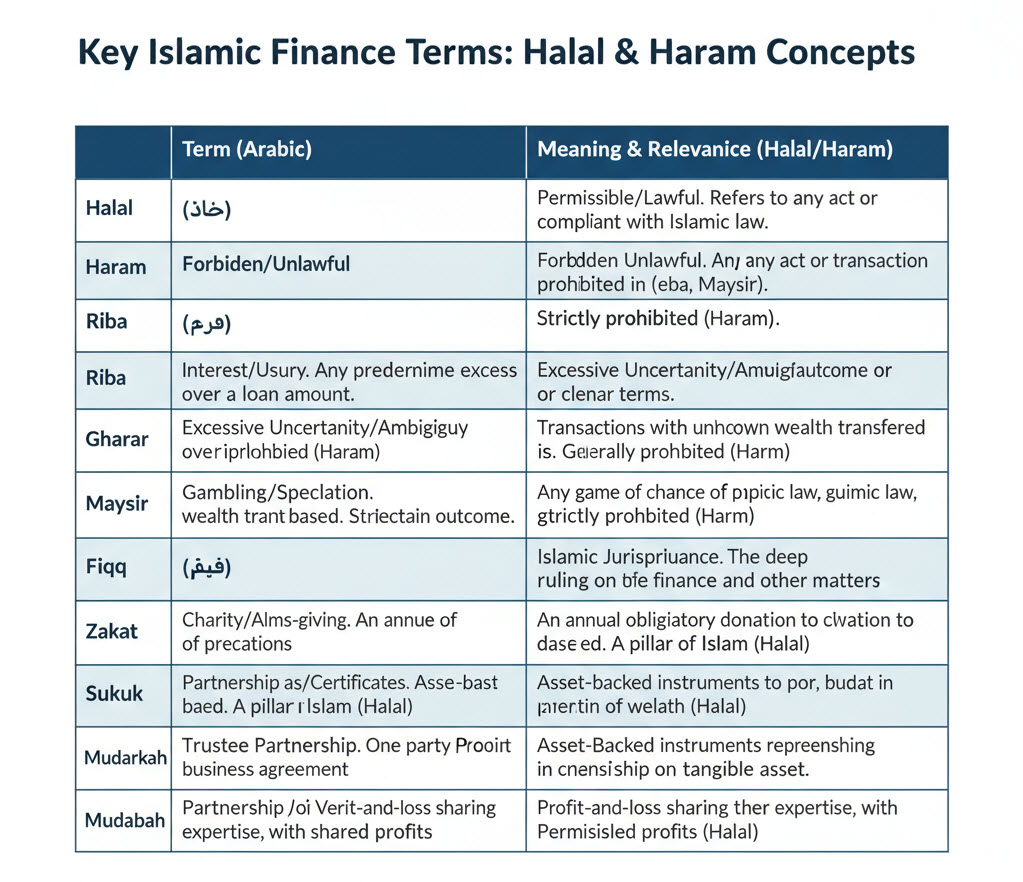
Glossary
| Term (Arabic) | Concept | Relevance (Halal/Haram) |
|---|---|---|
| Halal | Permissible/Lawful | Compliant with Islamic law. |
| Haram | Forbidden/Unlawful | Prohibited; to be avoided. |
| Riba | Interest/Usury | Strictly prohibited; any predetermined excess on a loan. |
| Gharar | Excessive Uncertainty | Prohibited; involves ambiguity in contract terms or outcomes. |
| Maysir | Gambling/Speculation | Prohibited; games of chance or pure betting without economic value. |
| Fiqh | Islamic Jurisprudence | The scholarly process of deriving rulings on financial/legal matters. |
| Zakat | Almsgiving/Charity | Obligatory annual donation; a pillar of Islam. |
| Sukuk | Islamic Bond | Asset-backed investment certificate; generally Halal. |
| Mudarabah | Profit-loss sharing | Partnership where one provides capital, the other expertise; Halal. |
Further Reading:
On Binary Options:
- Yusuf, Mahmud & Abduh, Muhamad Rahmani (2022), “Sharia Law Analysis of Binary Option”, Syariah: Jurnal Hukum dan Pemikiran – directly on binary options from a Shariah-law perspective.
- Kashian, Abdolmohammad & Parsa, Elham (2021), “Analysis of Binary Options from Economic and Jurisprudential Points of View”, Islamic Finance Research – analyzes binary options as an exotic derivative from both economic and fiqh angles.
On Options and Derivatives in General:
- Bacha, Obiyathulla Ismath (1999), “Derivative Instruments and Islamic Finance” – a classic paper on how modern derivatives fit, or fail to fit, Islamic legal principles.
- Uluyol, B. (2024), “Financial derivative instruments and their applications in Islamic banking and finance: fundamentals, structures and pricing mechanisms” – more recent review arguing derivatives may be usable when structured for risk management and stripped of prohibited elements like speculation and gambling.
- Alhejaili, Mohammad (2025), “Harmonising derivatives with Shari’ah: ethical practices and regulatory insights”, International Journal of Islamic and Middle Eastern Finance and Management – recent paper on the debate over whether some derivative use can be reconciled with Shariah via ethical/regulatory constraints.
- Setiawan, R. A. et al. (2022), “Issues in Islamic Derivatives and Proposals for Reforms in Islamic Capital Markets” – useful for the mainstream scholarly view that conventional futures/options are often criticized for gharar and maysir, while reform proposals seek Shariah-compatible substitutes.
- “Modern derivatives in Islamic perspectives in Pakistan” (2020) – qualitative study of Shari’ah scholars’ views on Islamic derivatives; useful if you want a scholar-opinion survey rather than only doctrinal analysis.
On Alternatives to Binary Options:
- “Shariah-Compliant Derivative Instruments” (Wiley chapter) – overview of Islamic financial instruments with derivative-like features and newer Shariah-compliant structures.
- Goard, J. (2024), “Pricing of Al-Urbun and a Class of Al-Istijrar Islamic Contracts” – useful if you want papers on Islamic contractual forms often discussed as alternatives to conventional option-like structures.
- Zaher & Hassan (2001), “A Comparative Literature Survey of Islamic Finance and Banking” – older but widely cited overview; includes the standard doctrinal objection to conventional options in Islamic finance literature.