
EUR/USD trades below 1.1000, with bullish RSI divergence hinting at a possible relief rally.
The US Dollar remained strong throughout last week, fuelled by hawkish comments made by FOMC members and by a general flight-to-safety mood. The dollar’s most recent rally started on November 10, after the US Consumer Price Index (CPI) came out hotter than expected, boosting expectations of higher Fed interest rates.
A day after the CPI release, Fed Governor Waller called for a 50 bps rate hike to tame inflation. The FOMC Meeting Minutes also showed that the majority of policymakers see the need for further tightening.
At the time of writing, a 25 bps rate hike is almost fully priced in, with the CME FedWatch tool showing an 88.6% probability, and the rest of the percentage going to a rate hold. However, this is a shift from approximately a week ago, when the CME FedWatch showed an 88.5% probability of a 25 bps rate hike and an 11.5% probability of a 50 bps rate hike, with a 0.0% chance of a rate hold. It’s an interesting change but one that will probably not affect the outcome: a 25 bps rate hike is coming.
Economic Calendar Highlights
The week opens on Monday with a cluster of Purchasing Managers’ Indexes (PMIs), starting with the Eurozone Manufacturing and Services PMIs at 9:00 am GMT, followed by the same indicators for the British economy at 9:30 am GMT, and ending with the US PMIs at 2:45 pm GMT. These are not high-impact economic indicators, but the week is rather slow in terms of economic releases, so their importance may be buffed.
The US Consumer Confidence survey will be released on Tuesday at 3:00 pm GMT, showing the opinions of about 3,000 households about current and future economic conditions. Usually, this release has a medium impact on the dollar.
The main event of the week will be the release of the Core Personal Consumption Expenditures (PCE) Index, scheduled for Wednesday at 1:30 pm GMT. The PCE is similar to the CPI, but it only tracks changes in the price of goods and services targeted towards and bought by individuals. It is also the Fed’s preferred inflation gauge, but it is overshadowed by the CPI, which is usually released about 10 days earlier. Nonetheless, higher PCE values can further increase the odds of a rate hike.
Technical Outlook – EUR/USD
The pair spent most of last week below the 1.1000 level, ending the trading session at 1.0965. The bears are in control of the price action, and 1.1000 is now resistance, but the last few daily candles show long wicks, which is a sign of indecision and possibly of fading bearish momentum.
The RSI is showing bullish divergence, which is another clue that points towards a relief rally. If the bulls can regain control and take the pair above 1.1000, we might see a temporary shift of power. However, the main bias is bearish, with a strong dollar and the pair sitting below all three moving averages.
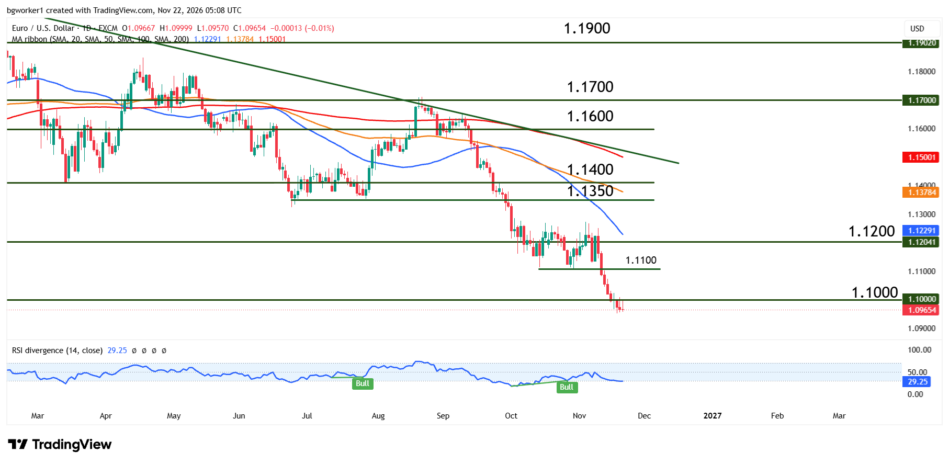
EUR/USD remains under pressure below 1.1000, but bullish RSI divergence hints at a possible relief rally ahead of the US PCE inflation release.