Overtime Review 2026: Is It Legit Or Scam?
We often spend our days pulling apart brokers that promise easy money. Overtime landed in our inbox, flagged by traders interested in binary-style products as “the new DeFi thing.” So we read the code audits, checked its position with regulators, and rolled our sleeves up – testing and tracing what the platform actually sells.
Overtime At A Glance
| Question | Answer |
|---|---|
| What is it? | A fully on-chain sportsbook and short-term crypto options protocol |
| Who’s behind it? | Grew out of Thales Protocol and has been live since 2021 |
| Does it hold your money? | No. It is non-custodial, so funds sit in smart contracts rather than a company account |
| Is the code audited? | Yes, by iosiro, with public audit reports |
| Is it licensed or regulated? | No. It has no licence and no KYC requirements |
| The catch | Its “Speed Markets” work like binary options, a product banned for retail traders across the UK and EU |
| Consumer protection if it goes wrong? | None. There is no regulator, chargeback protection or compensation scheme |
| Our classification | Grey-list (high risk), not blacklist (scam) |
| Our verdict | Not a scam, but it offers a high-risk product your regulator may have outlawed and provides limited safety net. Handle with caution |
What Overtime Actually Is
Overtime is a decentralized betting and trading protocol operating on Ethereum and its Layer-2 networks: Optimism, Arbitrum, and Base. There is no company holding user deposits; users connect a crypto wallet, and smart contracts manage all transactions.
It started life as Thales Protocol in 2021. Thales built “all-or-nothing” markets on crypto prices. You’d put up USD-pegged stablecoins to mint two tokens: an UP token and a DOWN token. On the expiry date, only one pays out the full collateral, decided by whether the Chainlink price feed landed above or below a set strike. The other token becomes worthless.
This structure is the textbook definition of a binary option: fixed payout, fixed expiry, and a single yes/no outcome. This is central to understanding the platform.
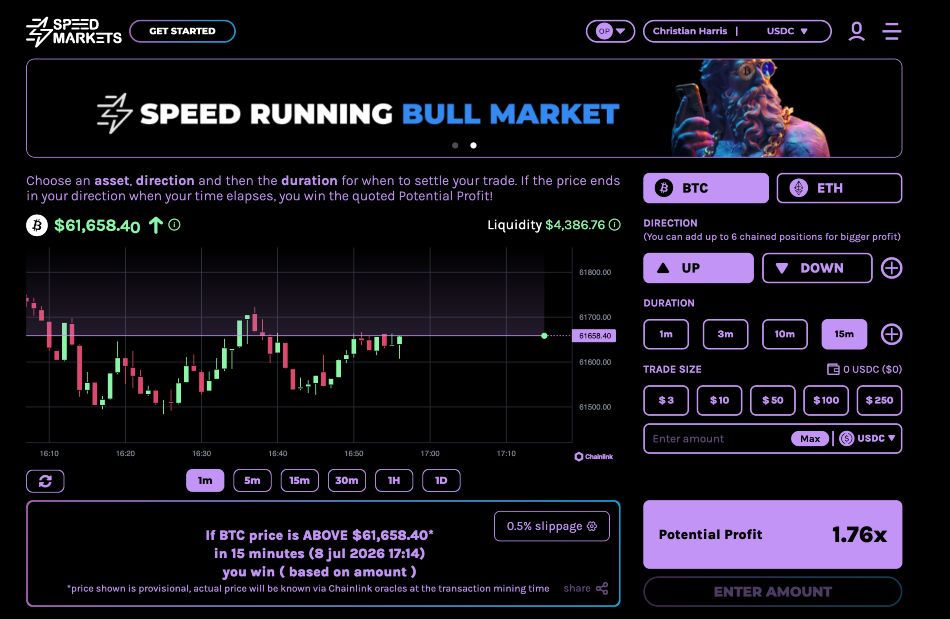
Speed Markets are structured like binary options
The team later adapted this model for sports. Overtime V1 created individual markets for each game with tokenized outcomes. V2 implemented a Merkle-tree design to improve speed and scalability. In 2025, the Thales brand was merged into Overtime, a new token called OVER was launched, and the platform moved to a new primary domain.
Today, the platform has three faces:
- Sportsbook — bet on real matches, priced by an automated market maker fed by Chainlink sports data.
- Speed Markets — short-term crypto price bets. Pick a direction, pick an expiry as short as five minutes, and win a fixed +100% (minus fees) if you’re right. These use Pyth price oracles.
- Casino — a full on-chain casino: roulette, blackjack, baccarat, dice, slots, Plinko, Hi-Lo, Keno, and several poker variants. Outcomes are drawn from Chainlink’s VRF (verifiable random function), with a $3 minimum bet and no account or KYC.
All of these features are genuine; the contracts are live and verifiable – we know we opened the platform and tried them. The key question is not whether Overtime functions, but whether it is appropriate for you to use.
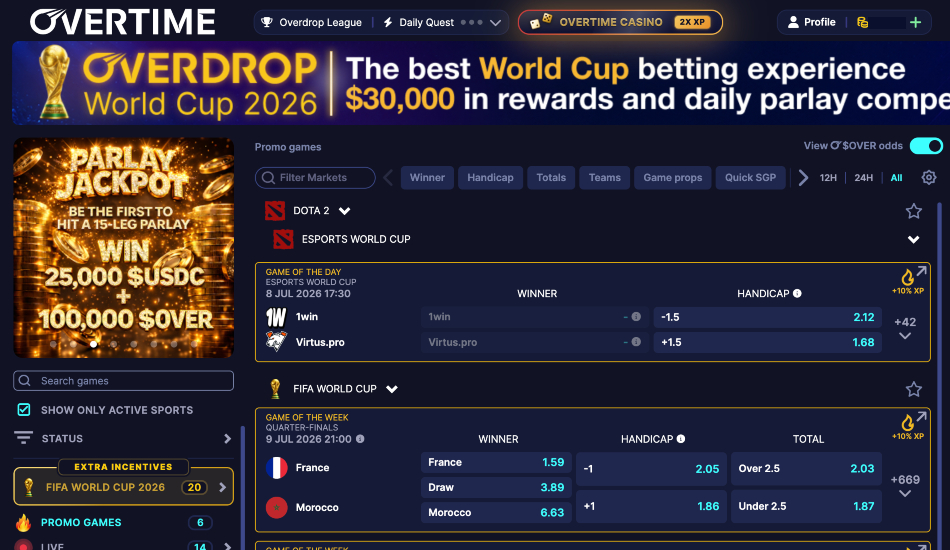
Sportsbook offers a range of contracts on major events
Regulatory Status By Country
Overtime offers two regulated activities: DeFi binary options trading and casino games. Each is subject to different regulations depending on jurisdiction. Below is a summary by several prominent locations.
| Your Location | Binary Options (Speed Markets) | Online Casino | Bottom Line |
|---|---|---|---|
| United Kingdom | Banned for retail traders by the FCA since April 2019 | No UK Gambling Commission licence | Off-limits. Neither product is offered through an authorized route |
| EU / EEA | Banned for retail traders under ESMA-based national rules since 2018 | No EU-wide gambling licence; rules are national | Avoid. The trading product is banned; the casino is unlicensed |
| United States | Legal only on CFTC-registered exchanges — Overtime isn’t one | No US licence; casino law is state-by-state | Not authorised for US residents |
| Rest of world | Legal in some countries, restricted in others | Depends on local gambling law | Check your own rules. Either way, there’s no consumer protection if it goes wrong |
Overtime.io is not misleading users, but it offers a very similar product to that which the FCA and ESMA have determined should not be available to retail traders. Its decentralized structure allows it to operate, as there is no local entity to fine or company to serve legal notice. This benefits the protocol but increases the risk for users.
The binary options issue is a financial regulation one. The casino is a gambling-regulation one, and it’s separate. As an example, in the UK, any operator offering gambling to consumers needs an operating license from the Gambling Commission, no matter where in the world it runs from — a license held abroad, or none at all, doesn’t cover British players.
Overtime’s casino holds no such license, runs no age or identity checks, and doesn’t block UK visitors. It operates without the relevant license, just as it offers its trading products without financial authorization. We’re describing a missing license here, not alleging a specific criminal act — what enforcement follows depends on the operator and the player’s location.
It is important to clarify the platform’s claim of “provably fair” games using Chainlink’s VRF. This feature ensures that game outcomes are not tampered with, but it does not improve players’ odds. The house edge remains present in every game, as in any casino.
Is It A Scam?
The term “scam” is often used imprecisely, especially in binary options where many providers are unregulated and unauthorized by top-tier regulators, but not necessarily running outright scams. Our standard test is whether the platform controls your funds and can prevent you from withdrawing them.
That’s the mechanism behind almost every broker fraud we cover. They take custody of deposits, then invent reasons to block withdrawals — “tax,” “verification fees,” “profit release charges.” The money was gone the moment it hit their account.
Overtime Markets does not meet the criteria for a scam. It is non-custodial; funds are held in open-source, forkable smart contracts rather than a company wallet. When a user wins a Speed Market, settlement is handled automatically by the contract. There is no support desk that can freeze balances or block withdrawals, as the platform does not hold user funds.
This design reduces the typical exit-scam risk. We found no evidence of drained user funds, no history of rug pulls on the core protocol, and no widespread pattern of blocked withdrawals — issues commonly seen with brokers we warn against.
Therefore, Overtime does not meet our criteria for an outright scam. Labeling it as such would be inaccurate, and we do not do so. However, “not a scam” does not mean “safe.” The risks are real, though they differ from typical scams. This distinction is why Overtime is on our grey list.
What Users Say
Scams typically leave evidence such as negative Trustpilot reviews, forum complaints about blocked withdrawals, and regulatory warnings. We searched for such indicators and found very little. The absence of these signs is more informative than a simple rating.
The Trustpilot footprint is empty. Overtime has no Trustpilot page – zero feedback from a platform that claims it has moved $200 million-plus across tens of thousands of users. That’s not a clean bill of health; it’s an absence of evidence in either direction. Compare it to Polymarket’s Trustpilot page, which has a poor score based on hundreds of reviews. Overtime users simply don’t file reviews there, because there’s no company chasing them for one and no support desk to complain to. Treat that near-blank page as “no track record to lean on,” not as a positive.
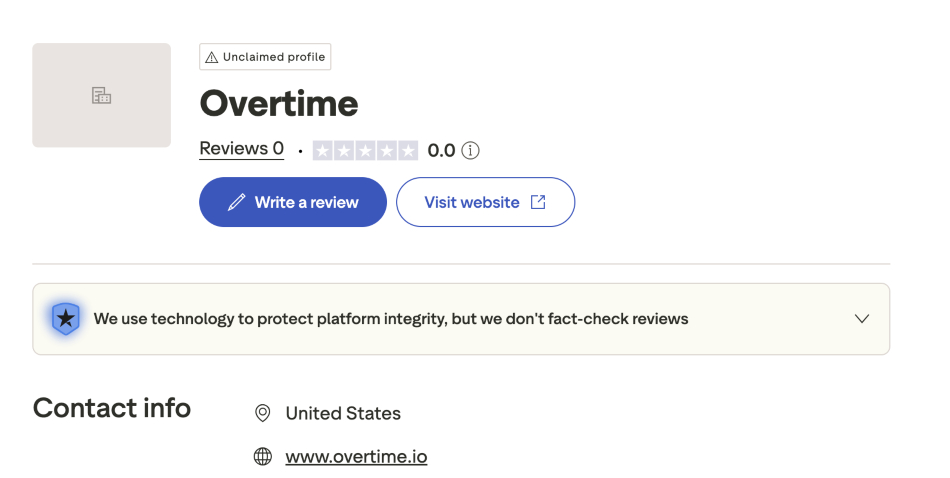
Overtime lacks a significant Trustpilot footprint
We found no complaints on Reddit or other forums alleging fraud, no accusations of exit scams, no reports of drained wallets on the core protocol, and no regulatory warnings. For a broker flagged for review, this absence of negative reports is a significant reason not to blacklist it.
Objective data confirms that users can incur legitimate losses. According to DL News, bettors wagered over $27 million and collectively lost approximately $1.6 million so far, reflecting the house edge in favor of liquidity pools. Not all liquidity providers profited; those on Arbitrum saw gains, while providers on Base experienced losses of about 9% and 7%, depending on the pool.
Bet sizes are limited by pool liquidity, with one NBA playoff market capped at around $18,000 per bet. These outcomes are not fraudulent but are inherent to the product’s design. This illustrates the grey-list case: the platform operates as described, but users can still lose money with no recourse.
The Real Risks
| Risk | What It Means for You | How Serious |
|---|---|---|
| Regulatory | You may be buying a product that is banned in your country, with no legal recourse if something goes wrong | High |
| Oracle failure | Prices come from Chainlink and Pyth feeds. If a feed is manipulated or fails, the payout could be affected | High |
| Smart contract bugs | The code is audited but not immune to flaws. A bug could drain funds instantly and permanently | Medium-High |
| Token liquidity | The OVER token trades thinly, with around $55,000 of volume in the 24-hour window we checked | Medium |
| Liquidity-provider losses | Acting as “the house” can still result in losses, including loss of principal after a bad run of outcomes | Medium |
| Self-custody | If you lose your private keys or approve a malicious transaction, the funds may be permanently lost. There is no password reset or chargeback | High |
| Tax and legality | You are responsible for your own tax obligations and for checking whether the activity is legal in your jurisdiction | Varies |
Oracle risk is a genuine concern. Overtime’s payouts rely entirely on external price feeds. If the feed is inaccurate, settlements may be incorrect. For example, in April 2026, due to an exploit in Drift Protocol on Solana lost approximately $285 million oracle manipulation attack. Although Overtime uses a different oracle configuration, any protocol that settles transactions based on external price feeds is vulnerable to similar risks. Speed Markets, with five-minute expiries, are particularly dependent on this mechanism.
The Overtime Scorecard
We’re scoring every DeFi broker on the same six measures, so our verdicts stay consistent rather than relying on gut feeling. Here’s Overtime against that rubric:
| Measure | Score /10 | Why |
|---|---|---|
| Fund custody | 9 | Non-custodial. The platform cannot directly access your money, which is a genuinely strong feature |
| Code audits | 7 | Multiple public audits by iosiro have been completed, and identified issues were fixed. However, ongoing upgrades still introduce risk |
| Transparency | 6 | The code is open source, documentation is public, and GitHub activity is visible. However, governance sits with a DAO rather than a named and accountable legal entity |
| Regulatory standing | 1 | There is no licence. The platform offers binary options without financial authorization from bodies such as the FCA, ESMA or CFTC, and operates a casino without a gambling licence such as one from the UK Gambling Commission. These are two separate regulatory gaps |
| Token liquidity | 3 | Trading volume in the OVER token is thin, which may make it difficult to exit a position |
| Consumer recourse | 0 | If something goes wrong, there is no regulator, ombudsman or compensation scheme to contact |
| Overall | ~4/10 | A technically sound protocol wrapped around a legally and financially hazardous product |
Overtime performs well in areas where scams typically fail, such as custody, audits, and code transparency. However, it scores poorly on criteria associated with regulated brokers, including legality, licensing, and customer support for financial losses.
How To Check Overtime.io Yourself
We encourage you to independently verify these claims. Each of the points above can be confirmed in approximately 15 minutes without making a deposit. The following is the verification process.
- Read the audits. Search “iosiro Thales audit.” The reports list every issue found and whether it was resolved. Read the severity ratings, not just the fact that an audit exists. An audit isn’t a safety guarantee; it’s a snapshot of one moment in the code’s life.
- Pull the contract on-chain. Open a block explorer for the relevant network, such as BaseScan, Etherscan or Arbiscan. Find the Speed Markets contract and confirm the source code is verified and public. Unverified contracts are a red flag; these are verified.
- Read the actual product terms. Load Speed Markets in the app. Screenshot the fixed +100% payout and the five-minute expiry option. That’s your proof, in the platform’s own words, that this is a binary option.
- Check the regulators. Search for the brand. You’ll find nothing because it isn’t authorized. That “no results” screen is itself the evidence.
- Test for KYC. Connect a wallet and see how far you get before anyone asks who you are. The answer is: all the way. No identity check means it’s more likely no regulated firm stands behind your trades.
By following these five steps, you will reach the same conclusion: Overtime is a functioning protocol that offers little consumer protection.
Who This Is For, And Who It Isn’t
Avoid Overtime.io if you are a UK or EU retail trader. The product is banned for retail users in these regions. Using it means purchasing an instrument deemed unsuitable by your regulator, with no protection if issues arise. The technical security of the smart contract does not alter the legal and financial risks.
US residents should avoid Overtime unless they have confirmed the product’s legal status in their jurisdiction. Offshore, unregistered binary options are not legal for US retail users, and Overtime is not registered with the CFTC.
Do not use Overtime if you cannot afford to lose your entire stake. Five-minute crypto bets with fixed payouts are essentially gambling. The house edge is inherent in the odds, and liquidity providers expect most traders to lose over time.
Participation may be appropriate only if you are in a jurisdiction where Overtime is legal, fully understand self-custody, are using funds you can afford to lose, and have reviewed the risks outlined above rather than relying on marketing materials. This applies to a limited audience.
FAQ
Is Overtime A Scam?
No. It’s a non-custodial, audited protocol with a multi-year track record. It doesn’t hold your funds or block withdrawals, which rules out the usual broker-scam pattern. It is, however, high-risk and offers a product banned for retail in several major markets.
Can Overtime Steal My Money?
Not in the way a custodial broker can. It never holds your funds. The genuine dangers are smart-contract bugs, oracle manipulation, losing your own keys, or simply losing your bets.
Is The OVER Token A Good Investment?
We do not provide investment recommendations. However, OVER’s trading volume is low, making it difficult to exit large positions without affecting the price. Consider this a risk rather than a benefit.