Are Prediction Markets Gambling?
The prediction markets contract can look straightforward: a yes-or-no question with a fixed payout. For example, will WTI crude close above $70 on Friday? A ‘yes’ pays $1, ‘no’ pays nothing, and the price reflects the market’s view. If you trade binary options, you are already familiar with this structure and may be tempted by this shiny, newer product. In fact, the same fixed $0/$1 payoff structure is now among the fastest-growing products in retail finance. According to the CFTC’s June 2026 rulemaking, trading volume on regulated prediction markets increased from under $1 billion in June 2024 to nearly $24 billion in April 2026. This growth has sparked debate over whether these are legitimate markets or simply gambling platforms.
To address the core question: is a prediction market, also known as an event contract more or less like gambling? The answer is that the payoff structure does not determine this. Instead, two factors matter:
- Who is on the other side of your trade, and
- How you approach trading.
If both are sound, the contract is a trading instrument. If not, it resembles gambling.
Let me explain how to distinguish between the two…
Same Shape, Two Reputations
A binary option and a prediction-market contract are structurally very similar, both offering a fixed payout on a yes/no outcome. The differences lie in two key areas.
The counterparty: Many retail binary options — especially the offshore kind — trade against the broker. The broker sets the payout, and a payout below fair value is the broker’s built-in edge. A prediction-market contract on an exchange like Kalshi trades against other traders. The two sides sum to $1.00 by construction, so there’s no house setting a sometimes challenging payout. You pay a small fee, usually a cent or two per contract, instead of an opaque margin.
The regulator: Retail binary options were pushed out of the mainstream for a decade of consumer harm concerns — the ESMA banned them for EU retail clients in 2018, the UK’s FCA made its ban permanent in April 2019, and Israel outright outlawed the industry in 2017. Prediction-market event contracts trade on venues that the CFTC treats as regulated exchanges. Same instrument, different regulatory standing. That said, regulations on prediction markets are evolving, with some agencies taking a dim view of the product.
The Spectrum: Where Each Instrument Sits
When considering if prediction markets are gambling products, it helps to consider how these products are structured compared to other financial products:
| Instrument | Payoff | Counterparty | Built-in edge against you | Regulator | Exit before expiry? |
|---|---|---|---|---|---|
| Prediction-market contract | Fixed $0/$1 | Other traders | None; ~1–2¢ fee | CFTC (US) | Yes, continuously |
| Roulette | Fixed | The house | ~5.3% (single zero) | Gaming | No |
| Sportsbook bet | Fixed | The house | ~4.5% vig | State gaming | Rarely |
| Offshore retail binary | Fixed $0/$1 | The broker | Payout sometimes set below fair; often 70–90¢ | Banned/unregulated for retail in some regions like EU, UK, Australia | Sometimes |
| FX / index CFD | Linear | Usually the broker | Spread + overnight financing | Varies, e.g. FCA / ASIC / CySEC | Yes |
| Exchange-traded future | Linear | Other traders (cleared) | Exchange fee | Varies e.g. CFTC (US) | Yes |
Examining the counterparty reveals the distinction between gambling and trading. In roulette and offshore binaries, the counterparty profits directly from your loss and sets the price to their advantage. In event contracts and futures, there is no house; prices are determined by supply and demand.
On the question of whether it is gambling, an exchange-traded prediction market contract may be preferable to a typical offshore retail binary, as there is no broker taking a payout against you.
Do The Prices Mean Anything? The Macro Evidence
In February 2026, the Federal Reserve published a paper, “Kalshi and the Rise of Macro Markets,” finding that prediction-market prices forecast Fed rate moves on par with — or better than — fed funds futures, Bloomberg’s economist consensus, and the New York Fed’s survey, as summarized in industry tracking by TS Imagine.
When the central bank’s own researchers say your contract prices predict rate decisions as well as the futures curve, the “it’s just gambling” argument loses its footing on macro events.
That matters to you directly, because those are the same events that move your oil, index, and FX positions — CPI prints, Fed decisions, jobs numbers. A yes/no contract on whether CPI comes in above 3% is reflecting real information from real traders. The CFTC has taken the same view in court, arguing these contracts are swaps under its jurisdiction. A federal financial regulator calling something a swap is about as far from “casino game” as a label gets.
None of this guarantees profitability. Prediction markets are zero-sum before fees and negative-sum after fees — every dollar of profit is offset by another’s loss, minus transaction costs. The average participant loses not because of the vig, but because they may be trading against more informed participants. A market offers the opportunity to trade with an edge, but does not provide one automatically.
Abstract principles alone do not prevent gambling; a repeatable process does. The following outlines a disciplined approach to trading crude oil prediction contracts, demonstrating how proper execution distinguishes trading from speculation:
The contract: Will front-month WTI crude settle above $70.00 this Friday? YES quoted at 44¢, implying the market sees a 44% chance. Spot is $68.50 with three trading days left.
- Nail the settlement rule. Which contract month, which official settlement price, and what cutoff? A trader who thinks “oil” and a contract that means “NYMEX front-month CL Friday settlement” are pricing two different things. This is the same discipline as reading a broker’s binary spec before you click — skip it and your edge is fiction.
- Build your own probability from implied volatility. Pull the implied vol on CL options — say 34% annualized. Daily sigma is 34% ÷ √252 ≈ 2.14%. Over three days, that’s 2.14% × √3 ≈ 3.7%, or about $2.54 on a $68.50 price. The strike sits $1.50 above spot, so the standardized distance is 1.50 ÷ 2.54 ≈ 0.59. A normal distribution puts the chance of finishing that far above at roughly 28%.
- Measure the edge, then attack your own number. The market says 44%; your model says 28%. YES looks overpriced, so the trade is to buy NO at its implied 56¢, worth about 72¢ on your math — a 16-point edge. A gap that wide is a warning, not a gift. Check the calendar: EIA crude inventories print Wednesday, and a surprise there can spike vol. That event risk means your 34% vol is probably too low, which increases your probability. Revise to ~33%, and NO is worth ~67¢ against the 56¢ price — an 11-point edge that survived scrutiny. Now you have a trade.
- Size it with Kelly, then cut it down. For NO bought at price c = 0.56 with your probability p = 0.67, net odds b = (1 − 0.56) ÷ 0.56 ≈ 0.79. Full Kelly: f* = (p × b − q) / b = (0.67 × 0.79 − 0.33) / 0.79 ≈ 0.25. Full Kelly says stake 25%. The full Kelly criterion suggests staking 25% of your bankroll. However, since your probability estimate may contain errors, it is prudent to reduce this amount. Using a quarter-Kelly approach, you would risk about 6% of your bankroll. For a $5,000 account, this equates to approximately $310, or about 555 NO contracts at 56¢ each, and the spread in. Crude binaries thin out away from round-number strikes. Check the second and third levels of the book; if your average fill is 57¢ instead of 56¢, that’s real money on 555 contracts. On small moves, round-trip fees can eat the whole edge, which is why this only works when the mispricing beats the friction.
- Manage the position. After Wednesday’s EIA report indicates a build, crude falls to $67.80, and your NO contract rises to 74¢. You can either hold until Friday for the remaining 26¢ or sell at 74¢ to secure an 18¢ profit per contract, free up capital, and reduce exposure to a potential reversal. The ability to take profits before expiry is a key advantage of flexible trading venues.
- Document the trade. Record your estimate, entry price, fill, exit, and outcome. Over time, your trading journal will reveal whether your edge is genuine or the result of chance.
Now, in contrast, an undisciplined approach involves buying YES at 44¢ based solely on a subjective view, without modeling volatility, considering the EIA calendar, or applying proper position sizing, and holding to expiry regardless of new information. The difference between consistent success and significant losses lies in following the disciplined process, not in the contract.
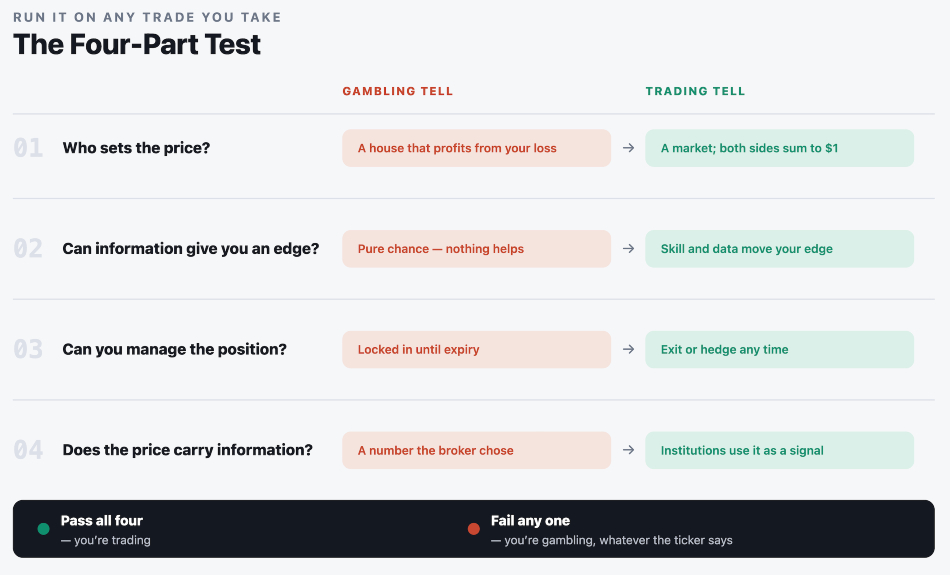
Four-Part Test
Consider four key questions before entering any position. These apply to prediction markets (and binary options):
10-Point Pre-Trade Checklist
The successful oil trade resulted from following a checklist, not from luck. This discipline distinguishes a well-considered position from a speculative bet.
Review every item on this checklist before entering an event trade:
What you need Why it’s non-negotiable
| # | What you need | Why it’s non-negotiable |
|---|---|---|
| 1 | A bankroll you can lose, and a fixed fractional-Kelly rule | One un-sized loss erases dozens of wins |
| 2 | A repeatable edge source (vol models, macro data, faster news reads) | Without a reason the price is wrong, you’re the liquidity, not the shark |
| 3 | Liquid contracts with tight spreads | A wide spread can cost more than the edge you’re trading — round-trip cost has to sit below your expected gain |
| 4 | Second- and third-level book depth priced in | The quote isn’t your fill; slippage on thin books turns +EV into −EV |
| 5 | Limit orders, not market orders | Market orders on a thin book hand your edge to whoever’s resting there |
| 6 | Exact settlement source, reference, and cutoff | The wrong month or price feed means you never traded what you thought |
| 7 | A fee and payout model per venue | A sub-fair broker payout and a 1¢ exchange fee reward completely different strategies |
| 8 | Tax treatment sorted up front | US event futures are often Section 1256 (60/40); other structures fall under capital gains |
| 9 | A written journal and hard loss limits | The only way to know if your edge is real, and the only brake on a bad day becoming a bad month |
| 10 | The discipline to pass | The best traders skip most setups; no edge, no click |
Where The Law Stands On Gambling Vs Legitimate Instrument
This part will move, so here’s the fault line rather than a scoreboard that expires. The fight is one question: is a prediction-market contract a federal financial derivative, or a wager that agencies get to regulate?
The CFTC and the platforms say it’s a swap under exclusive federal authority. A dozen-plus states say a sports or event contract that looks like a bet is a bet, and around 39 state attorneys general have backed state enforcement, per the Council of State Governments.
Federal courts have split – some siding with the platforms on federal preemption, others with the states. Minnesota passed an outright ban; the federal government sued to block it. Congress has a bill literally titled the Prediction Markets Are Gambling Act. Stanford’s Joseph Grundfest, a former SEC commissioner, flagged a real weak spot — precise, single-outcome contracts invite insider trading, a concern sharpened by two scandals where traders profited from non-public information about foreign events.
Most analysts expect the Supreme Court to settle it within 12 to 24 months. The plausible outcomes, and what each means for a trader:
- Federal preemption wins: event contracts operate nationwide under the CFTC, and the instrument’s “regulated derivative” status hardens.
- States win: a patchwork, where the same contract is legal in one state and barred in the next.
- A split verdict: economic and political contracts stay federal while sports contracts get pushed back to state gaming regulators — the outcome several observers think is most likely.
- Congress acts first: legislation draws the boundary before the Court does.
Regardless of the legal outcome, the structural characteristics of these contracts remain unchanged. The law will determine who regulates them, not their fundamental nature.
US residents can check the legal status of prediction markets at the state level with our tracker.
The Bottom Line
Is a prediction market gambling? Statistically, for most participants, it has a negative expected value, similar to binary options and sportsbooks. The instrument does not benefit those who lack an edge.
However, structure is distinct from reputation. A regulated, exchange-traded prediction market is a more transparent instrument than a typical offshore retail binary, primarily because no house sets a sub-fair payout and the price reflects actual market activity.
This is the key takeaway for your trading. Trade with a fair counterparty, a defensible edge, appropriate position sizing, and a clear exit plan, and you are trading. Omit any of these elements, and the activity becomes a bet, regardless of regulation or terminology.