Binary Options Trading in Kenya
Binary options are contracts that allow traders in Kenya to speculate on upward and downward price movements in financial markets. However, Kenya’s regulations prohibit licensed brokers from offering binary options, so platforms marketing binaries to Kenyans typically operate outside CMA oversight.
This beginner’s guide to binary options trading in Kenya explains the legal and tax ramifications of dealing these financial products. We also walk through a binary trade on a Kenya-related asset to demonstrate how these high-reward, high-risk products work.
Warning: In 2026 we came across two binary options websites, ‘tagoption.ke’ and ‘betabinary.ke’, specifically targeting Kenyans. We suspect both are scams with limited transparency, misleading marketing, poor support, withdrawal complaints, and platforms full of glitches during our testing. We urge Kenyan traders to avoid TagOption and BetaBinary.
Best Binary Options Brokers in Kenya
Based on our hands-on tests, which included looking at whether providers cater to Kenyan traders in their accounts, funding, assets and support, these brokers stood out as the best for binary traders in Kenya. Just because the platforms below accept residents from Kenya, this does not mean they are authorized by the CMA – you may not have any local legal protections.
| Broker | Min Deposit | Expiry Times | ||
|---|---|---|---|---|
 |
CloseOption | $5 | 30 seconds - 1 month | » Visit |
 |
Capitalcore | $10 | 1 minute - 1 hour | » Visit |
 |
AZAforex | $1 | 30 seconds - 1 day | » Visit |
 |
Crypto.com | Varies by payment method | 5 minutes to event cutoffs, can be hours, days and longer depending on contract | » Visit |
 |
Binarium | $5 | 60 seconds - 3 months | » Visit |
Visit
What Are Binary Options?
Binary options appear as about as straightforward as trading products get, at least on the surface. Trades generally come down to one question on the over-the-counter (OTC) platforms primarily available to Kenyan traders: will the price of an asset finish above or below a set level at a specific time?
- If you get it right, the trade pays a fixed return, often a percentage of your stake, such as 70%.
- If you get it wrong, you lose the amount you staked, for example 1000 Kenyan Shillings (KES).
That clarity is why binaries get so much attention online in Kenya, including on social media. You generally know the risk, i.e. how much you may lose, upfront.
The flip side is that the all-or-nothing outcome leaves very little room for error. On short expiries especially, which are the most common timeframes on platforms from our tests, a small flick in price at the wrong moment can decide the result.
An Example Trade
To turn theory into practice, let’s walk through a binary trade I made on the Kenyan shilling (KES) vs US dollar (USD).
I fired up the Pocket Option trading platform, an offshore/OTC broker, ran some analysis, and opted for a 30 second contract where I believed the KES would appreciate against the USD by the expiry.
I staked $10 and the platform offered me a 92% potential payout if my trade won. As you can see below, on this occasion I was correct, so my account was credited with $19.20 ($10 stake + $9.20 payout).
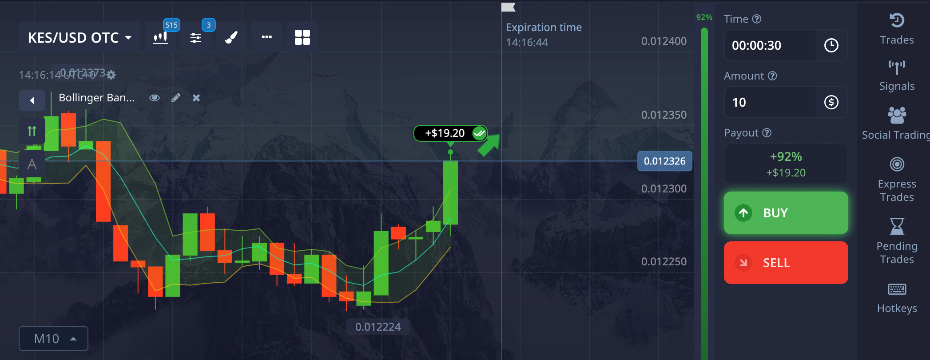
Pocket Option – KES/USD chart
Once the trade was placed, there was nothing to manage. That’s one of the defining features of binaries: no stops to move, no exits to tweak, and not usually a way to intervene once the clock starts. Having said that, some platforms do offer ‘early close’, ‘double up’ and ‘rollover’ features, which provide a degree of flexibility.
We use trades like the above to highlight two things we’ve seen repeatedly when trading binaries. First, the risk can often be capped and clear from the start, which is an attractive aspect of binaries. Second, payouts can vary a lot by broker and asset. A 92% return on a $10 risk is very different from a 60% return, which is also common on some assets.
Binaries are high risk because their negative expected value means that, over time, the odds are mathematically stacked so the average outcome is a loss. Basically, because the payouts are less than 100%, you need to win more than 50% of the time to make returns in the long run.
Can I Trade Kenyan Assets With Binaries?
We investigated the offerings at every firm in our list of active binary options platforms and most do not offer Kenyan-listed shares or NSE indices. Assets listed on the Nairobi Securities Exchange don’t appear on offshore binary platforms, and there’s no local exchange offering binaries in Kenya.
That said, some providers do offer binaries on currency pairs that contain the KES. Global markets are also widely available, including oil, which may be of interest to Kenyans given that refined petroleum is the country’s largest import by value.
| Broker | KES Currency Pairs | Kenyan Stocks | Kenyan Indices | Oil |
|---|---|---|---|---|
| Pocket Option | Yes (KES/USD) | No | No | Yes (Crude and Brent) |
| BinaryCent | No | No | No | Yes (Brent) |
Can I Open a Binary Account in Kenyan Shillings (KES)?
When we’ve opened and tested binary options accounts that accept traders from Kenya, most of them did not offer KES as a base account currency, with exceptions shown below.
Choosing a platform with a KES-based account may make for a smoother deposit, withdrawal and trade management experience. This is especially true when paired with a binary platform that offers local payment methods, such as M-Pesa.
| Broker | KES Base Account | Kenyan Deposits Methods |
|---|---|---|
| Pocket Option | Yes (account currency can be changed to KES in profile settings) | Yes (M-Pesa) |
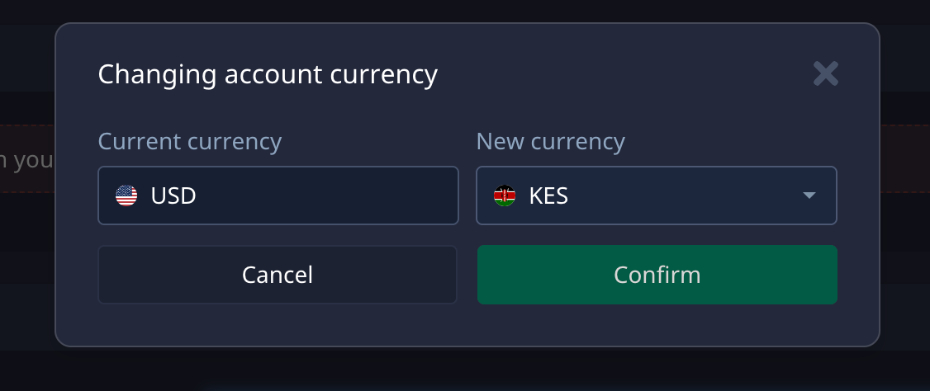
Pocket Option account area – selecting KES base currency
Which Binary Brokers Offer Support for Kenyan Traders?
From our testing, language isn’t a barrier for Kenyan traders. English is the default across the binary options platforms that accept clients from Kenya, both for the interface and for customer support.
Some brokers also offer customer support via live chat, email or website interface in one of Kenya’s non-English languages, such as Swahili. We’ve noted where this is available below.
| Broker | Support in Kenyan Language |
|---|---|
| Pocket Option | Yes (Kiswahili interface) |
| Deriv | Yes (Kiswahili interface) |
| Dukascopy | Yes (Swahili available via on-site translation tool) |
| Quotex | Yes (Kiswahili interface) |
Where things start to diverge is how useful that support actually is once you need it. We’ve seen fast live chat responses that are fine for basic questions, but slower follow-through when the issue involves verification, withdrawals, or trade disputes. That’s usually where the real differences between brokers show up.
Is Binary Options Trading Legal in Kenya?
The Capital Markets (Online Foreign Exchange Trading) Regulations state that a CMA-licensed online forex broker “shall not offer… binary options”.
That means there are no CMA-regulated binary brokers for Kenyan residents, so if an offshore platform offers binaries to Kenyans, you’re likely trading outside CMA oversight. This may mean no local investor-protection or dispute-resolution in case of issues like withdrawal delays.
Locally licensed brokers are also not permitted to offer currency pairs containing the KES. Offshore platforms may offer KES pairs to Kenyan residents, as we’ve detailed above, but outside CMA oversight, so users may have limited recourse.
Tip: You can verify any firm on the CMA licence register.
Is Binary Options Trading Taxed in Kenya?
Profits may be taxable if you’re a Kenyan tax resident, because Kenya charges income tax on gains or profits that accrue in or are derived from Kenya (even if the broker is offshore).
In many cases, trading-style profits are reported as income rather than capital gains, but classification can vary depending on circumstances.
Kenya’s tax framework has specific rules for financial derivatives that (when in force) require income from derivatives transactions to be characterised as “other income (financial derivative gains/losses)” in the relevant return period. However, there has been litigation affecting the Income Tax (Financial Derivatives) Regulations, 2023 (including reports that the High Court quashed them in October 2024).
Offshore brokers don’t typically issue Kenya-specific tax certificates, so you should keep your own records (deposits, withdrawals, P/L, dates, FX rates) and declare appropriately via KRA iTax.
Because the position can change (appeals, new regulations, updated KRA practice), treat this section as general information and confirm your current obligations with KRA or a Kenyan tax professional before filing.
Getting Started
There are a few basic steps to starting binary trading in Kenya:
- Choose a Broker: Because there are no CMA-regulated binary options platforms, broker choice matters more than the marketing suggests. Look past payout headlines and focus on basics: how the platform behaves around expiry, whether pricing feels consistent, and how smoothly withdrawals actually work. We’re also cautious about binary bonuses. They often come with conditions that complicate withdrawals, especially early on.
- Deposit Funds: Most brokers let Kenyan traders deposit using cards, e-wallets, crypto, or sometimes local solutions like M-Pesa. Even if you fund the account in shillings, the balance may be converted into USD before it reaches the platform if you don’t use a broker with a KES-based account. A binary broker that accepts modest deposits lets you see how funding, trading, and withdrawals work in practice without learning expensive lessons.
- Try the Platform: Binary options platforms are designed to be simple, you’ll notice this immediately if you’re coming from other products like CFD platforms. Expiry times, payout percentages, and how prices behave in the final seconds can all affect outcomes. We’ve found binary demo accounts genuinely helpful here, especially for short trades. Not to chase results, but to understand how tight the margins are.
- Trade With Real Money: When moving to live trading, keep things deliberately boring. Short sessions, keep a trading journal, and no chasing losses. Binary options don’t reward impatience. A handful of rushed trades can undo a lot of careful work, particularly on short expiries, so trade responsibly and manage risk.
FAQ
Is Binary Options Trading Legal in Kenya?
Binary options are not regulated under Kenya’s regulatory framework. There are no CMA-regulated binary options brokers, and trading is done through offshore platforms without local regulatory protection.
Can Kenyan Residents Trade Binary Options With Offshore Brokers?
Yes. Many offshore platforms still accept Kenyan traders. However, they operate outside Kenyan regulation, which means there’s no CMA oversight or formal local recourse if disputes arise.
Is It Safe to Trade Binary Options in Kenya?
Binary options are high-risk products, and trading from Kenya brings more risk because most platforms are based offshore and unregulated locally. Kenyans may find there’s no safety net if things go wrong.