Digital Options
Digital options trading is a simple way for traders to speculate on the future price of an asset, such as a stock, with an outcome that is either correct or incorrect. You’ll often see the same product (or a very similar one) marketed as digital contracts or grouped with binary options, depending on how the broker structures it and their marketing terminology.
This guide explains what digital options are, the main contract types, how digital contract-style products work, and how to start trading safely. We also rank the top digital options brokers following the tests of our experienced traders.
Best Digital Options Brokers
After running hands-on tests, these stood out as the best trading platforms offering digital options contracts:
| Broker | Min Deposit | Expiry Times | ||
|---|---|---|---|---|
 |
IQ Option | $10 | 60 seconds - 1 month | |
 |
Deriv | $5 | 15 seconds - 365 days | |
 |
World Forex | $1 | 1 minute - 7 days | |
 |
Quotex | $10 | 5 seconds - 4 hours |
Visit
Digital Options Explained
Digital options (also called digital contracts by some providers) are derivatives that let you predict whether an asset’s price will be above or below a chosen strike price at a set time (expiry).
Importantly, you don’t own the underlying asset – you’re speculating on the price and the trade settles based on the contract’s rules.
A typical ‘digital’ statement might be: ‘Will Tesla’s share price be above $500 at 3:00pm?’
The result is effectively true or false, and the payout is defined by the product structure.
How Digital Options Work
Most digital options contracts have three key elements:
- Strike price: This is the threshold the market must finish above/below (or touch, for some contract types).
- Expiry time: This refers to when the contract settles (timeframes vary by provider and market but typically start from several seconds).
- Payout/pricing: This is how profit and loss are calculated.
In practice, you’ll most commonly see one of these structures:
- Fixed-payout digital contracts (binary-style): You stake an amount. If your prediction is correct at expiry, you receive your stake back plus a fixed profit (normally shown as a % in platforms). If incorrect, you typically lose your stake.
- 0–100 priced digitals (sometimes called ‘digital 100s’): The contract is quoted between 0 and 100 based on implied probability. Volatility and the expiry time heavily influence the price and potential returns. See our dedicated guide on trading digital 100s.
0–100 priced example:
- The quoted price is 60 and the trader stakes $1 per point
- If the contract finishes correct at expiry, profit is (100 – 60) x $1 = $40
- If the contract finishes incorrect at expiry, loss is (60 – 0) x $1 = $60
With probability-priced digital contracts, potential gains and losses are determined by the entry price, so you generally need a strong win rate and disciplined risk management to be profitable in the long run.
Types
Digital options contract variations that we’ve seen on trading platforms over the years include:
- Up/Down: Predict whether the price will be above or below a strike at expiry. This is the most widely available format.
- Ladder: Multiple price rungs can change the payout depending on how far the market moves. Less common nowadays.
- One-Touch: Pays if price touches the strike at any point before expiry, though rules vary by broker. Less common nowadays.
- Target: Two strikes form a range; payout occurs if price closes inside that range, also sometimes dual digital options. Less common nowadays.
- Hi/Lo: Predicts the daily high or low range; useful when you have a view on volatility. Less common nowadays.
- Tunnel: Pays if price does not touch either boundary during the contract period, also called double-no-touch. Less common nowadays.
World Forex offers a handy calculator for learning how its different digital contract trades may play out based on different variables.
Digital Options vs Digital Contracts vs Binary Options
If you’re searching online, you may see overlapping terms. There are some differences:
- Digital options: The broad category: ‘yes/no’ settlement based on a strike and expiry (or touch/range rules for some variants).
- Digital contracts: Often a label for fixed-payout, binary-style digitals, but sometimes used more loosely for any digital option. Some brokers opted for this terminology following regulatory crackdowns spearheaded by ESMA in Europe, which gave traditional binaries a bad name.
- Binary options: The classic fixed return/loss contract offered by the majority of firms in our broker database.
This is how they primarily differ depending on the broker:
- Risk cap: Some products cap the maximum loss at your stake. Others (like 0–100 priced digitals) define max gain/loss based on the entry price.
- Strike control: Some platforms let you choose the strike; others offer pre-set strikes to select from.
- Early exit: Certain brokers allow you to close a position before expiry. This can reduce losses or lock in profits, though terms vary.
- Timeframes: Some brokers focus on very short expiries, lasting mere seconds, while others offer longer durations that can run into the weeks or even months.
Always check whether the broker’s ‘digital contracts’ are fixed-payout binaries, probability-priced digitals (0–100), or another variation entirely. Names aren’t standardized in our experience and it’s important traders know what they’re signing up to use.
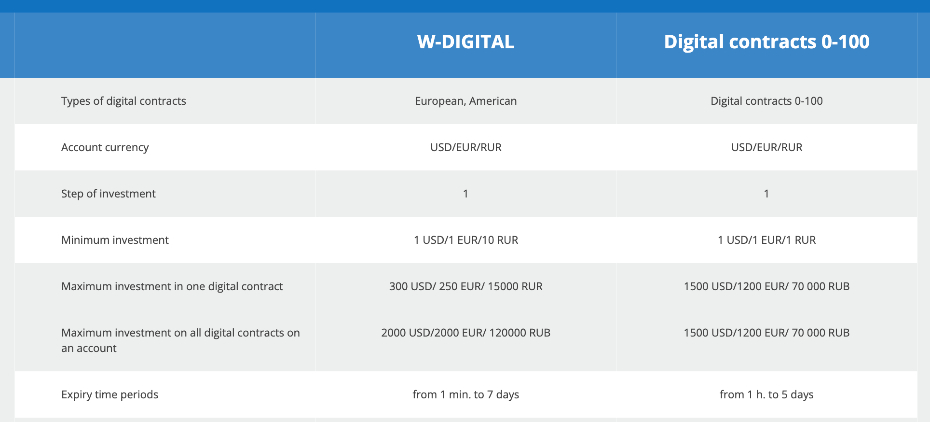
World Forex breaks down the differences between its digital options products
Pros
Reasons digital options are attractive to some traders are:
- Simple trade decision: Clear strike and expiry, with a defined outcome
- Known trade terms: Payout and risk parameters are set when you enter
- Broad market access: Depending on the broker, you may be able to trade forex, indices, commodities, crypto, or sometimes individual stocks. Though markets like ETFs and bonds aren’t generally offered in our experience using digital options platforms.
Cons
Key downsides include:
- All-or-nothing outcomes: A small miss at expiry, which is common, can still mean the full loss of your stake with many product structures.
- Fast pace: Short expiries can encourage overtrading and poor decision-making. This is why we always encourage trading responsibly.
- Broker quality varies: Unclear pricing and payouts, slow execution, unfair trading terms, and downright dodgy providers are all major risks we’ve encountered over the years.
- Regulatory restrictions: Access to digital options and related products have been restricted in some regions.
Legality & Regulation
Digital options and digital contracts are often treated like binary options by regulators. Rules vary by country and can of course change, so always verify local restrictions before trading digital options.
In major jurisdictions:
- UK: The FCA introduced a permanent ban on the sale and distribution of binary options to retail consumers, which likely covers the binary-style digital contracts some providers offer.
- EU/EEA: ESMA introduced an EU-wide prohibition on offering digital options-style products to retail clients in 2018, and many national regulators have since introduced their own, more permanent restrictions.
- Australia: ASIC banned the issue and distribution of binary options to retail clients and extended the ban to 2031.
- US: Binary and digital-style products are generally only allowed to be provided by regulated exchanges where there is robust oversight.
In regions where digital options-type products are tightly restricted, some individuals turn to offshore providers where they can open accounts. However, it’s important to understand that this is high risk – platforms may be operating with little to no regulatory oversight and you could have zero recourse options in the event of issues like withdrawal problems.
How To Start Trading Digital Options
Now that we’ve covered how they work, here’s a practical route to getting started if you decide you want to try these high risk products:
- Select A Broker: Choose a trusted provider and confirm the product rules (fixed payout vs 0–100 pricing, strike selection, expiry range, and early exit). Helpful tools include a demo account and trading app. Also check minimum deposits, fees, and withdrawals.
- Select The Asset: Choose markets you understand. Volatility and liquidity can influence pricing and how realistic your strike selection is.
- Set The Parameters: Choose a direction (up/down), strike price (if configurable), expiry time, and stake size based on your trading strategy and analysis.
- Manage The Trade: Monitor price action up until expiry. If your broker supports early close-out, you may be able to reduce losses or lock in any returns, but this does depend on the platform you’re using. Always investigate this before placing a trade.
Tips
- Start on demo to learn the platform, contract rules, and how pricing changes with volatility. This is vital for beginners.
- Use strict risk limits like a small % of your balance per trade to avoid account wipeouts. Some of our team recommend no more than 0.5%.
- Be selective: Fewer, higher-quality trades often beats chasing every move. Think quality over quantity.
- Avoid “must-win” strategies like aggressive stake escalation via Martingale unless you fully understand the risks.
- Be cautious about signals: We’ve seen plenty of dodgy signal providers. There’s no guarantee following their trade suggestions will lead to returns.
Bottom Line
Digital options (often marketed as digital contracts) are a straightforward way to speculate on price movement using a strike price and expiry.
They can be easy to place, but the risk can be high – especially on the short timeframes many platforms offer. This means you need a reliable broker, should understand the payout model, and focus on risk management.
FAQ
What Are Digital Options?
Digital options are derivatives that settle based on whether the price finishes above/below a strike (or meets touch/range rules, depending on the contract type).
What Are Digital Contracts?
Digital contracts are often another name for digital options, especially fixed-payout, binary-style products. Always check the broker’s contract rules because terminology can differ by platform.
What Is The Difference Between Digital Options and Binary Options?
Some brokers use the terms interchangeably. In general, binary options often refer to fixed-payout contracts, while digital options can also include probability-priced contracts (0–100), where the entry price determines max profit/loss.
Are Digital Options American Or European?
Some ‘touch’ contracts can pay if a level is reached before expiry (these are often known as American), while others settle only at expiry (usually called European). Naming varies by broker, so it’s important to confirm the specific contract type and trial them in a demo to see how they really operate in practice.
Are Digital Options Halal?
Opinions differ and depend on contract structure and intent. Some consider it permissible with appropriate analysis and risk controls, but others consider it gambling due to all-or-nothing outcomes.
We, at BinaryOptions.net, are not a religious authority so we recommend speaking to your local religous leader for guidance tailored to your circumstances and the specific product you’re interested in.