0DTE Options vs Binary Options
If you like your trades fast and decisive, zero days to expiration (0DTE) options and binary options are about as high-adrenaline as it gets. Both give you a shot at big returns in a short space of time, sometimes just minutes, but they work in completely different ways.
I’ve spent time using both, testing 0DTE trades during peak U.S. sessions and comparing them to short-term binary contracts. The 0DTE experience feels closer to day trading futures than anything in the binary space. The moves are sharp, the liquidity deep, and the margin for error razor-thin. With binaries, it’s all about the “yes or no” outcome; you either collect a fixed payout, or you don’t.
That difference in structure also changes how you manage risk, how you size positions, even how often you trade. Some thrive on the precision of 0DTE contracts, others prefer the simplicity of binaries.
Quick Introduction
- 0DTEs are standard listed options that have daily expirations on major U.S. indices like SPX; they’re regulated and trade on exchanges like Cboe Global Markets, which has bolstered its suite of same-day options.
- Binary payouts on over the counter (OTC) platforms offer a fixed percentage (often 60–90% from our tests); on regulated exchanges, binaries settle $0/$100 and your risk-reward comes from what you pay, not a fixed payout.
- 0DTE costs come in the form of commissions + exchange/regulatory fees (vary by broker and product); example: $1/contract to open ($0 to close), plus exchange fees that can be material for index options.
- There’s no commission or fee to trade binary options on OTC platforms, but you can lose your entire stake if the trade goes against you. On exchange-traded binaries, there can be a cost per contract and exchange fees.
- Liquidity and volatility matter for both: 0DTE spreads can widen sharply near events/into the close; binaries face order-book slippage on exchanges and lower payouts in volatile markets on OTC platforms.
- If you like the idea of structured, exchange-traded products where your edge comes from speed and precision, 0DTEs are a smart long-term route. They teach you discipline, risk management and how to read intraday flows.
- If you prefer quick, all-or-nothing decisions with low entry barriers, binary options are the easier starting point. Just be clear about the odds and use a trusted binary options platform.
0DTE Options Vs Binary Options: A Side-by-Side Comparison
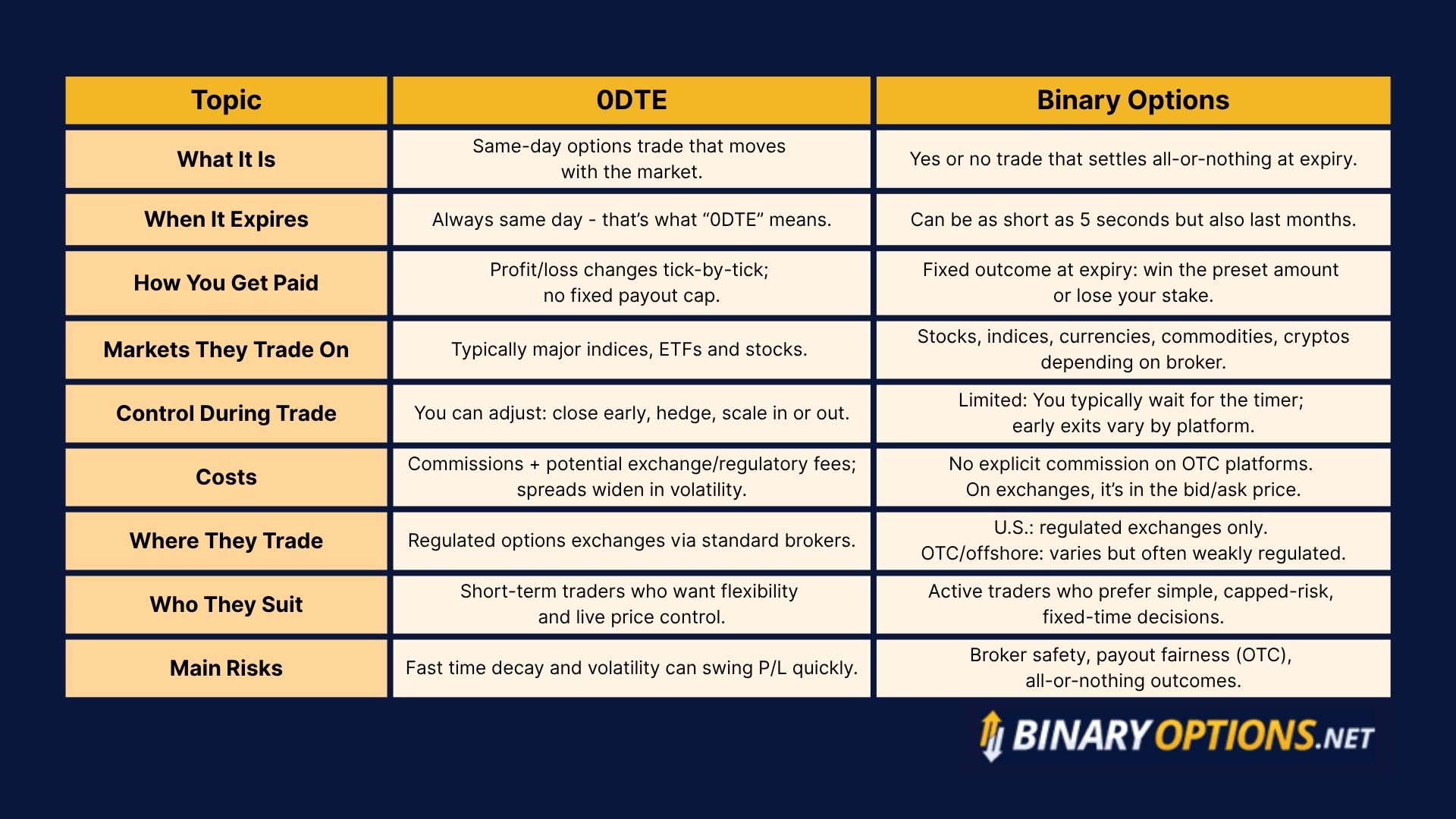
Below is a side-by-side comparison of same-day expiry options and binary options, revealing the key differences in how these financial products operate.
How 0DTE Options Work
Zero days to expiration options, also known as same-day expiration options, are contracts that expire the same day you trade them. There’s no overnight exposure; you’re stepping into a race that finishes before the closing bell.
Most traders use them on index options like the S&P 500 or NASDAQ, where volume and liquidity stay high all day.
The appeal comes from a combination of speed and leverage. A 15-minute move in the index can double or halve your position value. You’re not betting on a simple yes or no; you’re managing delta, theta decay, and momentum in real time.
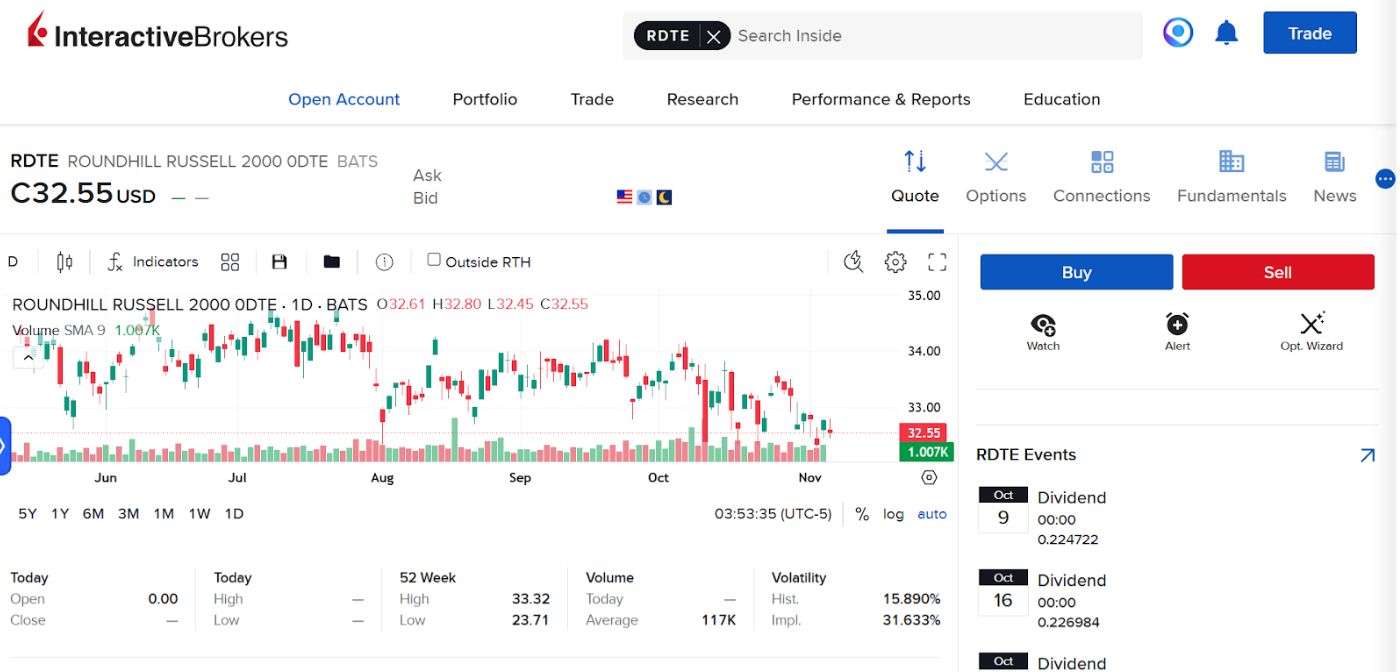
IBKR – Russell 2000 same-day expiry
The best traders can use these short-dated setups to fade volatility spikes or scalp intraday trends, not to gamble on random ticks.
The downside is that you have zero cushion. Time decay eats away at value fast, and every tick counts. When I’ve traded 0DTE contracts through midday volatility, the difference between a tidy profit and a stop-out was often under a minute.
How Binary Options Work
Binary options are built differently, especially at over the counter brokers. Each trade is a fixed-outcome contract on most platforms; either your prediction is correct, or it isn’t.
You might bet that S&P 500 will rise in 4 hours – a trade I configured in the Pocket Option platform below. If I’m right, I can collect a preset payout of 53% in this case. If I’m wrong, I will lose the stake. There’s no partial win, no scaling out.
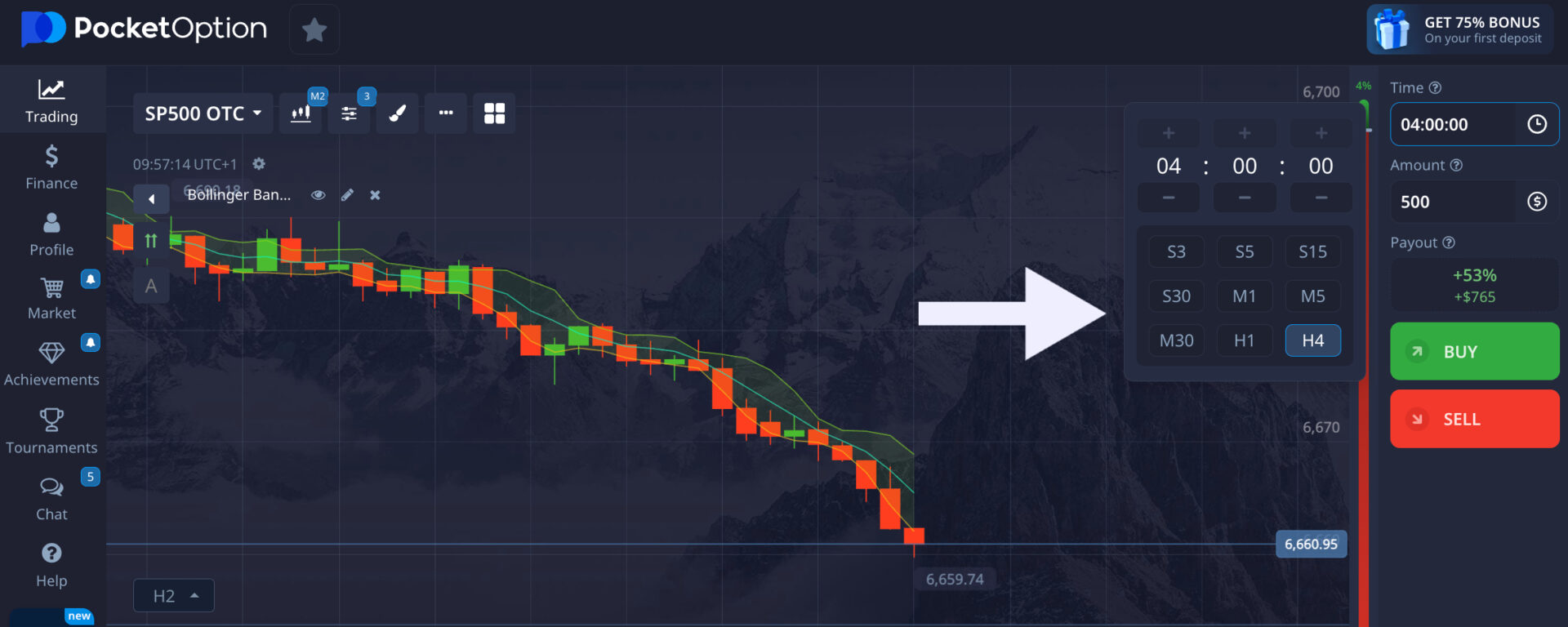
Pocket Option – SP500 same-day expiry
As a team, we’ve spent countless hours testing short-term binaries over the years, and what always stands out is their simplicity. Everything is transparent upfront: strike, expiry, and payout.
You know exactly what you stand to gain or lose before placing a trade. That certainty appeals to newer traders who don’t want to manage issues like margin requirements.
That simplicity also comes with limits. You can’t adjust the trade once it’s live, and many brokers control payouts dynamically, meaning the same contract might pay 80% one hour and 70% the next, depending on volatility and demand.
The 5 Key Differences
1. Fixed Payouts vs Market-Based Moves
The key difference between 0DTE and binary options comes down to how you get paid. Binary options offer fixed returns.
If your prediction is correct, you receive a pre-set payout, usually between 60% and 90% of your stake with OTC binaries. If you’re wrong, you lose the stake entirely. That structure is easy to understand, but it limits flexibility.
0DTE options don’t have that fixed outcome. Your profit or loss depends on how far the market moves relative to your strike price.
In my time trading same-day S&P 500 options, I’ve seen profits of 30–60% on modest intraday swings, but also fast reversals when volatility surged. There’s no cap on what you can earn or lose, which makes risk control crucial.
2. How Volatility Hits Each Product
Volatility plays both hero and villain here. For binary traders, volatility can shrink payouts because brokers generally reduce returns when price swings widen. During a U.S. CPI release, I’ve seen payouts fall from 82% to 68% in minutes.
That’s the platform managing risk, but it means the trader’s reward narrows just when the market gets exciting.
For 0DTE traders, volatility is the whole game. It moves premiums, widens spreads, and creates rapid profit opportunities, but also the potential for big drawdowns.
When I’ve placed trades on volatile days, like Federal Reserve announcements, the price of at-the-money calls could double or collapse in seconds. You need fast execution and a plan for exits; hesitation costs real money.
3. What Happens When You’re Wrong
With binaries, being wrong means losing 100% of that trade; there are no half measures. The advantage is that you know the maximum loss in advance.
With 0DTEs, your downside depends on how far the underlying moves against you and how you manage the position:
- If you’re trading options naked, losses can exceed the initial cost.
- If you’re using defined-risk spreads, you can contain them, but you must set that up in advance.
4. How Fast You Need to React
Both 0DTE and binary options move fast, but in different ways. With 0DTEs, you’re trading instruments that track live market prices tick-for-tick. Every small move in the underlying index, stock, or ETF shifts the option’s delta and premium.
During trades on the S&P 500, you might have less than 10 seconds to react before price momentum flips. It feels closer to scalping than traditional options trading.
Binary options, by contrast, generally have a locked-in structure once you click “Up/Down” on OTC platforms. You’re waiting for the clock to run down. There’s not usually a stop-loss, partial close, and no hedging unless you place a second trade in the opposite direction.
That slower decision cycle is why many retail traders prefer them; once the trade’s on, there’s nothing left to manage.
That said, some exchange-traded binary platforms do allow you to close trades early to lock in profits or cap losses.
5. Execution Quality
Execution quality makes the biggest difference. On high-volume days, spreads can widen sharply, and the platforms that handle order routing fastest, typically the larger brokers with direct exchange connections, often give noticeably better fills. Even a 0.25-point delay on an S&P option could swing a trade from profit to loss.
In the binary world, execution depends more on server speed and payout accuracy. Some platforms update prices smoothly and settle contracts instantly.
However, others might lag by a second or two, which depending on the length of the binary contract, with some as low as 5 seconds, can be enough to change the outcome.
What I Learned Trading 0DTE Options and Binaries
I’ve placed 0DTE options and binary trades during peak sessions and came away with three key learnings:
- Execution: The 0DTE executions that impressed most came from brokers offering exchange-listed options with precise liquidity data. Binary platforms, meanwhile, varied. A few handled execution perfectly, but others adjusted payouts dynamically based on market sentiment; an 80% return one minute and 72% the next, even on the same asset.
- Costs: On paper, 0DTE trading looks more transparent; you pay exchange commissions and standard option spreads. In practice, it depends on your broker. When trading 0DTE options on major U.S. indices, the total round-trip cost often sits around $1.20–$1.50 per contract, including exchange fees. Not huge, but noticeable when you’re trading multiple legs or scalping intraday. With binary brokers, there’s no explicit commission; the “fee” is hidden in the payout structure. If a platform advertises an 80% return, it’s effectively keeping a 20% edge on your win rate.
- Slippage: For 0DTE options, liquidity can vanish near expiry. Spreads widen dramatically in the final 15 minutes of trading, especially around big macro releases. A single tick can move the midpoint by several cents. High-end brokers with access to deeper liquidity pools handle this better. Binary options platforms don’t have “slippage” in the same way, but they do effectively re-quote – I’ve seen platforms adjust payouts during peak hours on major assets like EUR/USD and Gold.
Regulation and Reputation
0DTE options are increasingly part of the mainstream derivatives market. They trade on regulated exchanges like the Chicago Board Options Exchange (CBOE) and are overseen by major financial regulators such as the U.S. Securities and Exchange Commission (SEC) and the Commodity Futures Trading Commission (CFTC).
That framework means transparent pricing, real-time market data, and clearing through established exchanges.
Binary options regulation is more complicated. In some regions, they’re classed as legitimate financial instruments; in others, providers are banned outright.
In the European Union, the European Securities and Markets Authority (ESMA) banned the sale of binary options to retail traders in 2018 due to concerns over unfair pricing and misuse. The United Kingdom’s Financial Conduct Authority (FCA) followed with a similar ruling.
In the United States, the CFTC allows binary trading only through registered exchanges such as the North American Derivatives Exchange (Nadex), where contracts are standardized and transparent. Nadex has closed its doors to new clients as it’s moved to Crypto.com.
Offshore platforms still operate globally, but regulation varies widely, and that’s where risk creeps in. We’ve evaluated dozens of offshore binary platforms and there’s more unscrupulous, weakly regulated players where you might encounter withdrawal issues.
With unregulated binary options, you’re often relying solely on the platform’s integrity. That doesn’t mean all offshore brokers are bad, but the lack of oversight means you may not be able to appeal if something goes wrong.
Fast-moving products ultimately need slow, careful due diligence.
Should I Trade Binaries or 0DTE Options?
The Risk Tolerance Test
Your appetite for risk will help tell you which side of this fence you belong on. 0DTE traders need to be comfortable watching fast swings and managing open risk with precision. There’s no safety net, but there is flexibility; you can hedge, scale, or exit at any time.
Binary options, on the other hand, strip away all that control. You accept a fixed loss or gain upfront. That simplicity can feel safe, but it’s also final. If you prefer trades that are clear and contained, binaries might feel less stressful, provided you accept the built-in edge against you.
Capital, Time, and Skill Needed
You don’t need a huge account to trade either product, but the requirements differ. With 0DTEs, you’ll generally need margin and a broker that provides the ingredients to help you succeed. Execution quality, platform tools, and real-time data make a major difference.
Some 0DTE traders treat it like a professional setup, with stop limits, data feeds, and strict session plans.
Binary options need less capital (minimum deposits often start from just $5 based on our broker database) and less infrastructure (many firms run a web-based platform you can access in 5 minutes).
But that ease cuts both ways; some beginners trade too often and chase payouts instead of probabilities.
Which Type of Trader Is 0DTE and Binary Options Best For?
- 0DTE options suit experienced, short-term traders who thrive on fast decision-making and market structure. You’re dealing with real-time price flows, implied volatility shifts, and liquidity maps, not just a binary outcome. With intraday 0DTE setups on the S&P 500, the most successful runs come from simple, rule-based approaches: fade overreactions, cutting losses fast, and letting winning legs run only while volatility supports them.
- Binary options suit newer, active traders because they strip everything down to one question: will the price be above or below a level at expiry? That simplicity is the hook. You don’t need to calculate margin, or volatility skews. It’s an all-or-nothing call. Binary options reward timing, especially in the short-term. If you’re fast, disciplined, and selective with your setups, you might stay ahead. To get started, check out our selection of the best binary options trading platforms.
FAQ
Are 0DTE Options Safer Than Binary Options?
Neither is “safe,” but they manage risk differently. 0DTE options let you define or hedge your risk using spreads, stops, and scaling.
Binary options lock in your maximum loss upfront, but you can’t adjust the trade once it’s live.
Can You Hedge Binary Options With 0DTE Trades?
In theory, yes, you could offset a binary position with an opposite 0DTE trade on the same index or asset. In practice, the timing rarely lines up perfectly.
Binary options are fixed-term bets; 0DTEs are continuous, price-driven instruments. They move differently, and hedging one with the other often introduces more noise than protection.
Do 0DTE Options Require More Experience Than Binary Options?
Yes. 0DTE trading sits closer to professional-level options scalping than retail speculation. You’ll need to understand delta, theta decay, and how volatility crush impacts premiums near expiry.
When I’ve traded 0DTEs, even small hesitation can wipe out solid setups. It rewards sharp execution and constant screen time.
Which Suits Beginners Better – 0DTE Options or Binary Options?
Binary options are easier to understand but harder to master. The simplicity makes them appealing to beginners, but the broker’s edge is steep. 0DTEs demand more knowledge and discipline, but offer a level playing field on regulated exchanges.
If you’re starting out, learn structure and risk management before diving into either.