Fed and ECB Set to Drive Volatility Across Currency Markets
EUR/USD consolidates near 1.1200 after an extended decline from 1.1700.
A slow economic calendar translated into ranging price action last week, and not much happened in terms of directional movement. The US Dollar Index (DXY), which measures the dollar’s performance against a basket of 6 other majors, opened the week at 102.01 and finished it at 101.75. EUR/USD also traded in a narrow range, opening at 1.1195 and closing the week at 1.1203.
However, the story for this week is likely to be different because both the Fed and the European Central Bank (ECB) are set to announce their respective interest rates. Both central banks are expected to maintain the interest rates unchanged, but the press conferences of Fed Chair Warsh and ECB President Lagarde are likely to create volatility nonetheless.
The CME FedWatch tool shows a 90% probability that the US interest rate will remain unchanged at 4.00%. However, the probability of a 25 bps rate hike in December is still very high, at roughly 70% at the time of writing.
The dollar will also be highly affected by the release of key inflation data in the form of the PCE Price Index that’s due for release a day after the interest rate announcement.
Economic Calendar Highlights
The first major release of the week will be the US interest rate, scheduled for Wednesday at 6:00 pm GMT and followed half an hour later by Fed Chair Kevin Warsh’s press conference. As mentioned earlier, the rate is not expected to change, and Chair Warsh is not known for his forward guidance, which means he will not offer clear clues about the pace of future rate changes. A lacklustre press conference may translate into lower volatility than we are used to seeing, but the event should be treated with caution nonetheless.
US inflation data will be released on Thursday at 12:30 pm GMT, in the form of the Core Personal Consumption Expenditures (PCE) Index. This is the Fed’s preferred inflation gauge and is expected to show an increase of 0.3%, higher than the previous 0.2%. Higher inflation can determine the Fed to raise the interest rate or to keep rates higher for longer.
The US Gross Domestic Product (GDP) will be released at the same time, showing the annualized change in the value of all goods and services produced by the US economy. This is the broadest gauge of a country’s economic health and can have a hefty impact on its currency.
The ECB will announce the interest rate on Thursday at 1:15 pm GMT, with no change expected. The press conference will follow at 1:45 pm GMT.
Technical Outlook – EUR/USD
Last week’s price action shows indecision regarding the next direction. The dollar bulls have been in control since late August, while the pair descended from 1.1700 to 1.1200. However, exhaustion started to show around 1.1200, coinciding with an oversold condition of the RSI, which went as low as 18 (the RSI is considered oversold whenever it breaches the 30 level).
This week’s price action will be mostly driven by the fundamental side, as both currencies in the pair will be affected by their respective interest rate decisions. A full daily candle close below 1.1200 will open the door for a drop into 1.1000 support, while a bounce from the current level will make 1.1350 – 1.1400 the main target.
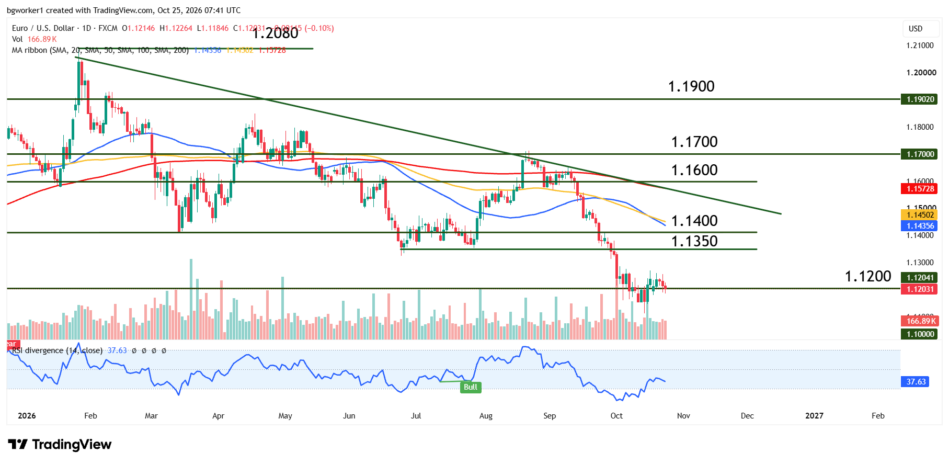
EUR/USD consolidates near 1.1200 ahead of Fed and ECB decisions, with a break lower potentially exposing support at 1.1000.