PRDT Finance Warning: Read Before You Bet A Cent
PRDT Finance markets itself as “the first fully decentralized cross-chain binary option/price prediction platform.” Strip away the branding, and you’re looking at binary options on crypto prices, wrapped in a Web3 wallet and gamified with coin-flip mini-games and treasure chests. In our opinion, which is partly formed from analyzing wider user reviews, we do not recommend making a deposit to PRDT.
Key Findings
- PRDT Finance is a DeFi binary options platform. You connect a wallet, pick an asset like BTC or DOGE, and bet whether the price will be UP or DOWN over a short window (5 minutes on Classic, 1–30 minutes on Pro).
- PRDT Finance is not regulated. We looked for it on the databses of 420+ financial bodies from our regulator tracker – it isn’t authorized by any. None have issued explicit warnings about PRDT, but that doesn’t mean it should be trusted.
- The product has a built-in negative expected return. Its products carry a structural expected loss and a potential conflict of interest between providers and customers. The house math means PRDT Finance likely wins over time.
- User reviews include serious allegations. We found reviewers on Trustpilot saying they can’t withdraw, that funds were drained, and that support went quiet. The team disputes these. None are independently verified, but the volume of complaints, especially with around 40% of reviews being 1-star at our initial checks, is a red flag in itself.
- A CertiK audit exists, but its Skynet score is middling (66.19, “BB”). An audit checks code, but it doesn’t fix the fact that the product is designed for you to lose money on average.
| Signal | What We Found |
|---|---|
| Product type | DeFi powered binary options – banned for retail investors in some regions, notably EU, UK, Australia |
| Expected return | Structurally negative; 5% fee on Classic compounds against you |
| Regulation | None; the platform pushes legal responsibility onto the user |
| “Decentralized” claim | Undercut by reliance on external price oracles |
| Audit | Real CertiK audit, but a middling “BB” score; covers code, not odds or business model |
| Token | Launched in late 2025; thin liquidity; pays holders a share of bettor losses |
| Marketing | Heavy reliance on paid press-release wires |
| User reviews | Serious, unverified withdrawal and rigging allegations; team disputes them |
| Recourse if wronged | None; no regulator, deposit protection or chargeback |
What PRDT Finance Actually Is
PRDT stands for “predictions.” The platform launched in fall 2021 on BNB Smart Chain and later expanded to Polygon, Ethereum, Arbitrum, and other networks, with claims of support for Solana. Its own materials describe it plainly as a “decentralized cross-chain binary option/price prediction platform.”
The mechanic is simple by design. You look at an asset. You bet the price will finish higher (UP) or lower (DOWN) than where it started by the time the round closes. Guess right, you win a payout from a shared pool. Guess wrong, and you lose your stake. That’s basically a binary option: a fixed, all-or-nothing payout tied to a yes/no outcome over a set period.
PRDT runs two versions:
- Classic uses fixed 5-minute rounds and charges a 5% fee on each prediction.
- Pro offers timeframes from 1 to 30 minutes and has no fee.
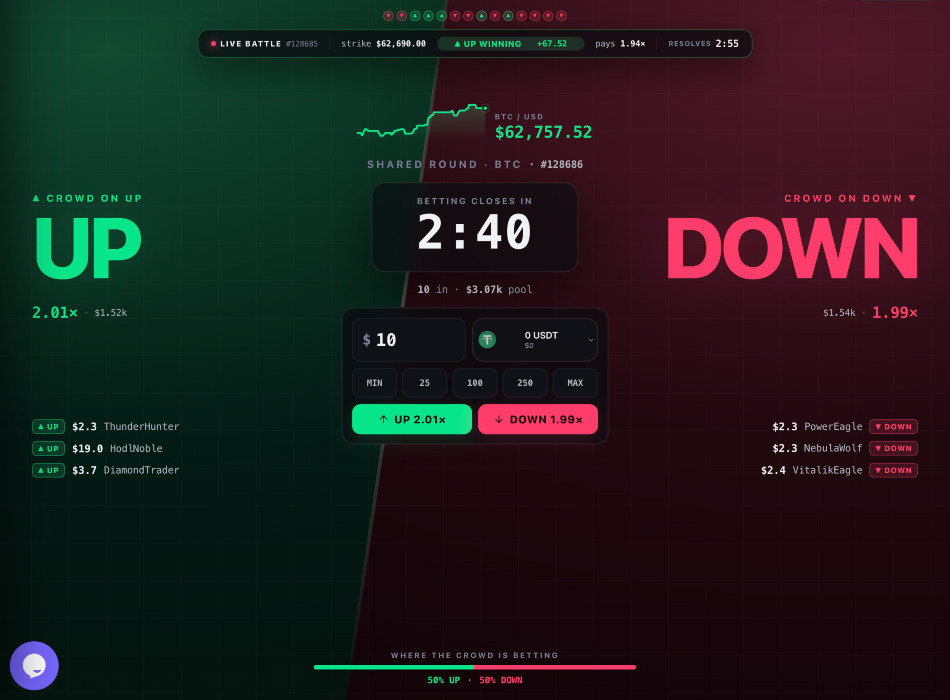
Classic
“No fee” on Pro doesn’t mean “no cost.” In a pooled prediction market, payouts to winners are diluted by how the pools split and by the platform’s cut of the prize. The absence of a visible fee doesn’t remove the house edge; it just hides it. Treat any “zero fee” claim on a betting product with suspicion until you can trace exactly where the platform makes its money.
A Walk Through The Product
Visit the website, and the first thing you notice is how much it borrows from a slot-machine loop rather than a trading terminal. Early versions were near-clones of PancakeSwap’s Prediction.
You connect a Web3 wallet. You pick a market. You hit UP or DOWN. A countdown runs. The round is resolved against a price feed, and you either claim your winnings with one click or you don’t.
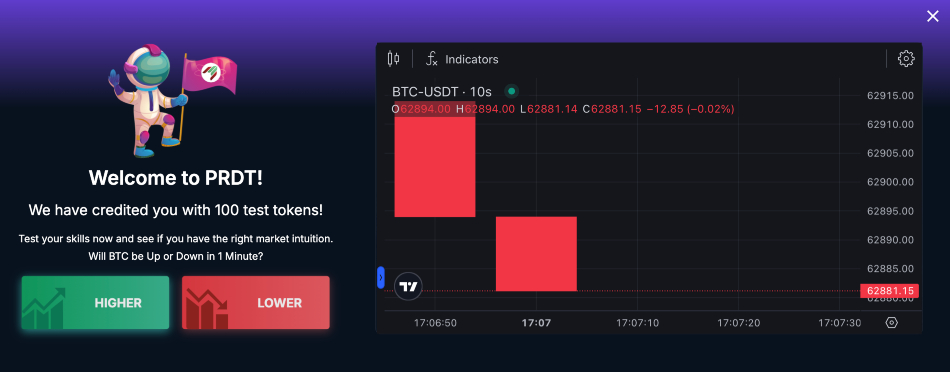
There’s also a “mining” system. Ahead of the token launch, users could earn PRDT by checking in daily and by referring other “active miners.” Referral-driven token distribution is worth flagging. It rewards recruitment, not skill or value, and it’s the same structure you see in countless schemes where early promotion matters more than whether the underlying product makes anyone money.
The Core Problem: The Math And The Law Both Point One Way
Here’s the part that no slick interface polish can hide.
Regulators in some regions studied these types of products and reached the conclusion they weren’t suitable for retail traders in their jurisdictions. In 2018, ESMA prohibited the marketing, distribution, and sale of binary options to retail investors across the EU. It cited the products’ “structural expected negative return” and an “embedded conflict of interest between providers and their clients.” The UK’s FCA made its own ban permanent in 2019. Also, as recently as 2026, the ESMA reaffirmed that event and prediction-market contracts referencing financial events fall inside its remit and remain subject to their permanent retail ban on binary options.
Now apply their concerns to PRDT’s fee structure. On Classic, a 5% cut is applied to each prediction. Even if you called direction correctly half the time, that rake compounds against you round after round. Over many short bets, price direction over three to five minutes is close to a coin flip. The platform’s cut turns a fair coin into a losing one. The “no fee” Pro version still runs a pooled payout that leaves room for the house.
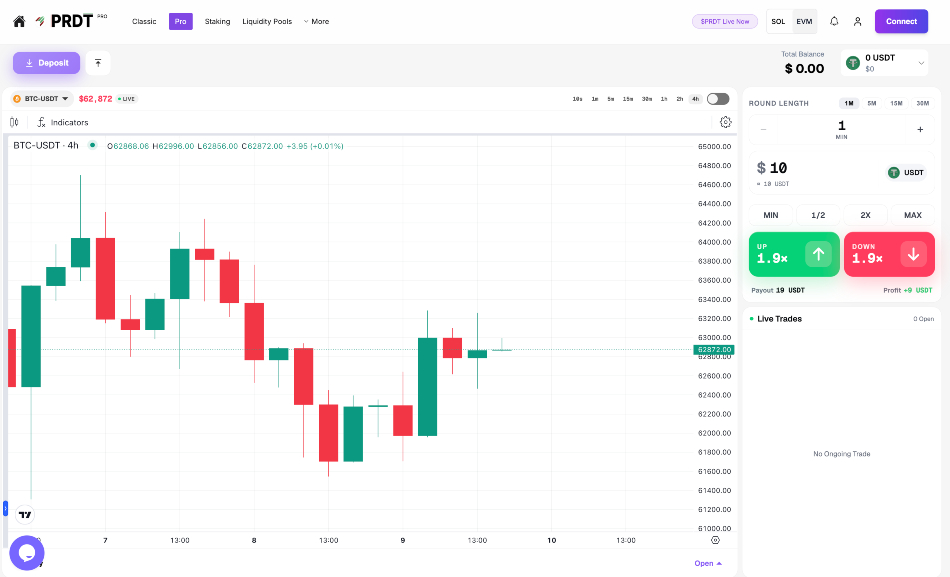
Pro
PRDT sidesteps regulations by being non-custodial and permissionless. There’s no broker to license, no KYC gate, and no regulator between you and the smart contract. Its FAQ says the platform is “accessible globally” and advises you to “check your local laws to ensure compliance.”
Read that carefully. The platform is handing you the legal and financial risk and asking you to accept it. Being able to reach the product doesn’t make it safe. It means the guardrails a regulated broker would provide aren’t there.
“Fully Decentralized” Doesn’t Survive Close Reading
PRDT leans hard on the word “decentralized.” The reality is more tangled.
The platform can’t work without an outside price feed to settle rounds, and that feed has changed over time. Early on, it pulled prices from the Binance API. It later announced Chainlink integration, and its current documentation points to Pyth for crypto and forex. A shifting reliance on external, sometimes centralized data sources is not what most people picture when they hear “fully decentralized.”
PRDT is not actually decentralized because it relies on a centralized price feed, and the owner-level privileges in the smart contracts could undermine trader capital. The takeaway isn’t that “decentralization is fake here.” It’s that the label does marketing work the architecture doesn’t fully back up.
The Audit Question: Real, But Oversold
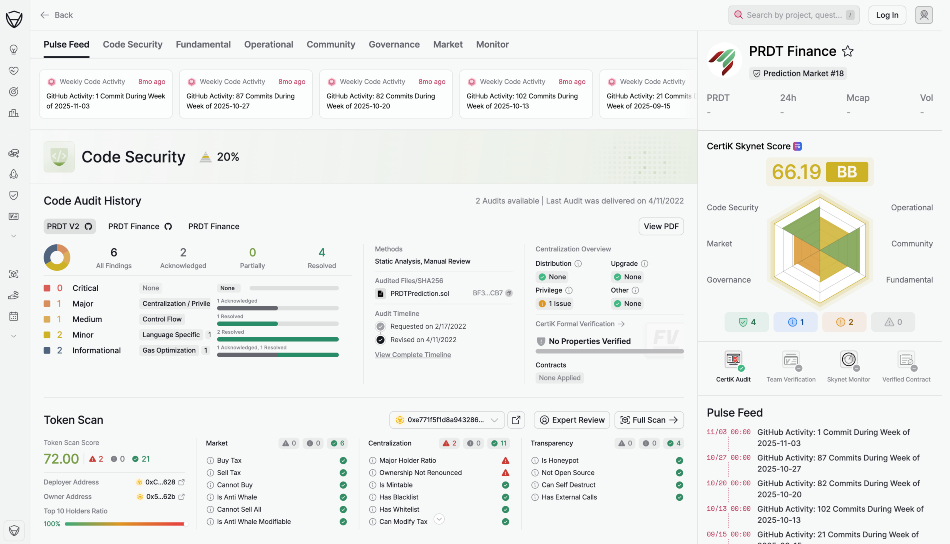
PRDT’s promotions frequently point to its CertiK audit as proof of legitimacy. The audit is real. CertiK’s Skynet page lists PRDT Finance with two available audits, a verified BSC contract, and a listed date of June 2025.
Two things temper that:
- First, the score. CertiK’s Skynet gives PRDT a rating of 66.19 out of 100, graded “BB.” That’s a middling result, not a gold star. It signals “some assurance,” not “safe to trust with your savings.”
- Second, and more important, an audit checks code for bugs. It does not vouch for the business model, the odds, the team’s intentions, or what happens to your money after you deposit it. CertiK states it makes no guarantees about accuracy or completeness, and users are solely responsible for their decisions.
The PRDT Token: Thin And Promotional
PRDT rolled out its token late in 2025. The pitch is an aggressive revenue-sharing model: 80% of platform revenue to stakers, 20% to buybacks and burn. That headline number deserves scrutiny.
“80% of revenue” only means something if the platform generates meaningful, durable revenue and if that revenue comes from a product people can win at. On these types of DeFi binary platforms, revenue is largely money losing bettors hand over. A token that pays holders a share of other users’ losses is not a business you want to be on either side of for long.
The market data reinforces caution. At the time of our initial tests, PRDT had a market cap of around $26 million, a fully diluted valuation of nearly $64 million, and a 24-hour trading volume of roughly $29,000. Volume that thin against that market cap means the token is illiquid. If sentiment turns, getting out at a fair price could be difficult. The circulating supply is 24 million of a 60 million maximum, so a large share of tokens is still to hit the market, creating future sell pressure.
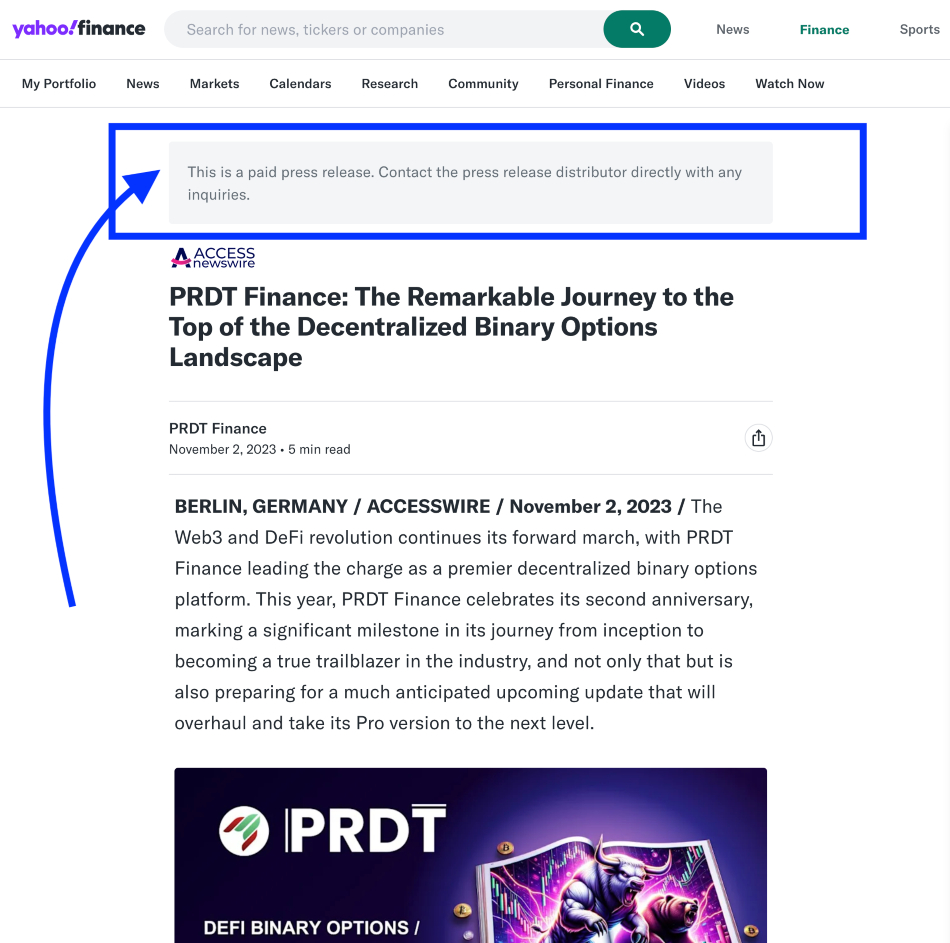
Much of the positive coverage you’ll find is on paid press-release wires like GlobeNewswire, AccessWire, and Benzinga’s sponsored channels. These are advertisements the project pays to distribute, not independent journalism. Treat them as marketing.
What Users Are Reporting
Public reviews are mixed, and they should be considered with care. We read every review on its Trustpilot profile. Some users praise the interface and support. Others make grave accusations.
On Trustpilot, reviews include claims that money can’t be withdrawn from Pro mode, that “mining” and predictions are rigged, that eligibility rules for rewards changed after users had already earned them, and, in one case, that liquidity was drained after an unfamiliar withdrawal address appeared in a user’s address book. Some reviewers say support stopped responding and that they were blocked on social media.

Truspilot
To be fair to PRDT, the team often publicly responds to these, disputes the accusations, calls them serious allegations that need proper investigation, and asks users to file support tickets with wallet addresses and transaction hashes. None of the fraud claims are independently confirmed.
But step back. Even setting every disputed claim aside, the pattern of “can’t withdraw” and “rules changed after I earned rewards” complaints is exactly the hurdle you’d expect around a high-risk betting product with no regulator to appeal to. When something goes wrong, there’s no ombudsman, no chargeback, and no deposit protection. Your only recourse is the team’s support inbox.
If You’re Determined To Use PRDT Anyway
You’re an adult, and it’s your money. If you proceed, here’s how to reduce potential damage:
- Assume you could lose all of what you put in. Size every position as if it were money you could lose without it changing your life. This is closer to a casino than a brokerage.
- Check your local law first. In the UK, the EU, and some other places, retail binary options are prohibited. Using a permissionless site doesn’t remove the risk.
- Use a fresh, separate wallet. Don’t connect a wallet holding significant assets. Fund a burner wallet with only what you’re prepared to lose and revoke token approvals after you’re done.
- Ignore the mining and referral loop. Earning tokens by recruiting others is a recruitment incentive, not a return.
- Don’t chase the token. Thin volume and a large uncirculated supply are a bad combination to buy into.
- Keep your own records. Save transaction hashes and screenshots. If a dispute arises, that’s the only leverage you’ll have with support.
How We Assessed PRDT
We reviewed PRDT’s live site and brief FAQ, its GitBook documentation, its CertiK Skynet listing, market data on CoinGecko and Coinbase, its listings on DappBay and DappRadar, public reviews on Trustpilot, and the regulatory rulings that govern this product category.
We separated the project’s promotional claims from independent data and treated paid press-release coverage as advertising. Prices, volumes, and audit scores were accurate as of writing and will move.
We also got hands-on. We loaded the Classic and Pro trading interfaces – explored the charting, tried the different analysis features and trading options.
Our conclusion isn’t a personal attack on the people behind PRDT. It’s just our opinion after assessing its setup, marketing and regulatory status, and trying its products. We wouldn’t deposit our own money with the platform.
FAQ
What Is PRDT Finance?
It’s a decentralized binary options platform. You connect a crypto wallet and bet whether an asset like Bitcoin or Ethereum will finish higher or lower after a short window — 5 minutes on Classic, 1 to 30 minutes on Pro. Call it right, and you win a payout from a shared pool. Call it wrong, and you lose your stake.
Is PRDT Finance Legal Where I Live?
It depends. The UK, Australia and EU banned the sale of this type of binary option to retail investors, and the US permits binaries only on registered exchanges. PRDT is permissionless and non-custodial, so the site loads more or less anywhere, but its own pages tell you to check your local law and warn that it may not be available in your jurisdiction. Being able to reach a potentially banned product doesn’t make using it legal or safe.
Is PRDT Finance A Scam?
There’s no proof it’s a scam. But two things are true at the same time: the product is built so the average user loses over time, and there’s a cluster of unverified complaints about frozen withdrawals and reward rules changing after the fact. There’s also no regulator, ombudsman, chargeback, or deposit protection standing behind it. Treat it as high-risk gambling with no safety net. For these reasons, we consider PRDT Finance greylisted rather than outright blacklisted.
Can You Actually Make Money On PRDT Finance?
Some people may win individual rounds. Across many rounds, the odds could work against you. Short-term price direction can be close to a coin flip, and the 5% Classic fee plus the pooled payout structure hand the platform an edge.
Does The CertiK Audit Mean PRDT Is Safe?
No. The audit is real, but the Skynet score is a middling “BB,” and an audit only checks code for bugs. It says nothing about the odds, the team, or what happens to your deposit after you send it. The audited contract address also differs from the one in the platform’s buy widget, so confirm you’re dealing with the exact contract that was reviewed before you commit anything.
Is The 80% Staking Reward at PRDT A Safe Yield, And What If I Can’t Withdraw?
Treat the “80% revenue share” as a bet, not a yield. It’s paid from platform revenue, which is mostly the money losing bettors give up, so it shrinks when activity slows. The liquidity pools add another trap: withdraw early, and the penalty comes out of your principal, meaning you can get back less than you put in. And if something goes wrong, your only route is the team’s support inbox and social channels.
If you use PRDT at all, use a separate burner wallet, keep transaction records, and risk only what you can afford to lose entirely.