Fed Rate Hike Sends Dollar Higher as Further Tightening Looms
EUR/USD breaks below 1.1500 after losing support at 1.1600
The dollar got a boost last week after the Federal Reserve raised interest rates by 25 basis points, bringing the target range to 3.75%–4.00%. The decision was unanimous and mostly triggered by the strong jobs report and hotter inflation figures released earlier. The Fed pointed to resilient domestic spending and elevated inflation as reasons for tightening policy.
The updated economic projections showed that sixteen of the eighteen officials anticipate at least one more increase before the end of the year. This can change with incoming data, but for the time being, the Fed is giving markets little reason to expect a quick return to rate cuts. The odds for another 25-bps rate hike in October are 57%, according to the CME FedWatch tool.
EUR/USD finally broke out of its tight range and finished the week below 1.1500. With the rate announcement behind us, attention turns to whether the dollar can hold onto its gains during a relatively slow economic week.
Economic Calendar Highlights
The week’s most active day will be Wednesday when a series of Manufacturing and Services PMIs will be released. The French figures are scheduled for 7:15 am GMT, followed by Germany at 7:30 am GMT and the Eurozone at 8:00 am GMT. Better-than-expected numbers could offer the euro some support after last week’s decline.
The US versions will be released at 1:45 pm GMT. Manufacturing is expected to slow down from 53.9 to 53.4, while services are forecast to slip from 56.5 to 56.0. These are not high-impact indicators but in a slow week, their significance may be amplified.
The Revised University of Michigan Consumer Sentiment survey is due on Friday at 2:00 pm GMT, alongside Inflation Expectations. Sentiment is expected at 47.5, compared with the preliminary 47.8. Following the Fed’s hike, an increase in inflation expectations could increase the odds of another rate hike.
Technical Outlook – EUR/USD
The strong move anticipated last week has now materialized, with EUR/USD breaking below 1.1600 and extending its losses through 1.1500. The ended last week below 1.1500 and below all three Moving Averages, leaving sellers in control.
For the time being, the main levels to watch are 1.1500 and 1.1600 as resistance, while 1.1400 is the next major support. We could see some consolidation or a short-term bounce after the recent decline, particularly with a lighter calendar ahead. However, as long as the pair trades below 1.1600, the bias is bearish. From a longer-term perspective, the pair is still in a range.
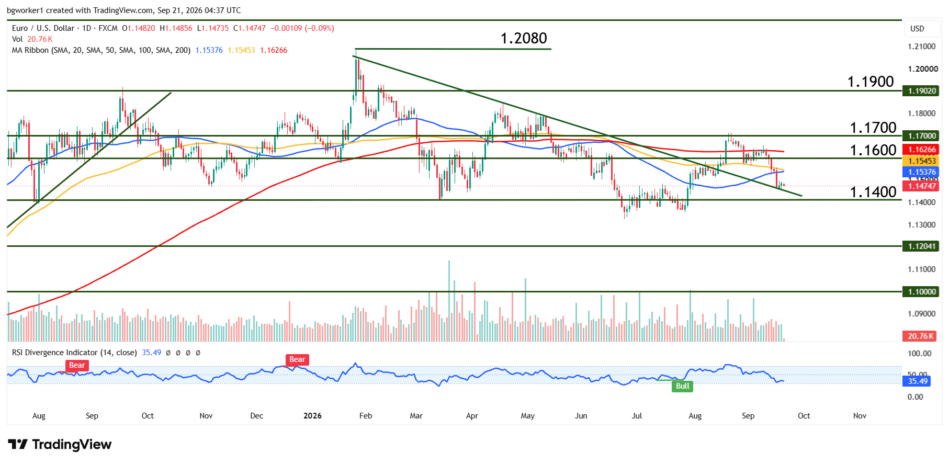
EUR/USD falls below 1.1500 after the Fed raises rates, leaving 1.1400 as the next major support to watch.