Dollar Drops, Attention Turns to Critical NFP Report
EUR/USD eyes a breakout above a long-term bearish trend line after failed break of 1.1400
The US Dollar suffered its biggest weekly decline in three months after the Federal Reserve maintained the interest rate steady, as it was largely anticipated. Inflation is still well above the 2.0% target, and some investors are beginning to wonder if the Fed is doing enough to bring it lower.
The Core PCE Price Index, which is the Fed’s preferred inflation gauge, showed a 0.1% change, lower than the expected 0.2%. The small change did not move the rate change odds by much, and Fed Chair Warsh did not provide clear clues regarding monetary policy going forward. At the time of writing, the probability of a 25-bps rate hike in September is 67%, according to the CME FedWatch tool.
The US-Iran war is still a cause for uncertainty and market turmoil. In a post on Truth Social, President Trump said the U.S.A. is ready to strike Iran “at levels of Military Terror, Strength, and Power not seen since World War II”. He continued by saying he will hold off the attack at the request of Iran and other Middle Eastern countries “in that the perimeters of a deal has been agreed to.” We’ve seen many deals fall apart, and it’s uncertain if this time they’ll be able to make it last, but at least it’s better than news of fresh attacks.
Economic Calendar Highlights
The week starts with the release of the ISM Manufacturing PMI, scheduled for Monday at 2:00 pm GMT. This is a leading indicator of economic health, with medium impact on the dollar; however, the impact increases if the actual number differs substantially from the forecast.
On Wednesday at 12:15 pm GMT, traders will take a first look at the US labor market data, with the release of the ADP Non-Farm Employment Change. The indicator shows the change in the number of employed people, excluding the farming industry and government. It tries to mimic the more important NFP report, scheduled for two days later.
The Non-Farm Employment (NFP) report is scheduled for Friday at 12:30 pm GMT, and it will be the most important release of the week. It’s the main gauge for the health of the US labor market, and the Fed watches it closely as a part of its double mandate. The NFP release usually creates very strong volatility and can trigger extended moves.
Technical Outlook – EUR/USD
The euro strengthened on rising inflation and bets the ECB will hike the interest rate sooner rather than later, while the dollar weakened throughout the week. This allowed the EUR/USD pair to climb to a high of 1.1547 before finishing the week at 1.1527.
The break of 1.1400 did not produce a strong directional move, and now the euro bulls are driving the price towards the long-term bearish trend line. A break of this trend line may trigger an extended bullish move where the price could climb above all three moving averages. For the time being, support is represented by the 50-day Moving Average (blue line), followed by 1.1400.
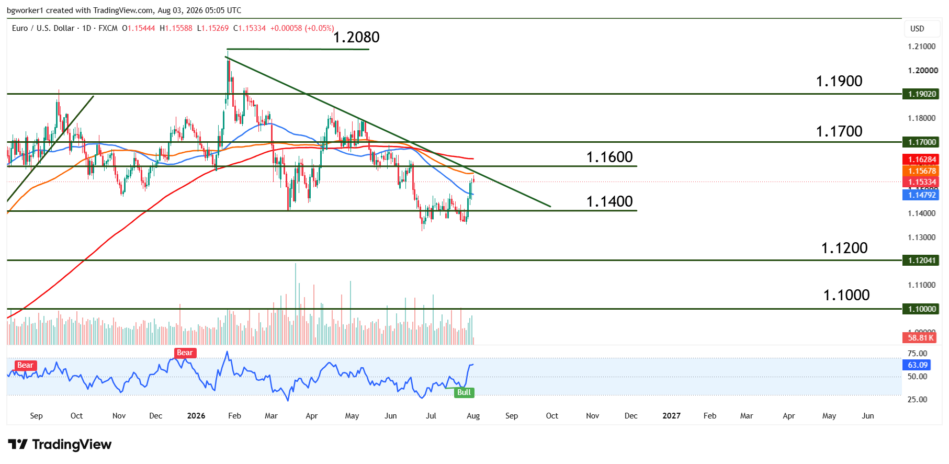
EUR/USD advances toward a long-term bearish trend line after reclaiming 1.1400, with a breakout potentially paving the way for a move above the major moving averages.